The Toyota Prius stands as one of automotive history’s most transformative vehicles, representing the world’s first mass-produced hybrid electric vehicle and the foundation for global electrification of the automotive industry across 28 years of continuous production from 1997 to the present day. With approximately 6.5+ million cumulative deliveries worldwide since its visionary 1997 debut, the Prius has established itself as one of the automotive industry’s most important nameplates, fundamentally changing customer perception regarding environmental responsibility, fuel efficiency, and the feasibility of hybrid technology as practical family transportation. The nameplate’s evolution from the original 1997 first-generation NHW10 featuring a modest 1.5-liter CVCC engine producing 68 horsepower through the contemporary fifth-generation model launching in 2023 and delivering revolutionary 194-196 horsepower hybrid systems with performance approaching mainstream sedans—demonstrates Toyota’s unwavering commitment to continuous technological advancement while preserving fundamental commitment to environmental responsibility and genuine customer value. The revolutionary fifth-generation Prius, introduced in 2023 and continuing into the present day, represents genuine transformation: the 2.0-liter Atkinson-cycle four-cylinder engine combined with sophisticated AC motor assistance delivers 194 horsepower in front-wheel-drive configuration and 196 horsepower in all-wheel-drive versions, achieving unprecedented 0-60 mph acceleration of 7.1 seconds while maintaining extraordinary fuel efficiency of 52-57 miles-per-gallon depending on specification. The parallel Prius Plug-in Hybrid variant, offering 223 horsepower and up to 87 kilometers of all-electric driving range from its 13.6-kilowatt-hour lithium-ion battery, represents the ultimate expression of accessible electrified transportation delivering genuine environmental responsibility merged with unexpected performance capability.
Origins and the Revolutionary 1997 Debut
The Concept and Development Philosophy
The Toyota Prius originated from visionary leadership under Takeshi Uchiyamada, a distinguished Toyota engineer who initiated development of a “car for the 21st century” commencing in 1993. The fundamental development objective emphasized environmental responsibility while maintaining practical family transportation characteristics rather than pursuing exotic technology for its own sake. Toyota leadership recognized that environmental solutions required mass-market acceptance rather than niche positioning, establishing the foundational philosophy that would define the Prius throughout its production history.
The initial hybrid system configuration, developed in collaboration with TRW and Heldt, employed a revolutionary power-split device utilizing a planetary gear set to seamlessly merge an internal combustion engine and electric motor outputs. This innovative architecture enabled optimal efficiency throughout diverse driving conditions: the electric motor provided responsive low-speed acceleration, while the gasoline engine handled sustained highway driving with electric motor supplementation. The system represented a fundamental breakthrough in electrification technology, enabling dramatic efficiency gains without requiring complete vehicle redesign.
The December 10, 1997 Market Debut
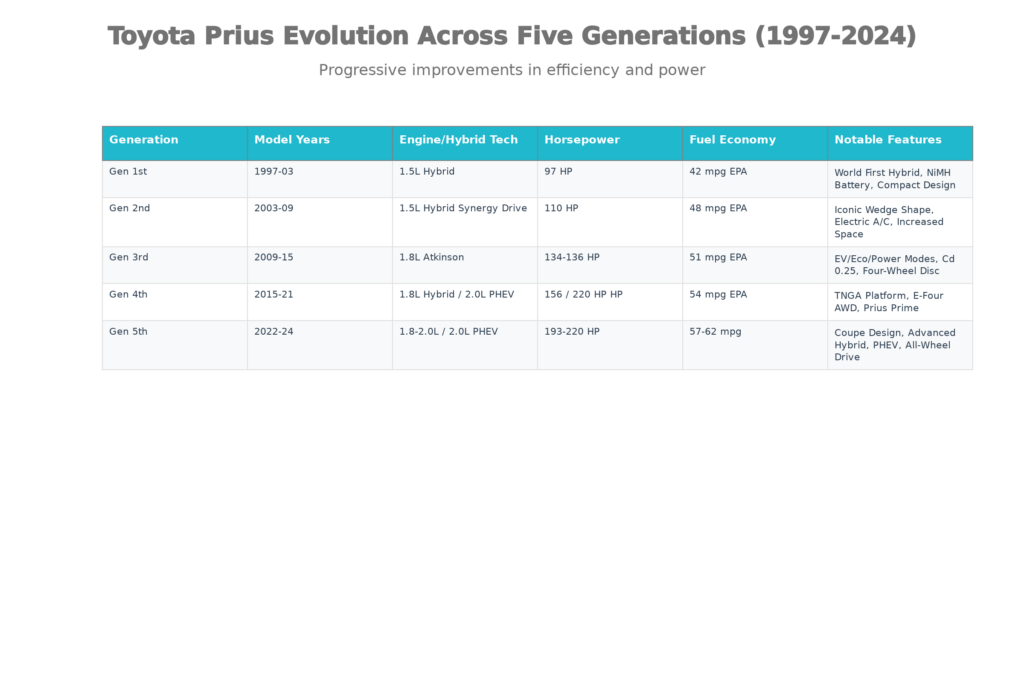
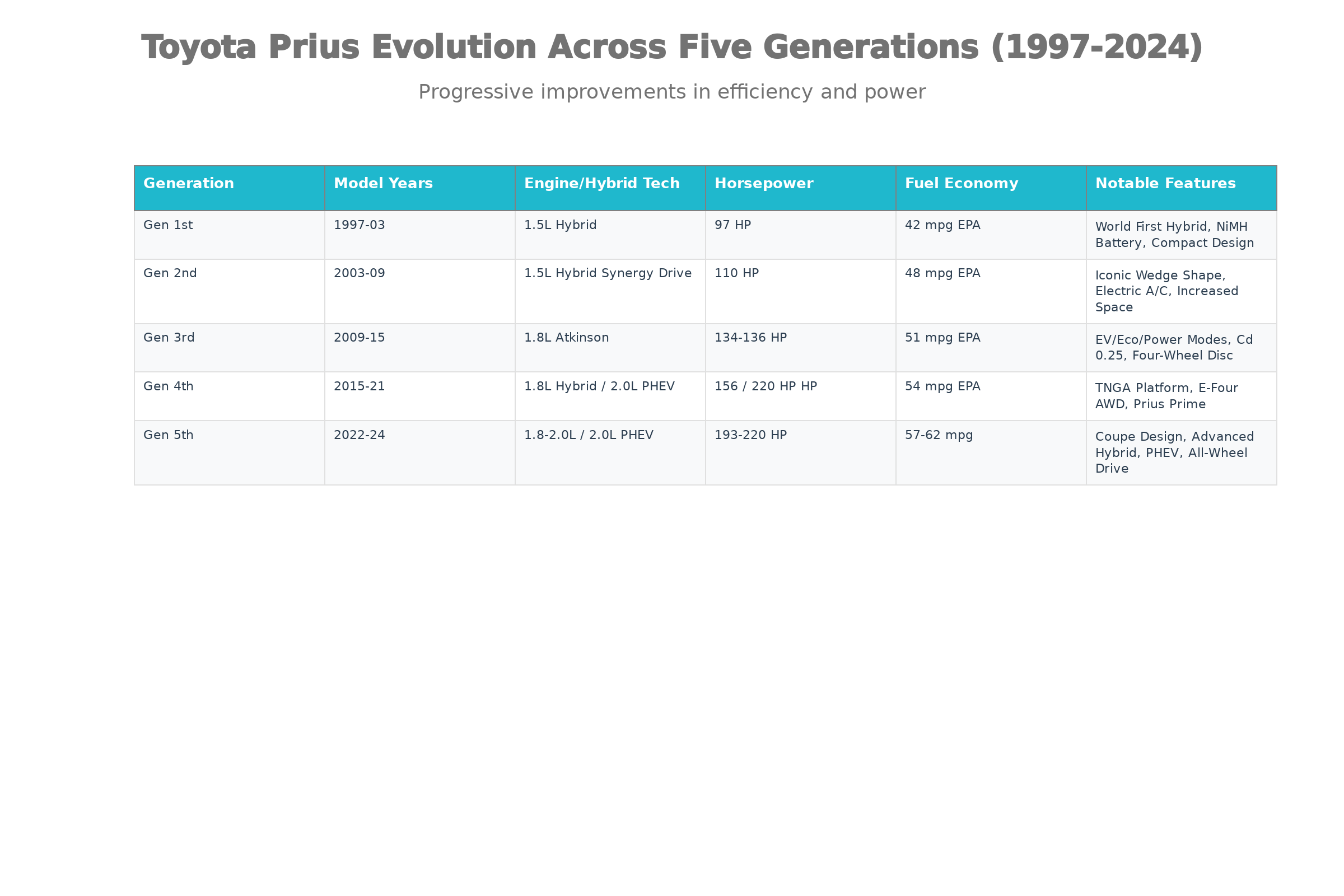
The Toyota Prius officially launched in Japan on December 10, 1997, representing a pivotal moment in automotive history: the world’s first mass-produced hybrid passenger vehicle achieving commercial viability. The first-generation NHW10 Prius featured a straightforward 1.5-liter CVCC inline-four engine producing approximately 68 horsepower (SAE Gross specification) combined with an electric motor delivering approximately 40 horsepower, enabling total system output of approximately 97 horsepower. The nickel-metal hydride battery pack, hidden behind the rear seats, represented unprecedented miniaturization of battery technology enabling practical packaging within a conventional vehicle architecture.
The initial customer reception proved enthusiastic: Japanese buyers appreciated the genuine environmental responsibility merged with practical five-passenger seating, 560-kilometer theoretical driving range, and reliability characteristics that aligned with Toyota’s manufacturing reputation. The vehicle won Japan’s New Car of the Year award in 1997 and the Automotive Researchers’ and Journalists’ Conference Car of the Year designation in 1998, establishing formal recognition of the technical achievement. Production commenced at the Takaoka plant, with cumulative 1997-2000 first-generation production reaching approximately 37,425 examples before successor introduction.
Generational Evolution Across Five Distinct Generations
First Generation NHW10: The Pioneer (1997-2000)
The original first-generation Prius, manufactured exclusively in Japan from 1997 through 2000, achieved historical significance as the world’s first mass-produced hybrid vehicle. The configuration delivered 57.6 miles-per-gallon fuel efficiency—extraordinary for the era—alongside 114 grams-per-kilometer CO2 emissions establishing environmental leadership. The vehicle’s relatively utilitarian styling reflected its positioning as visionary engineering rather than fashion statement, prioritizing technological substance over aesthetic drama. Export commencement occurred in 2000, with North American customers demonstrating enthusiastic reception establishing international demand for hybrid transportation.
Second Generation NHW20/NHW21: Hybrid Synergy Drive Introduction (2003-2009)
The second-generation Prius, designated NHW20 for right-hand-drive markets and NHW21 for left-hand-drive configurations, represented comprehensive redesign introducing Hybrid Synergy Drive (HSD)—Toyota’s revolutionary hybrid system architecture that fundamentally improved efficiency and performance. The engine displacement remained 1.5-liters, yet overall system power increased to 113 horsepower through advanced motor assistance. The HSD system achieved remarkable fuel efficiency: the EPA-estimated combined rating reached 55 miles-per-gallon, while Japanese test cycles indicated 65.7 miles-per-gallon—establishing new benchmarks for naturally-aspirated four-cylinder efficiency.
The second generation achieved particular commercial success: production volumes escalated dramatically from first-generation levels, with millions of examples manufactured through the 2009 production conclusion. Celebrity adoption, particularly Hollywood icons including Leonardo DiCaprio, established the Prius as a cultural symbol of environmental consciousness transcending automotive circles. By 2008, cumulative Prius sales surpassed one million examples, establishing genuine mass-market acceptance of hybrid technology.
Third Generation ZVW30: Engine Expansion and Hybrid Optimization (2009-2015)
The third-generation ZVW30 Prius, introduced in 2009, featured comprehensive refinement: the engine displacement increased to 1.8-liters while the electric motor received substantial enhancements delivering combined system output of 134 horsepower. The third-generation achieved remarkable EPA combined fuel economy of 51 miles-per-gallon, establishing the nameplate as the efficiency leader among globally-marketed sedans. The introduction of the plug-in hybrid variant in 2012, offering 11 miles of all-electric driving range, initiated dual-powertrain strategy addressing diverse customer preferences regarding electrification approaches.
Fourth Generation XW50: Advanced Efficiency and Refined Design (2016-2022)
The fourth-generation XW50 Prius, introduced in 2016, featured revolutionary aesthetic redesign: the boxy proportions of earlier generations evolved toward sleeker, more athletic proportions inspired by “a runner in the starting blocks.” The hybrid system, designated 4th Generation Hybrid Synergy Drive, delivered 121 horsepower combined output while achieving 54 miles-per-gallon EPA combined rating. The fourth generation represented technological refinement rather than fundamental revolution, yet achieved strong customer reception establishing commercial viability through gradual improvement philosophy.
Fifth Generation ZVW50: Performance Revolution and Contemporary Excellence (2023-Present)
The fifth-generation Prius, launched in 2023 and continuing into 2026, represents revolutionary advancement: the 2.0-liter Atkinson-cycle four-cylinder engine combines with permanently-magnet AC synchronous motor delivering unprecedented 194 horsepower in front-wheel-drive configuration and 196 horsepower with all-wheel-drive rear motor enhancement. The 0-60 mph acceleration of 7.1 seconds establishes the Prius as performance-competitive with traditional sedans while maintaining extraordinary fuel efficiency of 52-57 miles-per-gallon depending on specification. The all-wheel-drive Prius Prime plug-in hybrid variant delivers 223 horsepower system output, 87-kilometer all-electric driving range from its revolutionary 13.6-kilowatt-hour lithium-ion battery, and 0-100 kilometers-per-hour acceleration of 6.8 seconds—performance characteristics that would have been inconceivable in earlier Prius generations.
Revolutionary Powertrain Architecture
The Hybrid Synergy Drive and Planetary Gear Set Innovation
The foundational Hybrid Synergy Drive architecture, first introduced in the second-generation 2003 Prius, employed a sophisticated planetary gear set enabling three operating modes: engine-alone operation during sustained highway driving, electric-motor-alone operation during low-speed urban driving, and combined hybrid operation during acceleration or high-demand conditions. This innovative configuration eliminated traditional transmission complexity while achieving superior efficiency compared to conventional automatic transmission architectures.
Contemporary Fifth-Generation System Specifications
The fifth-generation hybrid system features a 2.0-liter Atkinson-cycle four-cylinder engine producing 150 horsepower and 139 pound-feet of torque combined with a sophisticated AC synchronous permanent-magnet motor delivering 181 horsepower and 247 pound-feet of torque. The continuously variable electric CVT transmission seamlessly blends engine and motor power delivery, enabling smooth acceleration throughout the operating range. The lithium-ion battery pack, positioned beneath the rear seat floor, reduces center-of-gravity while maintaining practical interior packaging.
The Plug-in Hybrid Variant and All-Electric Capability
The revolutionary fifth-generation Prius Plug-in Hybrid (Prius Prime) features the same 2.0-liter Atkinson engine paired with a more powerful 163-horsepower transaxle front motor, delivering combined system output of 223 horsepower. The 13.6-kilowatt-hour lithium-ion battery enables up to 87 kilometers of all-electric driving range—sufficient for many customers’ daily commuting requirements—while maintaining traditional hybrid functionality for extended journeys. The all-electric range represents 50-percent improvement compared to the preceding generation plug-in hybrid, reflecting Toyota’s commitment to genuine electrification capability.
Production Scale and Commercial Achievement
6.5+ Million Vehicles: Unprecedented Hybrid Success
The cumulative production of approximately 6.5 million Prius examples across five generations and 28 years of production establishes the nameplate as one of automotive history’s most commercially successful vehicles. The consistency of demand—with sustained annual sales reaching approximately 400,000+ units at peak years—underscores genuine customer value and manufacturer commitment to continuous improvement. The Prius family totals represented 61 percent of the 10 million Toyota hybrid vehicles sold worldwide through 2017, establishing the nameplate as the definitive hybrid platform.
Toyota Hybrid Portfolio Leadership
Toyota’s broader hybrid portfolio, encompassing the Camry, Corolla, RAV4, Highlander, and numerous luxury Lexus variants, achieved 15 million cumulative sales worldwide by 2020. The Prius, as the original and foundational platform, represented the proof-of-concept that established customer confidence in hybrid technology across diverse vehicle segments and customer demographics. The hybrid technology that originated through the Prius development program extended across 44 individual models globally, establishing Toyota as undisputed industry leader in electrification technology deployment.
Environmental Impact and Global CO2 Reduction
Documented Environmental Achievement
Toyota announced that hybrid vehicles have reduced CO2 emissions by more than 120 million tonnes worldwide compared to equivalent gasoline-powered vehicles. The cumulative environmental impact reflects not merely marketing claims but documented emissions reduction across millions of vehicles operating across diverse geographic markets and driving conditions. The environmental achievement validated Toyota’s fundamental philosophy that environmental responsibility required mass-market acceptance rather than niche positioning.
Design Language and Visual Evolution
The Prius design philosophy evolved dramatically across generations: the original 1997 first-generation emphasized utilitarian proportions appropriate to visionary technology, while the second and third generations preserved conservative aesthetics emphasizing substance over fashion. The fourth-generation 2016 redesign introduced contemporary proportions and LED lighting technology, while the fifth-generation 2023 refresh established sleek, athletic proportions communicating performance capability through visual language. Contemporary Prius models feature integrated aerodynamic elements optimizing drag coefficient and efficiency characteristics rather than purely aesthetic drama.
Cultural Impact and Environmental Movement Leadership
Symbol of Global Electrification
The Toyota Prius achieved extraordinary cultural prominence as the symbol of environmental consciousness and vehicle electrification worldwide. The nameplate became synonymous with the environmental movement, with widespread adoption by environmental activists, political figures, and celebrities establishing the vehicle as a cultural icon transcending automotive circles. This cultural association, while establishing the Prius as representing environmental progress, also generated some criticism from observers characterizing hybrid vehicles as politically polarized statements.
Collector Status and Market Performance
Original first-generation NHW10 examples and early second-generation NHW20 variants have demonstrated stable market valuations with limited appreciation, reflecting their continued automotive relevance rather than obsolescence or scarcity. Early Prius examples command modest values of $5,000-$15,000 depending on mileage and condition, while contemporary fifth-generation models depreciate following traditional patterns. The focus on utility and environmental purpose rather than scarcity or nostalgia characterizes the Prius collector market.
Future Direction and Electrification Evolution
Toyota leadership has confirmed that the Prius nameplate will continue as the flagship for hybrid vehicles, with next-generation platforms expected to introduce revolutionary all-wheel-drive performance variants and expanded plug-in hybrid capabilities. The company’s strategic commitment to maintaining hybrid technology alongside battery electric vehicles reflects recognition that electrification requires diverse technological approaches addressing diverse customer needs and geographic charging infrastructure availability.
The Bottom Line
The Toyota Prius’s extraordinary legacy—spanning 28 years from the visionary 1997 debut through five generations achieving 6.5+ million cumulative deliveries, establishing hybrid technology as mainstream transportation, and reducing CO2 emissions by 120 million tonnes globally—represents one of automotive history’s most important achievements. The nameplate succeeded through uncompromising commitment to environmental responsibility merged with genuine practical utility, refusal to sacrifice reliability for fashionable technology, and continuous engineering refinement pursuing incremental improvement rather than revolutionary change.
The Prius proved definitively that environmental responsibility and practical performance represented complementary rather than conflicting objectives when engineering teams committed to comprehensive system optimization. The vehicle’s evolution from 68-horsepower original through contemporary 196-horsepower all-wheel-drive and 223-horsepower plug-in hybrid variants demonstrates that hybrid technology enables performance capabilities rivaling traditional gasoline engines while maintaining efficiency advantages.
The Toyota Prius stands as proof that transformative automotive achievement emerges through relentless pursuit of integrated solutions addressing customer needs while maintaining environmental responsibility. The vehicle that introduced mass-production hybrid technology has established itself as one of automotive history’s most important nameplates—a lasting monument to Toyota’s commitment to environmental stewardship merged with genuine customer value delivery. The Prius remains the ultimate symbol of automotive electrification and environmental consciousness, establishing benchmarks for efficiency and responsible transportation that competitors continue pursuing across contemporary and future vehicle development.