August 21, 2002: A legendary sports car manufacturer entered the SUV segment—and changed automotive history forever.
The Porsche Cayenne stands as one of the most consequential gambles in automotive history: a legendary sports car manufacturer’s audacious decision to build a sport utility vehicle, fundamentally challenging the brand’s identity while simultaneously ensuring its survival into the modern era.
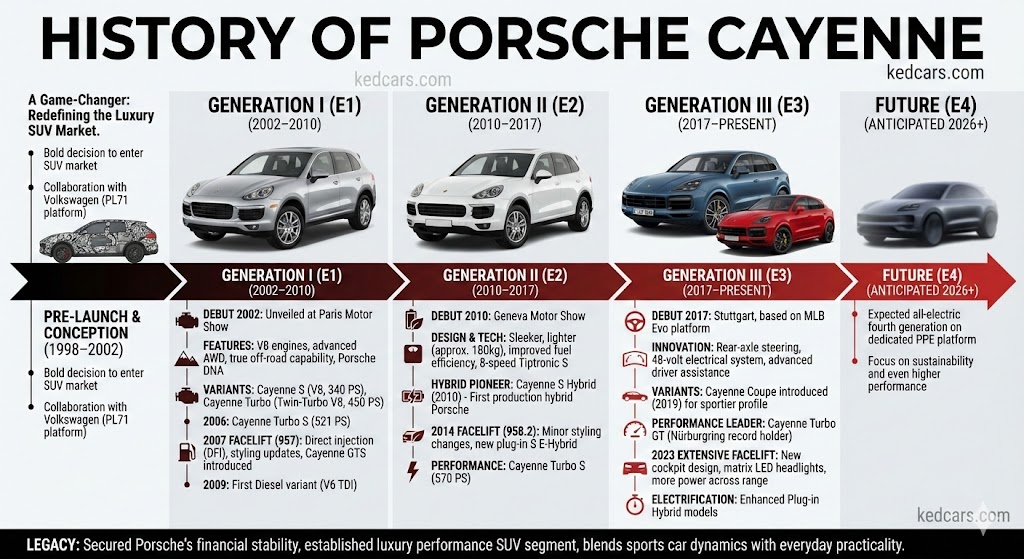
On August 21, 2002, the first Porsche Cayenne rolled off the assembly line at the company’s newly constructed Leipzig factory in Germany, representing a moment of either commercial genius or brand suicide depending on one’s perspective. Purists denounced the SUV as a betrayal of Porsche’s sixty-year heritage of uncompromising sports car engineering. Corporate strategists, however, recognized an essential truth: the future belonged to customers who valued performance alongside practicality. Two decades later, the Cayenne’s vindication proves absolute: the model has sold over one million units globally, generated revenue sustaining Porsche’s entire product portfolio, and established the SUV market segment as definitively performance-oriented rather than purely utilitarian.
Origins: Project Colorado and Strategic Necessity
The Joint Venture Vision
The Porsche Cayenne originated from strategic necessity rather than visionary ambition. In June 1998, Porsche and Volkswagen officially announced “Project Colorado”—a joint venture developing a shared SUV platform enabling both manufacturers to enter the burgeoning luxury sport-utility segment while amortizing enormous development costs across two distinct brands.
The partnership proved remarkably innovative: rather than rebadging identical vehicles, each manufacturer would develop proprietary powertrains, chassis tuning, and design languages ensuring distinctive brand character. Volkswagen’s project would evolve into the Touareg, produced in Bratislava, Slovakia. Porsche’s contribution would become the Cayenne, manufactured in Germany under comprehensive Porsche engineering supervision.
Porsche executives faced an uncomfortable reality: the company’s traditional sports car segments faced saturation. Affluent customers increasingly demanded practical four-door vehicles serving family transportation alongside performance expectations. Declining 911 sales suggested that exclusivity through two-seat sports car purity was economically unsustainable. The Cayenne represented a strategic bet that Porsche could extend performance engineering into SUV segments, capturing customers demanding practicality without compromising mechanical excellence.
The Weissach Development Program
Porsche’s engineering standards demanded that the Cayenne transcend mere platform-sharing. Development commenced at Porsche’s Weissach engineering facility—the company’s spiritual home where the legendary 911 and 959 had been engineered. Test vehicles appeared on the Weissach development track as early as spring 1998, with comprehensive validation across Europe’s most demanding testing facilities including the Nürburgring, Nardo, and Hockenheim circuits.
The engineering mandate proved absolute: the Cayenne had to perform like a genuine Porsche, delivering sports car-level handling precision without sacrificing off-road capability. This requirement drove innovation throughout the vehicle architecture: engineers developed proprietary engines, advanced all-wheel-drive systems, and suspension geometry tailored specifically to Porsche performance expectations rather than accepting conventional SUV compromises.
The Leipzig facility, constructed between 1999 and 2002, represented Porsche’s complete commitment to the project. Rather than outsourcing manufacturing, Porsche invested €1+ billion establishing state-of-the-art production facilities in Germany’s Saxony region. The factory featured an FIA-certified test circuit enabling final-vehicle validation before customer delivery—an extraordinary manufacturing investment demonstrating Porsche’s confidence in the Cayenne concept.
Initial Market Reception and Controversy
The Cayenne’s December 2002 market launch encountered passionate resistance from Porsche traditionalists who viewed the SUV as a betrayal of brand heritage. Automotive enthusiast communities engaged in intense debate: could a sports car manufacturer credibly produce an SUV without diluting brand identity? Would customers accept a Porsche badge on a bulky, utilitarian vehicle?
These fears proved unfounded. By 2003, demand exceeded all projections. Customers discovered that Porsche’s engineering discipline and performance emphasis translated perfectly to the SUV segment. The Cayenne proved faster than competitor SUVs, handled with greater precision, and delivered driving engagement that established luxury brands simply could not match. What initially seemed like commercial desperation transformed into market validation: the Cayenne had proven that performance and practicality were complementary rather than contradictory.
Engineering Excellence: Performance-Focused Design
Powertrains and Engine Development
Simply rebadging a Volkswagen Touareg was never acceptable to Porsche engineering. The original Cayenne debuted with proprietary engine options: a 3.2-liter narrow-angle VR6 producing 250 PS (247 horsepower) and a sophisticated 4.5-liter V8 producing 340 PS in the Cayenne S. The pinnacle offering was the Cayenne Turbo with 450 horsepower—exceptional output for an SUV at that time.
Engine development at Porsche emphasized mechanical character and performance over conventional efficiency compromises. The 4.5-liter V8, positioned at a 90-degree angle, featured 32 valves, Porsche’s VarioCam variable valve timing technology, and sophisticated intake management systems. The V8 was completely different from Volkswagen’s conventional engines, reflecting Porsche’s commitment to distinctive engineering.
Subsequent generations introduced progressive refinement: direct fuel injection appeared on the second generation (E2), improving efficiency without sacrificing character. The third generation (E3) adopted twin-turbocharged engines, representing Porsche’s decisive shift toward forced-induction technology. The 2024 Cayenne Turbo E-Hybrid combines a 4.0-liter twin-turbo V8 producing 599 PS (591 horsepower) with a 130 kW electric motor delivering 176 PS (174 horsepower), achieving a remarkable combined system output of 739 PS (729 horsepower) and 950 Nm (701 lb-ft) torque.
Transmission and All-Wheel Drive Systems
The Cayenne’s dynamic performance derived equally from sophisticated transmission and drivetrain systems. Porsche Traction Management (PTM) distributed engine power between front and rear axles in a 62:38 ratio as standard, with an advanced multi-plate clutch enabling variable distribution between 100:0 and 0:100 as driving conditions required.
First-generation Cayennes featured a comprehensive off-road capability: a low-range transfer box improved traction on extreme terrain, while a fully locking center differential prevented wheel spin during challenging conditions. The second generation replaced the mechanical transfer box with an on-demand all-wheel-drive system employing an actively controlled multi-plate clutch—a refinement improving everyday efficiency while maintaining off-road credibility.
Chassis and Suspension Innovation
The original Cayenne introduced Porsche Active Suspension Management (PASM)—the first instance of this technology appearing on a Porsche vehicle. PASM adjusted suspension damping in real-time, optimizing the balance between comfort and performance according to driving conditions and driver inputs. Later generations added Porsche Dynamic Chassis Control (PDCC) with active anti-roll bars, further refining the balance between agility and stability.
Modern Cayennes feature sophisticated air suspension with two-chamber, two-valve technology enabling independent adjustment of rebound and compression characteristics. This engineering refinement delivers extraordinary versatility: the suspension can prioritize comfort during relaxed highway cruising while instantly transitioning to track-focused responsiveness when dynamic driving demands engagement.
Performance Evolution: From GTS to Turbo GT
The GTS Legacy (2007-Present)
The first-generation Cayenne GTS, introduced in 2007, represented Porsche’s commitment to performance-focused variants within the SUV lineup. The original GTS featured a naturally-aspirated 4.8-liter V8 producing 405 PS (298 kW)—the peak output achievable from naturally-aspirated engines in this generation. The GTS became a benchmark for luxury SUV performance, establishing a tradition that persists through contemporary models.
The second-generation GTS evolved to a 4.8-liter engine producing 420 PS, maintaining naturally-aspirated character while incrementally improving output. By 2015, Porsche made a decisive pivot: the GTS switched to a 3.6-liter V6 biturbo design, embracing forced-induction technology that fundamentally transformed performance delivery. This transition reflected industry-wide acceptance that turbocharged engines could deliver superior performance while meeting contemporary fuel consumption and emissions regulations.
The 2025 model year reintroduced the GTS as a premium performance offering featuring a 4.0-liter twin-turbocharged V8 producing 493 horsepower—a remarkable increase reflecting evolutionary refinement of forced-induction technology. The GTS achieves 0-60 mph in 4.2 seconds with a 171 mph top speed, positioning it between the base Cayenne and the flagship Turbo E-Hybrid in the performance hierarchy.
The Cayenne Turbo GT: Track Record Setter
The most remarkable Cayenne variant is the Turbo GT—a comprehensively track-focused iteration that represents the ultimate expression of Porsche SUV engineering. The Turbo GT features a specially tuned 4.0-liter twin-turbo V8 producing 640 horsepower and 850 Nm (626 lb-ft) torque. Porsche engineers modified the crankshaft, pistons, connecting rods, intake systems, cooling systems, fuel injectors, and turbocharger compressor wheels—effectively creating an entirely new powertrain within the same displacement envelope.
The Turbo GT’s significance extends beyond raw power output. On June 14, 2021, Porsche test driver Lars Kern established a new Nürburgring SUV lap record, completing the 20.832-kilometer Nordschleife circuit in 7:38.925 minutes—a result that definitively established the Cayenne as the fastest production SUV on the planet’s most demanding race circuit.
This engineering achievement carried profound significance: the Turbo GT proved that comprehensive engineering excellence could enable SUVs to achieve performance metrics previously reserved for purpose-built sports cars. The vehicle featured track-specific suspension tuning, carbon ceramic braking systems as standard, and Pirelli P Zero Corsa performance tires exclusively developed for the model. The Turbo GT sits 17mm lower than standard Cayennes, with suspension rigidity enhanced by 15%.
The Coupe Variant: Design Evolution
The third-generation Cayenne introduced a revolutionary variant: the Cayenne Coupe—a fastback design emphasizing visual drama and contemporary aesthetics. Rather than a traditional SUV silhouette, the Coupe features a sloping roof, abbreviated rear overhang, and distinctive proportions projecting sports car character. All Cayenne powertrain options remain available in Coupe configuration, including the performance-focused Turbo GT.
The Coupe Turbo GT with GT Package represents the ultimate Cayenne expression: it achieves 0-100 km/h in 3.6 seconds while delivering a 305 km/h (190 mph) top speed—performance metrics rivaling supercar benchmarks from mere years earlier. The combination of track capability with practical four-seat transportation exemplifies Porsche’s philosophy that performance and utility are complementary rather than contradictory.
Contemporary Performance Lineup (2024-2025)
Current Generation Specifications
| Model | Engine/Motors | Power Output | 0-60 mph | Top Speed |
|---|---|---|---|---|
| Cayenne | 3.0L Twin-Turbo V6 | 348 hp | 6.1 sec | 149 mph |
| Cayenne S | 4.0L Twin-Turbo V8 | 468 hp | 4.9 sec | 165 mph |
| Cayenne E-Hybrid | 3.0L V6 + E-Motor | 463 hp | 5.5 sec | 157 mph |
| Cayenne S E-Hybrid | 4.0L V8 + E-Motor | 512 hp | 4.8 sec | 169 mph |
| Cayenne GTS | 4.0L Twin-Turbo V8 | 493 hp | 4.2 sec | 171 mph |
| Cayenne Turbo E-Hybrid | 4.0L V8 + E-Motor | 729 hp | 3.7 sec | 183 mph |
| Cayenne Turbo GT | 4.0L Twin-Turbo V8 | 640 hp | 3.3 sec | 186 mph |
All contemporary Cayennes feature standard all-wheel drive, eight-speed Tiptronic automatic transmission, and adaptive air suspension. Hybrid models include 25.9 kWh batteries providing up to 82 kilometers (51 miles) of all-electric driving range with 11 kW on-board chargers enabling full recharge in approximately 2.5 hours.
Market Success: From Controversial to Canonical
Production Milestones and Volume Achievement
The Cayenne’s commercial success exceeded even optimistic corporate projections. Initial Leipzig factory capacity supported approximately 70 vehicles per day. Market demand drove capacity expansion to 350 vehicles daily—five times initial projections. By September 2013, Porsche celebrated the 500,000th Cayenne production milestone, a remarkable achievement for any vehicle introduced merely 11 years earlier.
Contemporary production figures demonstrate sustained commercial strength: the 2024 fiscal year witnessed 93,900 Cayenne vehicles produced globally—a slight decline from 2023 but confirmation that the model remains Porsche’s volume driver. In the United States, 2024 achieved a Cayenne sales record of 22,432 units, confirming the model’s central importance to Porsche’s American market positioning.
Vindication Two Decades Later
The initial skepticism that greeted the 2002 launch has transformed into recognition of visionary strategic insight. Automotive historians increasingly credit the Cayenne with fundamentally saving Porsche—not through dramatic corporate restructuring, but through enabling consistent revenue generation sustaining investment in new product development, manufacturing facility modernization, and technology advancement.
Without Cayenne revenue, Porsche would have struggled to fund development of subsequent four-door models including the Panamera and Macan. The SUV’s profitability essentially subsidized the company’s continued sports car production, enabling Porsche to maintain the 911 and Boxster lineages through periods when two-seat sports car sales proved economically challenged.
Global Market Positioning
The Cayenne’s appeal transcends geographic boundaries and cultural automotive traditions. The model sells successfully across North America, Europe, Asia, and Middle Eastern markets—each region maintaining distinctive purchase preferences yet recognizing the Cayenne’s distinctive position within luxury SUV segments. The model’s versatility—equally at home on rural mountain roads, urban streets, or desert terrain—contributes to its universal appeal.
Design Philosophy and Brand Integration
Visual Identity and Evolutionary Refinement
Head of Design Michael Mauer characterizes the Cayenne’s evolution across three generations using the principle: “Establish, sharpen, refine”—a methodology equally applicable to technical development as design language. The original 2002 Cayenne featured bulky, muscular proportions that many automotive critics dismissed as ungainly despite acknowledging performance capabilities.
Subsequent generations refined these proportions without abandoning distinctive character. The second-generation design introduced more sophisticated surface treatment and refined details. The third-generation completely reimagined the visual language, adopting sleeker proportions emphasizing athletic capability while maintaining Porsche’s design DNA. The introduction of the Coupe variant provided additional design variation, offering customers choices between traditional SUV proportions and contemporary fastback aesthetics.
Engineering Transparency and Mechanical Honesty
The Cayenne’s design communicates engineering authenticity: visible air intakes serve actual cooling functions, muscular body surfaces reflect underlying structural strength, and proportional arrangements emphasize the relationship between engine positioning and wheel placement. This design honesty resonates with Porsche customers who appreciate mechanical purposefulness over decorative ornamentation.
Interior design emphasizes driver engagement rather than technology novelty. Controls position intuitively within driver reach, touchscreen interfaces integrate sophisticated technology without dominating the driving environment, and material selection emphasizes quality craftsmanship. The result manifests as a genuine Porsche interior—performance-focused without sacrificing luxury appointments.
The Bottom Line
The Porsche Cayenne’s remarkable trajectory—from controversial 2002 debut through two decades of continuous production and refinement—exemplifies how strategic vision and engineering excellence can transform skepticism into vindication. What traditionalists denounced as brand betrayal transformed into the market reality that saved Porsche’s business model while maintaining uncompromising performance standards.
The Cayenne proved definitively that performance and practicality are complementary rather than contradictory. By insisting that its SUV deliver sports car-level handling precision, Porsche established performance benchmarks for luxury sport-utility vehicles, influencing competitor design standards across the segment. Subsequent Porsche models including the Panamera sedan and Macan compact SUV leveraged platform-sharing strategies pioneered by the Cayenne, transforming cost structures and enabling expanded product portfolios.
The contemporary Cayenne lineup—from modest 348-horsepower base models through the remarkable 729-horsepower Turbo E-Hybrid—demonstrates Porsche’s commitment to continuous evolution while maintaining core identity principles. The Nürburgring lap record established by the Turbo GT, the plug-in hybrid technology enabling electric driving, and the Coupe variant’s contemporary aesthetics confirm that the Cayenne remains dynamically relevant rather than merely historically significant.
The Porsche Cayenne stands as a testament to courageous strategic decision-making and unwavering commitment to engineering excellence. That Porsche refused to compromise performance standards despite entering an unfamiliar market segment resulted in a vehicle that transcends categorical definitions. The Cayenne is simultaneously practical family transportation, high-performance road car, and trail-capable off-roader—a comprehensive achievement that validates Porsche’s fundamental philosophy that mechanical excellence and honest engineering transcend temporary market trends or categorical traditions.