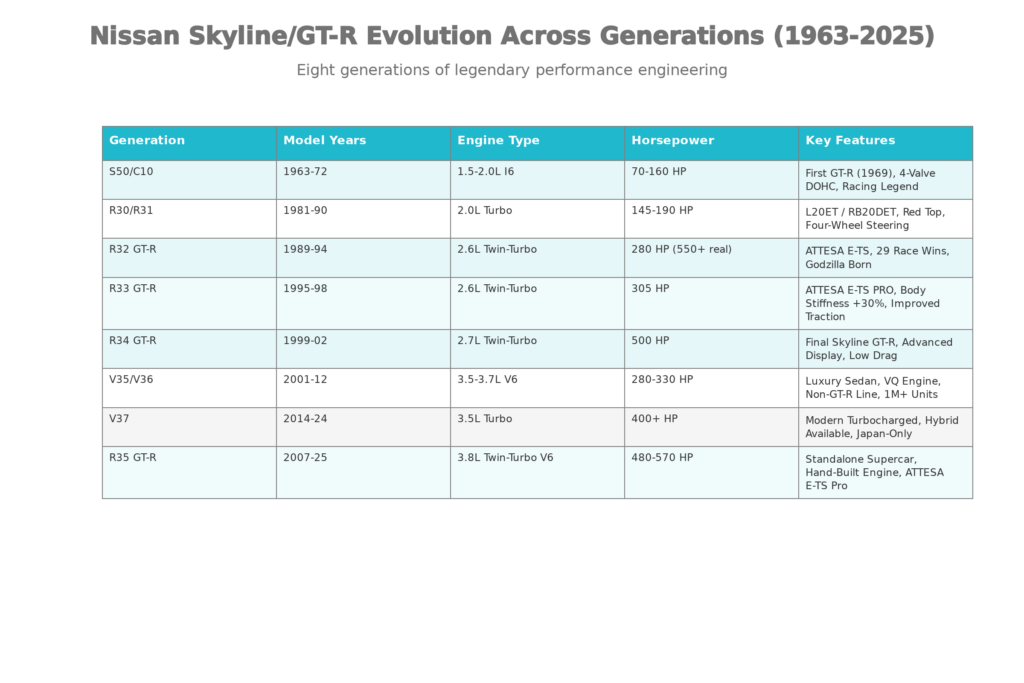
The Nissan Skyline stands as one of automotive history’s most iconic and culturally significant vehicles, representing Japanese automotive engineering excellence and the evolution of accessible performance across seven decades of continuous production. Originally manufactured by the Prince Motor Company beginning in 1957 as a luxury sedan, the Skyline underwent transformative evolution following Prince’s 1966 merger with Nissan, subsequently transitioning from practical transportation into a legendary performance platform that established fundamental benchmarks for Japanese sports car development. The nameplate achieved mythical status through the legendary Skyline GT-R variants—particularly the revolutionary 1989 R32 generation earning the nickname “Godzilla” for its dominance in international motorsport, the refined R33 generation demonstrating technological sophistication, and the ultimate R34 generation representing the pinnacle of naturally-aspirated and turbocharged performance from the Skyline GT-R lineage. The R34 Skyline GT-R, produced from 1998 through 2002, achieved profound cultural prominence through starring roles in the blockbuster Fast and the Furious film franchise, cementing the nameplate as a global icon representing Japanese automotive ambition and accessible supercar performance. The contemporary thirteenth-generation V37 Skyline, launched in 2014 and continuing into the present day, represents a philosophical departure emphasizing hybrid efficiency and turbocharged technology rather than the naturally-aspirated characteristics defining earlier generations, while the forthcoming R36 GT-R signals revolutionary all-electric propulsion promising 1,360 horsepower establishing the nameplate’s continued relevance in the electric vehicle era.
Origins and the Prince Motor Company Era
The 1957 Debut and Luxury Sedan Positioning
The Nissan Skyline originated as a luxury sedan produced by the Prince Motor Company, an independent Japanese manufacturer established in 1945 that competed directly against Toyota and Nissan across diverse vehicle categories. The first generation Skyline, introduced in April 1957, featured a straightforward 1.5-liter inline-four engine producing approximately 60 horsepower, delivering modest performance appropriate to its positioning as a premium family vehicle. The original platform emphasized comfort and refinement rather than performance: independent front suspension using De Dion tube architecture, a commodious four-door sedan configuration, and elegant bodywork reflecting contemporary Japanese automotive design language.
The second-generation S50 Skyline, introduced in 1963, achieved particular commercial success through expanded engine options and refined proportions. The introduction of the GT-B variant—employing a 2.0-liter six-cylinder engine producing 125 horsepower borrowed from the larger Prince Gloria sedan—initiated the Skyline’s gradual transformation from purely luxurious conveyance toward performance-oriented transportation. The GT-B’s 1964 Japanese Grand Prix second-place finish, combined with subsequent racing victories, established the nameplate’s performance credentials among enthusiasts appreciating mechanical authenticity alongside practical transportation value.
The Nissan Era and the GT-R Legacy
The Third Generation C10 and the Original GT-R (1968-1972)
Following the 1966 merger, the third-generation C10 Skyline debuted under the Nissan nameplate in August 1968, establishing the platform as Nissan’s performance flagship competing against Toyota and Mazda sports cars. The introduction of the legendary Skyline GT-R (model code KPGC10) in February 1969 initiated one of automotive history’s most successful racing legacies. The GT-R employed a revolutionary 1.992-liter twin-cam straight-six engine with triple Weber carburetors producing approximately 160 horsepower, delivering authentic performance that captured Japan’s domestic racing imagination.
The GT-R variant immediately dominated Japanese touring car racing, establishing winning records that persisted throughout the early 1970s. Approximately 832 four-door Hakosuka GT-R sedans were manufactured, along with approximately 1,197 two-door hardtop examples, establishing production volumes modest by contemporary standards yet significant compared to exclusive foreign sports cars. The iconic “pop-up” headlight design, the dramatic side air intakes, and the overall proportions established visual language that enthusiasts remain devoted to across contemporary decades.
The Golden Age: R32 and R33 GT-R Generations (1989-1998)
Following a 16-year hiatus from the GT-R nameplate, Nissan unveiled the revolutionary eighth-generation R32 Skyline GT-R in January 1989, establishing a watershed moment in Japanese automotive performance development. The R32 GT-R introduced a completely revolutionary 2.6-liter twin-turbocharged straight-six engine designated RB26DETT, producing approximately 300 horsepower (understated in international markets for competitive and regulatory considerations, with actual performance considerably exceeding official figures). The integration of the groundbreaking ATTESA E-TS all-wheel-drive system—providing infinitely variable torque distribution between front and rear axles—established suspension and traction control sophistication that competitors required years to replicate.
The R32 GT-R achieved legendary status through complete domination of the Japanese Touring Car Championship for four consecutive years (1990-1993), combined with extraordinary success in Australian Touring Car Championship competition. The racing victories prompted Australian automotive publication Wheels to immortalize the vehicle with the iconic nickname “Godzilla”—a designation reflecting the vehicle’s seemingly unstoppable performance advantages that competitors struggled to overcome. Approximately 43,937 R32 Skyline GT-R examples were manufactured, establishing the generation as the highest-volume GT-R iteration until the contemporary R35.
The ninth-generation R33 Skyline GT-R, produced from 1993 through 1998, continued the performance tradition while introducing refined creature comforts and updated styling. The RB26DETT engine maintained approximately 300 horsepower output in standard configuration, with optional components and tuning modifications enabling significantly greater power extraction. Approximately 218,000 total R33 Skyline examples were manufactured, establishing the generation as commercially successful despite the GT-R variant’s exclusive positioning representing the performance pinnacle.
The Final Skyline GT-R: R34 “Godzilla Returns” (1998-2002)
The tenth-generation R34 Skyline GT-R, introduced in January 1999 and produced through August 2002, represented the final Skyline GT-R variant before the nameplate’s ultimate separation into the dedicated Nissan GT-R lineage. The R34 GT-R preserved the legendary RB26DETT twin-turbocharged straight-six engine while incorporating evolutionary improvements: ceramic turbochargers featuring ball-bearing construction providing snappier throttle response, revised engine management enabling more responsive power delivery, and enhanced reliability characteristics. Official power output remained conservatively rated at 276 horsepower in Japanese domestic market specification, yet comprehensive testing revealed substantially greater actual performance—with credible evidence suggesting 330-plus horsepower in realistic conditions.
The R34 GT-R achieved particular prominence through starring roles in the blockbuster Fast and the Furious film franchise, wherein Paul Walker’s character Brian O’Conner’s distinctive silver R34 GT-R became an instant icon. The film’s release sparked unprecedented international enthusiasm for the Skyline nameplate, transforming the vehicle from a respected Japanese performance car into a global cultural phenomenon. Subsequent anime appearances, particularly the legendary Initial D series, further cemented the R34’s position within Japanese automotive culture as representing the aspirational pinnacle of street racing performance.
Approximately 62,000 R34 Skyline examples were manufactured across all variants, with GT-R models representing a subset of this total production. The 2005 introduction of the NISMO Z-Tune—a limited-edition restoring program producing only 19 completed examples—employed modified R34 GT-R bodyshells combined with stroked 2.8-liter RB26DETT engines producing approximately 500 horsepower, establishing the ultimate expression of Skyline GT-R performance engineering.
The R35 GT-R Separation and Modern Era
The Dedicated GT-R Platform (2007-2025)
In 2007, Nissan formally separated the GT-R designation from the Skyline nameplate, introducing the revolutionary R35 GT-R as an independent model leveraging the Premium Midship platform. This architectural departure enabled the development of a genuinely revolutionary supercar: the R35 GT-R featured a 3.8-liter VR38DETT twin-turbocharged V6 engine producing approximately 473 horsepower in base form, escalating through successive generations to 570 horsepower in the final iteration. The hand-assembled engine—constructed by only nine specially-designated “Takumi Craftsmen” mechanics throughout the car’s 18-year production span—represented automotive artistry merged with manufacturing precision that competitors struggled to replicate.
The R35 GT-R production, concluding in December 2024 after 48,000 cumulative deliveries, represented the most commercially successful GT-R generation in history. The vehicle achieved particular prominence through continuous technological evolution: progressive power increases, refined suspension geometry, advanced driver assistance systems, and comprehensive digital integration transformed the vehicle from anachronistic performance machine into a genuine modern supercar competitive with contemporary exotic imports.
The Future R36 GT-R and All-Electric Performance
Nissan’s official announcement regarding the forthcoming R36 GT-R confirmed revolutionary all-electric propulsion utilizing solid-state battery technology, with preliminary specifications indicating approximately 1,360 horsepower—more than double the R35 GT-R NISMO’s 600-horsepower output. The Nissan Hyper Force concept, representing the design direction for the production R36, incorporates distinctive proportions and aggressive styling emphasizing contemporary electric vehicle aesthetics. Estimated arrival timeframe suggests production beginning in the 2026-2027 period, establishing the R36 as a watershed moment in automotive performance history.
The Contemporary V37 Skyline
The Thirteenth Generation and Hybrid Evolution (2014-Present)
The contemporary V37 Skyline, representing the thirteenth generation and launched in February 2014, marked a philosophical departure emphasizing refined efficiency and turbocharged technology rather than the naturally-aspirated character defining earlier generations. The base Skyline employs a 2.0-liter turbocharged four-cylinder engine producing approximately 255 horsepower paired with sophisticated CVT transmission, targeting the luxury sedan market prioritizing daily usability and refined highway performance.
The performance-oriented V37 variants employ significantly more powerful engines: the 2024 Skyline 400R variant features a 3.0-liter twin-turbocharged V6 engine producing 400 horsepower and 406 pound-feet of torque, delivering respectable acceleration befitting the nameplate’s performance heritage. The 2024 Skyline NISMO variant, tuned by Nissan’s racing division engineers, increases the same VR30DDTT engine to 414 horsepower and 406 pound-feet of torque, establishing the generation’s performance pinnacle alongside sporty suspension tuning and aerodynamic enhancements.
The introduction of hybrid variants, particularly the Skyline 350GT Hybrid, reflects industry-wide electrification trends emphasizing efficiency alongside performance. These variants combine gasoline engines with electric motor assistance and rechargeable batteries, delivering improved fuel economy while maintaining authentic driving characteristics appropriate to the nameplate’s performance positioning.
Design Language and Visual Identity
The Skyline’s design evolution reflects careful balance between preserving iconic visual characteristics while embracing contemporary styling sensibilities. The distinctive proportions—the characteristic hood-to-windshield ratio, the integrated side air vents communicating mechanical authenticity, and the overall silhouette emphasizing performance orientation—remain instantly recognizable across generations. Contemporary V37 variants feature updated LED lighting integrating vertical light bars, revised bumper designs reflecting modern safety standards, and refined surfacing materials communicating premium positioning.
Cultural Impact and Global Influence
The Fast and the Furious Phenomenon
The Nissan Skyline achieved transcendent cultural prominence through starring roles in the Fast and the Furious film franchise, particularly the R34 GT-R driven by Paul Walker’s character Brian O’Conner. The vehicle’s dramatic acceleration, distinctive styling, and modification potential made it ideal subject for action cinema: the iconic silver R34 GT-R became instantly recognizable globally among audiences encompassing both automotive enthusiasts and casual moviegoers. This cinematic prominence transformed the Skyline from respected Japanese sports car into a cultural icon representing street racing aesthetics and accessible performance dreams.
Anime and Manga Legacy: Initial D
The legendary manga and anime series Initial D, serialized from 1995 through 2013 with concurrent anime adaptation, profoundly influenced the Skyline’s cultural significance particularly regarding the R34 GT-R variant. While the series primarily featured the Toyota AE86 as the protagonist vehicle, the Skyline GT-R received significant emphasis as the competitive opposition that the protagonist gradually overcame through superior driving technique and mechanical engagement. The series’ technical accuracy—entire pages dedicated to detailed car specifications—established Initial D as credible performance documentation rather than frivolous entertainment. The Skyline’s portrayal in anime established the nameplate as representing legitimate high-performance engineering achieving genuine respect among serious automotive enthusiasts.
Engine Architecture and Powertrain Evolution
From Straight-Six Simplicity to Twin-Turbocharged Sophistication
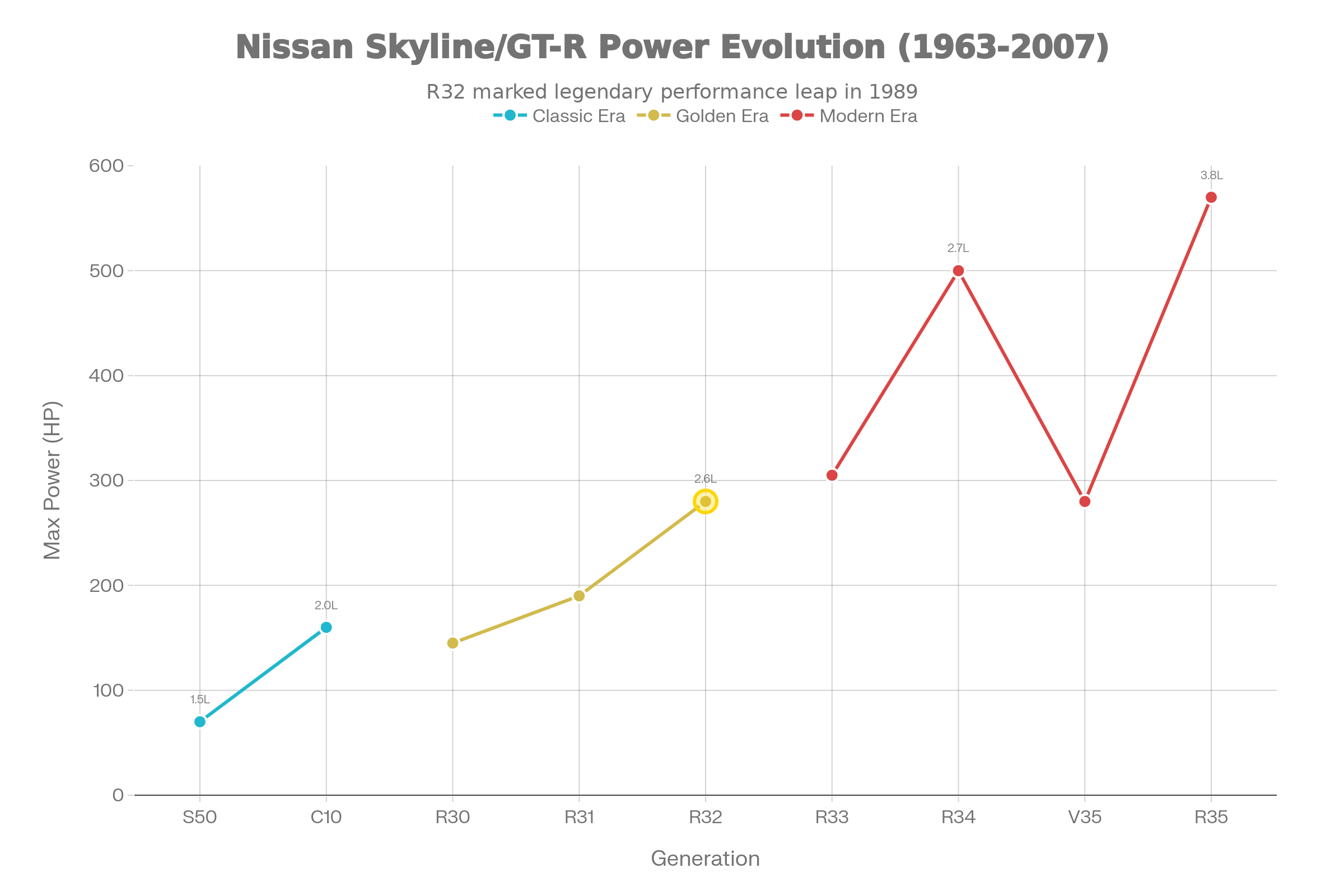
The original Prince Skyline’s 1.5-liter inline-four engine represented mechanical simplicity emphasizing reliability over performance. Successive generations progressively expanded displacement and engineering sophistication: the S50 GT-B’s 2.0-liter six-cylinder established the foundation for performance variants; the C10 GT-R’s 1.99-liter twin-cam straight-six delivered genuine competitive credibility; the R32 GT-R’s revolutionary RB26DETT twin-turbocharged straight-six established baseline expectations for Japanese performance engineering.
The RB26DETT engine, employed from the R32 through the final R34 GT-R (and subsequently revived for the NISMO Z-Tune), represented engineering sophistication enabling remarkable power density through forced-induction technology. The hand-assembled construction, premium materials, and meticulous engineering standards established the engine as genuinely special—a mechanical masterpiece justifying the reverence that contemporary enthusiasts maintain.
Collector Status and Market Performance
Vintage Skyline GT-R examples, particularly R32, R33, and R34 variants, have experienced remarkable appreciation across recent years. Well-preserved R32 GT-R examples command $100,000-$200,000 depending on mileage and originality, with exceptional low-mileage specimens frequently exceeding $250,000. The R34 GT-R, particularly the 1999-2001 production period, has appreciated dramatically due to the Fast and the Furious prominence: examples in exceptional condition achieving $300,000-$500,000 at contemporary auctions. The NISMO Z-Tune variants, produced in only 19 examples, have achieved legendary status commanding prices exceeding $1 million when examples become available for sale.
The Botttom Line
The Nissan Skyline’s extraordinary legacy—spanning nearly seven decades from the 1957 Prince Motor Company original through the R34 Skyline GT-R, the separated R35 dedicated GT-R platform achieving 48,000 cumulative deliveries, and the forthcoming all-electric R36 GT-R promising 1,360 horsepower—represents one of automotive history’s most impressive achievements in sustained performance excellence and cultural significance. The nameplate succeeded through the convergence of multiple factors: Nissan’s engineering discipline delivering genuine performance through proven mechanical architecture; the GT-R’s legendary racing dominance establishing authentic performance credibility; fortunate cultural alignment positioning the R34 GT-R as the iconic representation of Japanese street racing culture; and anime and film appearances establishing global recognition transcending automotive circles.
The Skyline stands as proof that exceptional performance need not require excessive complexity—the RB26DETT engine’s hand-assembled construction, fundamental mechanical simplicity, and proven reliability established a foundation enabling dramatic power escalation through careful engineering and customer customization. The nameplate’s enduring collector enthusiasm, sustained appreciation across generations, and continued cultural prominence despite comprehensive industry electrification demonstrates that vehicles celebrating mechanical authenticity, distinctive design language, and genuine driving engagement remain eternally relevant.
The Nissan Skyline remains the ultimate representation of accessible Japanese performance—a vehicle that emerged from humble origins as a luxury sedan to become a global icon representing automotive ambition, engineering excellence, and the democratization of supercar performance. As the all-electric R36 GT-R prepares for introduction, the nameplate’s continued evolution demonstrates Nissan’s commitment to maintaining the Skyline’s fundamental character—genuine performance delivered through technological sophistication—across whatever propulsion technologies the automotive future demands.