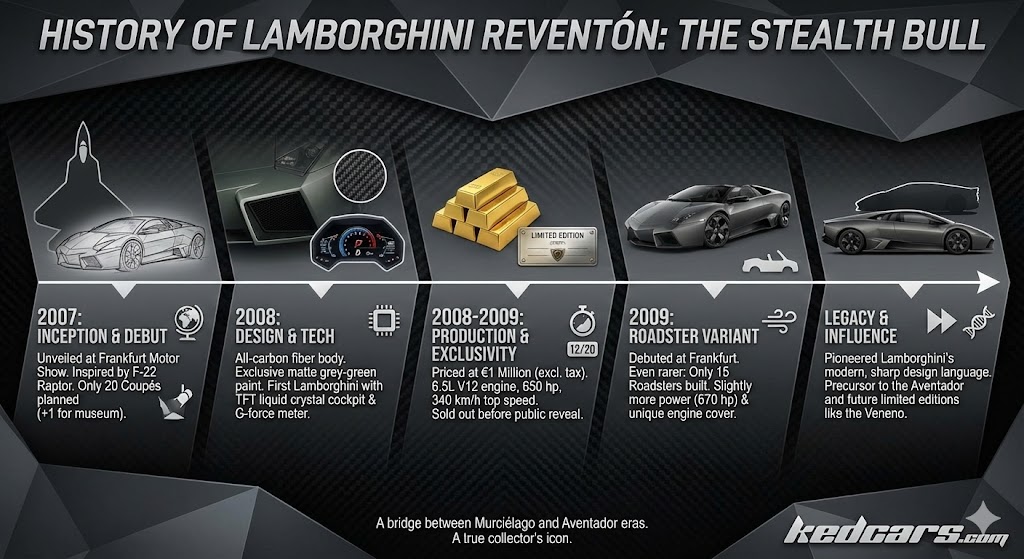
The Lamborghini Reventón stands as one of automotive history’s most visually arresting and deliberately exclusive hypercars, representing a watershed moment in Lamborghini’s design evolution through the creation of precisely 20 production coupes and 15 roadster examples between 2007 and 2009. Unveiled at the 2007 Frankfurt Motor Show, the fighter-jet-inspired Reventón completely redefined expectations for limited-production supercars, establishing a template for bespoke, exclusive vehicles that would influence Lamborghini’s design philosophy for subsequent decades. Designed under the creative direction of Lamborghini Centro Stile with Filippo Perini as chief designer and oversight from Belgian design innovator Luc Donckerwolke, the Reventón derived mechanical components from the Murciélago LP640 while featuring completely reimagined bodywork incorporating F-22A Raptor fighter-jet aesthetic principles.
Every Reventón vehicle emerged finished in an exclusive opaque gray designated “Grigio Reventón”—a strategic departure from automotive customization convention that paradoxically strengthened the hypercar’s exclusivity and design coherence. The €1 million original pricing (approximately $1.38 million USD) immediately doubled in secondary markets due to overwhelming collector demand, establishing the Reventón as an acquisition transcending traditional vehicle ownership toward investment appreciation and mechanical art form. The carbon-fiber body construction, precisely engineered aerodynamics generating 1,200 kilograms of downforce at 250 kilometers per hour, and 6.5-liter naturally-aspirated V12 engine delivering 650 horsepower combined to create an automotive experience emphasizing emotional engagement and visual distinctiveness competing against contemporary supercars through sheer aesthetic boldness.
Contemporary market valuations for low-mileage Reventón coupes and roadsters have appreciated to $6.5 million through $8.5 million USD—representing extraordinary value appreciation reflecting genuine collector recognition that design-forward, limited-production hypercars command lasting enthusiasm among individuals valuing automotive aesthetics and mechanical authenticity transcending transient performance specifications. The Reventón’s strategic influence extended beyond its immediate production: the vehicle established design language principles—hexagonal geometry, Y-shaped motifs, fighter-jet-inspired interiors emphasizing “feel like a pilot” philosophy—that would persist throughout subsequent Lamborghini designs including the Aventador, Veneno, and contemporary models.
Design Philosophy and Fighter-Jet Inspiration
Aeronautical Design Language and Visual Distinctiveness
The Lamborghini Reventón’s fundamental design achievement reflected meticulous commitment to aeronautical aesthetics: Lamborghini engineers and designers openly acknowledged that the F-22A Raptor fighter jet’s angular, radar-evading geometry inspired the Reventón’s visual character, adapting stealth-bomber principles toward automotive expression. Rather than pursuing abstract futurism, the design team incorporated functional aeronautical principles: the aggressive forward-facing air intakes provided necessary engine cooling, the variable-geometry air intake system optimized airflow patterns, and the adjustable rear diffuser managed aerodynamic pressure distribution.
This engineering-forward design philosophy distinguished the Reventón from competitors pursuing decorative styling: every visual element—from the acute-angle central “arrow” characterizing the front fascia through the asymmetric lower side air intakes (larger on driver’s side to increase oil-cooler flow) through the integrated rear wing—served quantifiable aerodynamic or mechanical functions. The designer consciously avoided ostentatious aerodynamic add-ons that would compromise visual coherence: unlike the Countach 25th Anniversary’s festooned wings and prominent cooling intakes, the Reventón integrated aerodynamic features seamlessly within unified design expression.
The strategic decision to mandate universal “Grigio Reventón” opaque-gray exterior coloring—eliminating customer color selection—reinforced design coherence while paradoxically strengthening exclusivity perception. This constraint reflected designer conviction that automotive art required unified visual presentation: allowing customers to specify alternative colors would fragment the design intent. Subsequent years validated this philosophy: the monochromatic gray finish became iconic, with collectors subsequently seeking out examples in this distinctive specification rather than lamenting limited color choice.
Interior Cockpit Philosophy and Fighter-Jet Instrumentation
The Reventón’s interior architecture reflected systematic commitment to fighter-jet aesthetic principles without theatrical excess. The instrument panel featured three TFT liquid-crystal displays with toggle modes, establishing digital instrumentation sophistication unusual for 2007-era supercars, while maintaining elegant visual restraint through milled-aluminum structural elements protected by carbon-fiber casings. A g-force meter displayed instantaneous magnitude and direction of gravitational forces acting upon the vehicle—a measurement otherwise associated with aerospace and motorsports applications rather than road-going vehicles.
The military-green Alcantara upholstery, black leather, brown Alcantara accents, and aluminum detailing created cabin ambiance emphasizing purposeful engineering rather than luxury decoration. This interior design philosophy—emphasizing function, instrumentation, and mechanical feedback—appealed to driving enthusiasts valuing visceral engagement over technological distraction.
The 6.5-Liter Naturally-Aspirated V12 Engine
Mechanical Heritage and Performance Engineering
The Reventón’s 6.5-liter naturally-aspirated V12 engine derived directly from the Murciélago LP640, establishing mechanical continuity while delivering enhanced performance through engineering optimization. Upgraded specifications produced 650 horsepower at 8,000 rpm and 660 Newton-meters of torque at 6,000 rpm, with the Roadster variant achieving marginally higher 670 horsepower through revised intake geometry. The continuous availability of 90 percent peak torque across the 3,700 to 8,000 rpm operating range created responsive power delivery throughout the complete driving envelope.
The variable-geometry intake system optimized airflow patterns responding to engine operating conditions, improving throttle response and enabling linear power progression. This naturally-aspirated configuration emphasized mechanical responsiveness absent in turbocharged competitors: customers experienced immediate power delivery without turbo-lag delay, creating sensory feedback emphasizing driver engagement and emotional connection.
The e-gear electrohydraulic manual transmission with paddle shifters provided lightning-fast sequential gear changes while enabling driver control over power delivery timing. All-wheel-drive Viscous Traction systems ensured that extraordinary torque translated continuously into vehicular motion, minimizing wheel slip while maintaining driver-machine feedback during spirited driving.
Aerodynamic Engineering and Performance Validation
Wind-Tunnel Development and Downforce Generation
The Lamborghini Reventón’s aerodynamic engineering, developed in collaboration with renowned racing-car manufacturer Dallara, achieved exceptional downforce generation of 1,200 kilograms at 250 kilometers per hour (155 miles per hour)—a capability positioning the hypercar among aerodynamically sophisticated vehicles despite its design-forward aesthetic emphasis. This extraordinary aerodynamic performance resulted from meticulous wind-tunnel development and integration of aerodynamic features within unified design expression rather than through application of obvious add-ons.
The adjustable rear diffuser, variable-geometry air intakes, and integrated body geometry collectively managed airflow patterns maintaining vehicle stability at extreme speeds. These aerodynamic elements functioned transparently within the overall design: customers experienced superior track performance and high-speed stability without encountering the visual distraction of protruding wings, splitters, and cooling ducts.
Production Specifications and Market Positioning
Ultra-Exclusive Limited Manufacturing
The Lamborghini Reventón production remained deliberately constrained to 20 production coupes plus one museum example (designated 00/20), with an additional 15 roadster variants manufactured during 2007-2009. Every vehicle received sequential numbering stamped between the driver and passenger seats, establishing individual identification and production chronology. The Sant’Agata Bolognese factory produced vehicles at deliberately measured pace, reflecting Lamborghini philosophy that exceptional automotive creation demanded meticulous engineering attention incompatible with mass-production timescales.
The original €1 million pricing immediately demonstrated market enthusiam: secondary market valuations doubled to approximately $2.1 million USD within years of initial deliveries, establishing the Reventón as acquisition transcending traditional vehicle ownership toward mechanical art form and collector investment. Contemporary market valuations (2024-2025) position low-mileage Reventón coupes at $6.5 to $8.0 million USD, with roadster variants commanding $8.5 million USD and beyond—representing extraordinary appreciation reflecting genuine collector recognition of design innovation and mechanical excellence.
Geographic Distribution and Ownership Concentration
The 20 production coupes distributed globally with strategic concentration: ten units delivered to United States customers, seven to European owners, one to Canadian buyer, and two to Asian markets. This distribution reflected Lamborghini’s deliberate customer selection emphasizing genuine performance enthusiasm and design appreciation over investment speculation. Notable owners included high-profile collectors and dignitaries, establishing the Reventón as vehicle commanding international recognition among automotive enthusiasts and cultural influencers.
Design Legacy and Subsequent Lamborghini Influence
Establishing Design Language for Subsequent Models
The Reventón’s design significance transcended its immediate limited production: the vehicle established design language principles that would influence Lamborghini creations for subsequent decades. Hexagonal geometry, Y-shaped motifs, and fighter-jet-inspired interior philosophy emphasizing “feel like a pilot” sensibility became foundational elements persisting through the Aventador, Veneno, and contemporary Revuelto flagship. The Reventón represented transitional moment between Murciélago-era design and Aventador’s next-generation styling, effectively previewing design direction for production vehicles while maintaining exclusivity through limited production and fighter-jet aesthetic distinctiveness.
The vehicle also established precedent for limited-production, design-forward models: the subsequent Veneno, extreme-track-focused variants of the Aventador, and contemporary specialty editions all drew inspiration from the Reventón’s template of mechanical heritage combined with revolutionary design language and severely constrained production quantities.
The Bottom Line
The Lamborghini Reventón represents one of automotive history’s most visually distinctive and deliberately exclusive hypercars, demonstrating definitively that design-forward innovation and mechanical authenticity could command lasting enthusiasm among collectors valuing automotive aesthetics transcending transient performance specifications. Through collaborative effort between Lamborghini Centro Stile designers and aeronautical-inspired design principles, the Reventón created aircraft-influenced visual character integrated with quantifiable aerodynamic engineering delivering 1,200 kilograms of downforce and responsive mechanical performance.
The strategic decision to constrain production to precisely 20 coupes and 15 roadsters, mandate universal “Grigio Reventón” gray coloring, and price vehicles at €1 million established the Reventón as acquisition transcending traditional vehicle ownership toward mechanical art form and collector investment. Contemporary market valuations exceeding $8.5 million for low-mileage examples validate that design-forward, limited-production hypercars command lasting appreciation reflecting genuine collector recognition of automotive excellence.
The Reventón’s design legacy extended far beyond its production run: the vehicle established hexagonal geometry, Y-shaped motifs, and fighter-jet-inspired interior philosophy that would persist throughout subsequent Lamborghini designs. This influence demonstrates that exceptional design leadership establishes lasting creative imprint transcending individual models, establishing architectural principles guiding brand evolution for decades.
The Lamborghini Reventón stands as testament to possibility of design-forward hypercars achieving legendary status through visual distinctiveness and mechanical authenticity rather than excessive horsepower or technological novelty. In automotive landscape increasingly dominated by computational optimization and performance-specification chasing, the Reventón represents uncompromising commitment to design excellence, manufacturing precision, and emotional engagement—values transcending automotive fashion cycles to establish the fighter-jet-inspired hypercar as timeless achievement worthy of celebration and continued reverence among enthusiasts, collectors, and design-forward automotive advocates worldwide.