The Jeep Wrangler stands as the direct spiritual and mechanical successor to the legendary 1941 Willys MB military reconnaissance vehicle, representing the world’s longest continuously produced four-wheel-drive nameplate. With more than five million examples manufactured since the Wrangler brand officially debuted in 1987, the vehicle encompasses a remarkable lineage spanning from World War II battlefields through contemporary adventure-driven global markets. The Wrangler remains the definitive expression of off-road capability merged with open-air freedom, maintaining the fundamental design principles established by Karl Probst’s 1940 Bantam prototype—a separate body-on-frame architecture, rigid live axles front and rear, fold-flat windshield, removable doors, and the distinctive seven-slot grille that defines Jeep visual identity across generations. From the original utilitarian 1987 YJ generation through the contemporary JL model, the Wrangler has transformed from a niche off-road specialty vehicle into a mainstream performance SUV offering customers unprecedented powertrain diversity including a returning six-cylinder V8 option, turbocharged four-cylinder engines, and plug-in hybrid electric capability—demonstrating Jeep’s commitment to delivering authentic off-road performance regardless of propulsion preference.
Origins and Military Heritage
The 1941 Willys MB and World War II Genesis
The Jeep story began in June 1940 when the United States Army issued a specification for a revolutionary new vehicle type: a compact, quarter-ton four-wheel-drive reconnaissance car capable of executing diverse battlefield roles from reconnaissance patrols through casualty evacuation and supply transport. The requirements explicitly demanded a vehicle weighing less than 2,160 pounds, capable of negotiating brutal terrain, and manageable by minimal crew members. The Army solicited 135 automobile manufacturers to submit competing designs; remarkably, only three companies responded: Bantam, Willys-Overland, and Ford Motor Company.
A Detroit-based freelance automotive designer named Karl Probst created the original Bantam prototype in just 18 hours, completing a mechanically sound design that exceeded initial Army expectations during September 1940 testing. Despite Bantam’s innovative breakthrough, War Department officials harbored legitimate concerns regarding the small manufacturer’s production capacity to satisfy military supply requirements. Consequently, the Army invited Willys-Overland and Ford to inspect the Bantam design and submit competing bids.
On July 16, 1941, Willys-Overland Motor Company received the initial contract to manufacture 16,000 revised Willys MB (Model B) vehicles at $738.74 each. The MB designation distinguished the production vehicle from the earlier experimental MA prototype, which featured the column-mounted gear shifter, awkwardly positioned handbrake, and other characteristics that initial testing revealed required refinement. The Willys MB emerged as the definitive design: over 637,000 examples were ultimately manufactured during World War II by Willys and Ford, establishing the Jeep as the world’s first mass-produced four-wheel-drive automobile and cementing its legendary reputation for durability, versatility, and mechanical simplicity that has endured across eight decades.
The Transition to Civilian Production: The CJ Series
As World War II concluded in 1945, Willys executives recognized that the legendary military Jeep possessed extraordinary peacetime value. Farmers, construction contractors, and industrial enterprises required practical, economical, all-terrain vehicles capable of executing tasks that conventional automobiles could not accomplish. The company introduced the Jeep CJ-2A (Civilian Jeep) in 1945, adapting the military MB platform through practical improvements: a proper tailgate, side-mounted spare wheel, improved seating comfort, and civilian lighting systems replaced military blackout configurations.
This civilian adaptation proved spectacularly successful, initiating a 40-year production run that evolved through successive generations: the CJ-3A, CJ-5, CJ-6, CJ-7, and finally CJ-8 Scrambler variants, each refining the fundamental architecture while gradually introducing modern convenience features. Throughout this extended production period, American enthusiasts increasingly embraced Jeeps as recreational vehicles rather than purely utilitarian machines, establishing the cultural identity that would define the contemporary Wrangler: freedom, adventure, off-road capability, and mechanical authenticity.
The Wrangler Era Begins: Four Generations of Continuous Evolution
First Generation YJ: The Official Wrangler Debut (1987-1995)
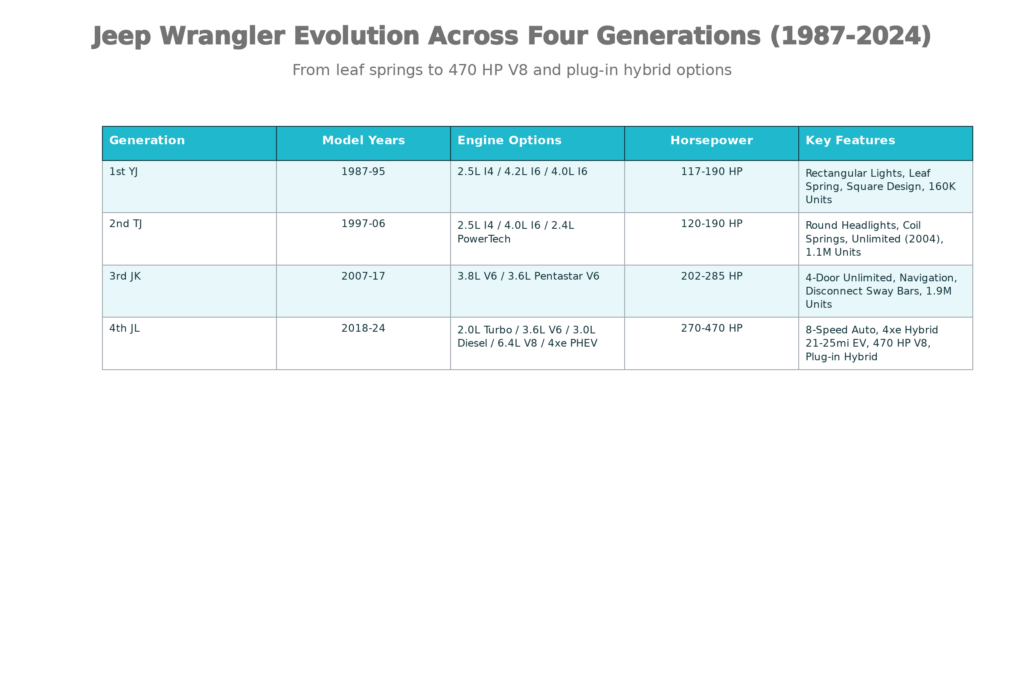
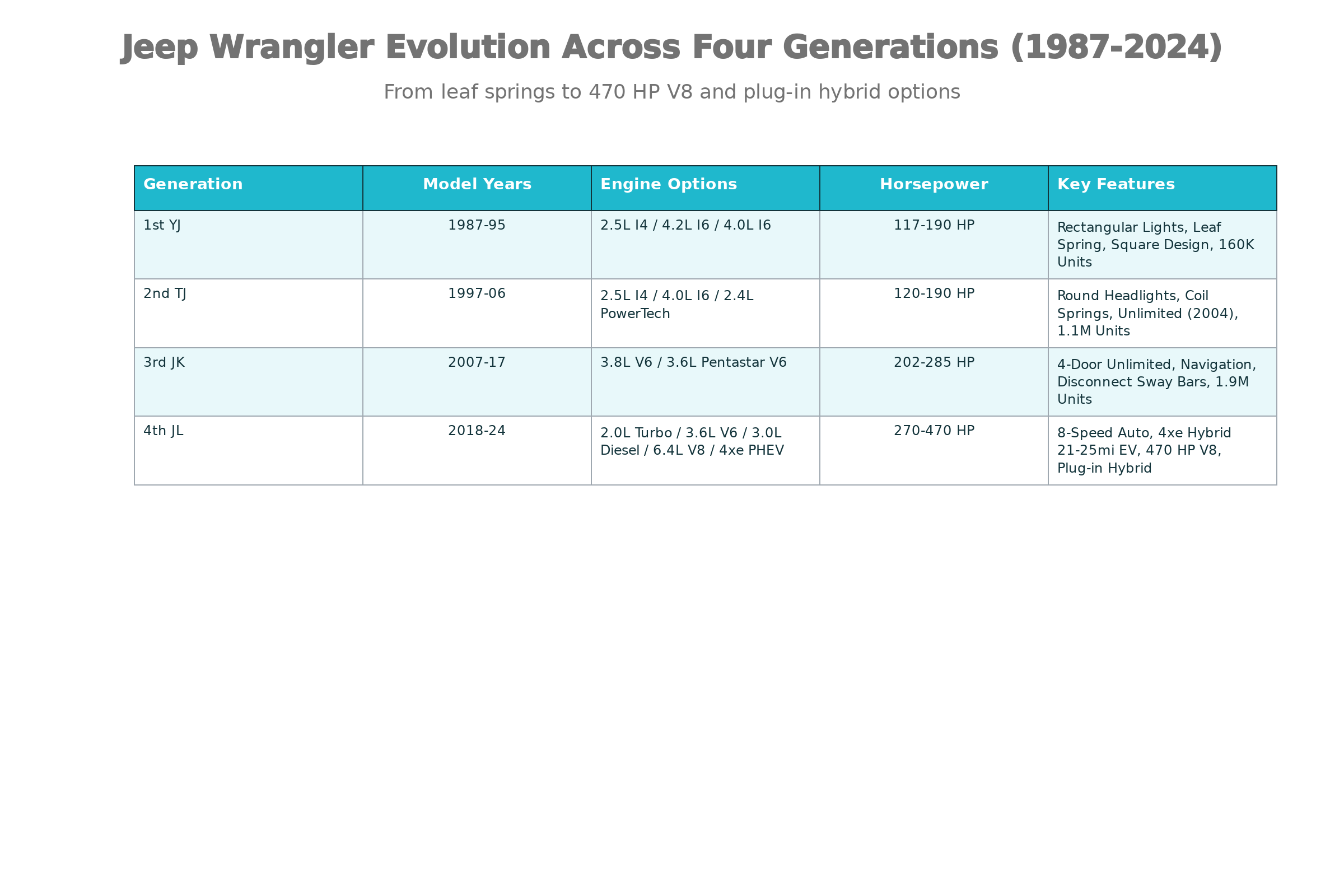
The first model officially designated as a “Wrangler” debuted in 1987 as the YJ generation, representing American Motors Corporation’s comprehensive redesign of the aging CJ platform. Recognizing that customer preferences were shifting toward greater on-road comfort, improved reliability, and contemporary safety features, AMC engineers substantially reconceived the Wrangler while preserving the fundamental characteristics that defined Jeep identity: solid axles, open-air capability, removable doors, fold-flat windshield, and unapologetic off-road engineering.
The YJ generation introduced distinctive styling cues that remain instantly recognizable: square, dual-round headlights mounted in a grille that evoked earlier military heritage while announcing contemporary design sensibilities. Under the simplified exterior, the YJ retained leaf-spring suspension sourced from the aging CJ platform while incorporating upgraded components from the contemporary Cherokee and even some Renault-sourced components reflecting AMC’s Franco-American partnership. Approximately 630,000 YJ Wranglers were manufactured through 1995, establishing strong market appeal across diverse customer demographics and geographic regions.
Second Generation TJ: The Round Headlights Return (1997-2006)
The second-generation Wrangler TJ arrived in 1997 (with no 1996 model-year offering) as a comprehensive modernization that paradoxically emphasized retro design aesthetics. The most significant change—a return to round headlights—represented a deliberate design choice to restore visual continuity with original Willys heritage while embracing contemporary engineering. The designers replaced every body panel except doors and tailgate, increased overall torsional body stiffness by 100 percent, and stiffened the frame by 15 percent, collectively achieving approximately 33 percent total structural rigidity improvement.
The TJ generation introduced coil-spring suspension inherited from the contemporary Jeep Cherokee, dramatically improving both on-road ride quality and off-road articulation compared to the previous leaf-spring architecture. The drag coefficient was reduced from the soft-top YJ’s 0.65 to 0.58, improving highway fuel economy and reducing wind noise. Remarkably, this generation also introduced dual airbags in the steering wheel and dashboard—genuine safety innovations for a vehicle category that had traditionally prioritized raw capability over passive protection systems. The Wrangler Unlimited variant debuted in 2004, offering an extended wheelbase configuration with two rear doors that proved exceptionally popular with families and buyers prioritizing interior versatility.
Third Generation JK: Four-Door Versatility Arrives (2007-2018)
The third-generation Wrangler JK, introduced in 2007, represented perhaps the most consequential generational transformation: the introduction of a genuine four-door configuration offered alongside the traditional two-door platform. The longer wheelbase (102.4 inches for four-door models) accommodated a third and fourth row of actual seating, transforming the Wrangler from a two-person primary vehicle occasionally carrying rear passengers into a legitimate family transport solution. This expansion coincided with broader market shifts, as SUV segment leaders increasingly offered four-door configurations to capture mainstream family demographics.
The JK generation also introduced significantly improved interior comfort, modern convenience technologies, and substantially more sophisticated suspension systems. The Rubicon trim debuted as the ultimate factory off-road package, offering premium Dana 44 front and rear axles, electronic locking differentials, electronic sway-bar disconnect systems, and a 4:1 low-range transfer case enabling exceptional rock-crawling capability. Contemporary JK sales volumes demonstrated this generation’s broad market acceptance, establishing the Wrangler as a mainstream product offering rather than a specialized off-road vehicle.
Fourth Generation JL: Modern Technology Meets Heritage (2018-Present)
The contemporary JL generation, launched for the 2018 model year, represents the current evolutionary apex of Wrangler development. The redesign introduced fresh exterior styling maintaining iconic proportions while embracing contemporary design language, lightweight aluminum doors and hood reducing curb weight and improving efficiency, and fully modern interior technology including touchscreen infotainment systems, advanced digital instrument clusters, and sophisticated driver assistance capabilities approaching semi-autonomous levels.
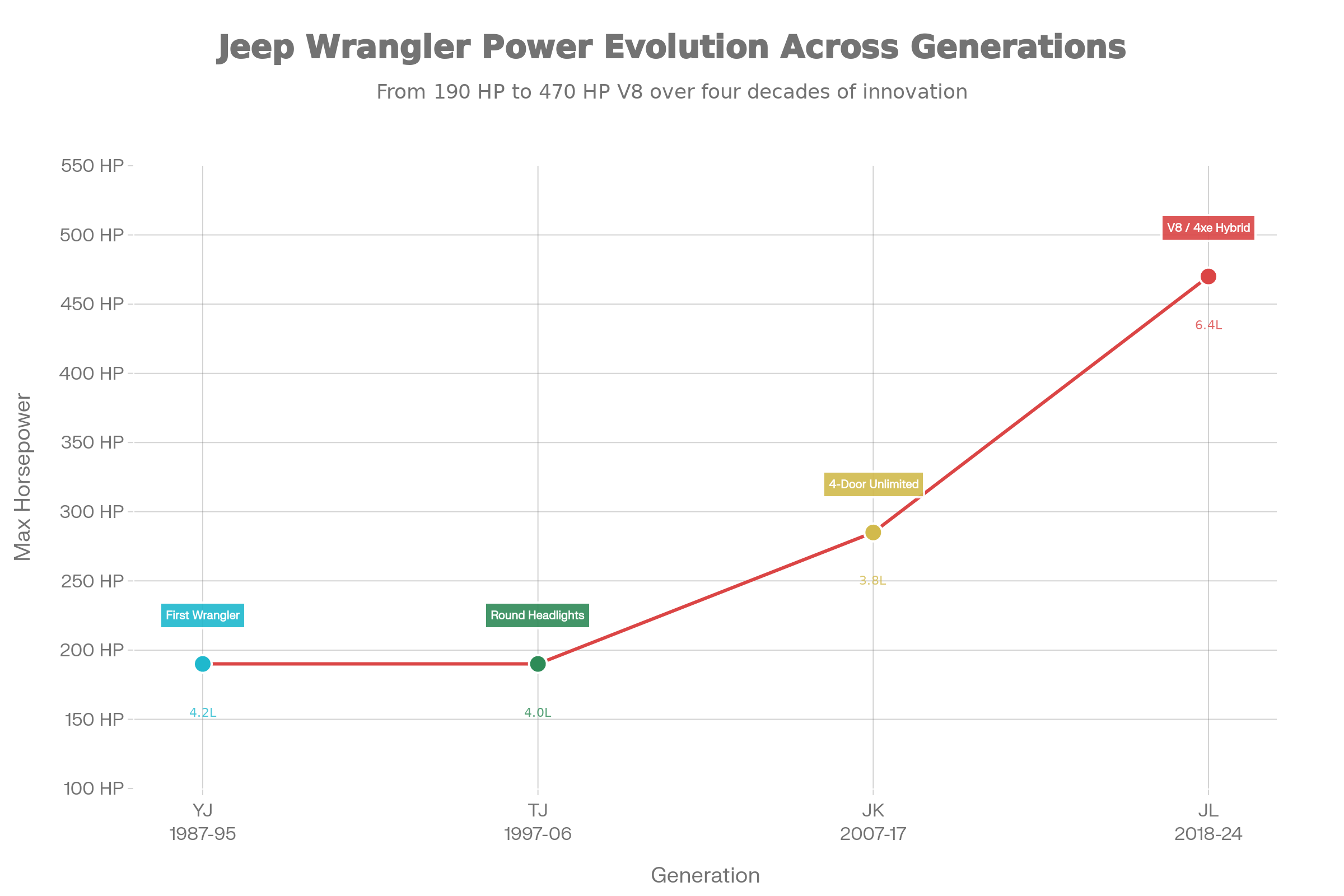
The JL generation encompasses unprecedented powertrain diversity. The standard 3.6-liter Pentastar V-6 produces 285 horsepower, an optional 2.0-liter turbocharged four-cylinder delivers 270 horsepower with improved torque and efficiency characteristics, and for 2022, the legendary Rubicon 392 variant returned a V-8 option for the first time in approximately four decades. Additionally, the Wrangler 4xe plug-in hybrid variant, introduced in 2021, combines a turbocharged four-cylinder engine with electric motors, battery storage, and sophisticated power management systems to deliver exceptional all-electric range for daily commuting alongside traditional gasoline range for extended adventures.
Powertrain Evolution and Engine Lineage
The Original “Go-Devil” Four-Cylinder Foundation
The original 1941 Willys MB employed a humble 2.2-liter, naturally aspirated inline four-cylinder engine designated the “Go-Devil,” producing just 60 horsepower—remarkable mechanical simplicity that emphasized reliability over raw performance. This engine survived through decades of CJ variants, providing dependable power through successive displacement increases to 2.4, 2.5, and ultimately 2.8 liters while maintaining fundamental mechanical simplicity. The straightforward design enabled owner maintenance with minimal specialized tools, establishing a mechanical philosophy that persists through contemporary Wrangler development.
The Contemporary 3.6-Liter Pentastar V-6
Modern Wranglers continue the tradition of engine simplicity through the Pentastar V-6, a straightforward naturally aspirated design producing 285 horsepower and 260 pound-feet of torque. This engine pairs exclusively with a six-speed manual transmission in base configurations, though an eight-speed automatic is available on higher trim levels. The Pentastar’s legacy extends across diverse Chrysler Group products, establishing proven reliability and modest fuel economy balanced against consistent performance delivery.
The 2.0-Liter Turbocharged Hurricane Four-Cylinder
The 2.0-liter turbocharged “Hurricane” inline four-cylinder represents modern turbocharging technology applied to compact engine architecture. Producing 270 horsepower and 295 pound-feet of torque, the turbocharged engine delivers superior low-end torque response compared to the naturally-aspirated V-6 while achieving improved highway fuel economy. The turbo engine pairs exclusively with an eight-speed automatic transmission, benefiting from sophisticated electronic controls optimizing boost pressure across varying operating conditions. This engine emphasizes driver engagement through responsive throttle response while maintaining the fuel efficiency increasingly demanded by contemporary consumers.
The 6.4-Liter HEMI V-8: The 392 Returns
The 2021 introduction of the Wrangler Rubicon 392 marked the dramatic return of V-8 power to the Wrangler after nearly 40 years of absence. The 6.4-liter HEMI engine, proven through years of service in Dodge Charger and Challenger Scat Pack variants, produces 470 horsepower and an astonishing 470 pound-feet of torque—matching or exceeding the plug-in hybrid variant’s torque output despite fundamentally different mechanical philosophies. Nearly 75 percent of peak torque is available at engine idle speed, enabling the Wrangler 392 to achieve 4.5-second 0-60 mph acceleration while simultaneously delivering exceptional rock-crawling capability at engine idle speeds through the sophisticated 48:1 crawl ratio.
The HEMI V-8’s abundant low-speed torque, combined with engine braking and unique torque converter locking strategies, enables confident grade negotiation at idle speeds that four and six-cylinder variants require continuous throttle modulation to accomplish. The engine produces a distinctive aggressive exhaust note, delivering visceral emotional connection that contemporary buyers increasingly value alongside measured performance metrics.
The 4xe Plug-In Hybrid: Electric Capability Without Range Anxiety
The Wrangler 4xe plug-in hybrid variant combines a 2.0-liter turbocharged four-cylinder engine with dual electric motors and a 17-kilowatt-hour lithium-ion battery pack installed beneath the rear seat. This sophisticated powertrain delivers a combined 375 horsepower and 470 pound-feet of torque—matching the V-8 variant’s peak torque output through electric assistance at low engine speeds. Three selectable operating modes—Hybrid (combining engine and electric power), Electric (running on battery power alone for up to 21 miles on full charge), and eSave (preserving battery charge for later deployment)—accommodate diverse driving scenarios from urban commuting through remote off-road exploration.
The plug-in hybrid approach fundamentally differs from conventional hybrids: the engine serves as a power source rather than the default propulsion method. This strategic decision prioritizes off-road capability—the transmission-mounted electric motor can distribute power directly to all four wheels regardless of engine operation, maintaining trail performance characteristics equivalent to gasoline-powered variants. Regenerative braking during downhill travel and engine braking during descents recover energy that conventional vehicles dissipate as heat, improving overall efficiency while maintaining authentic Jeep rock-crawling dynamics.
Design and Generational Aesthetics
The Wrangler’s design language remains instantly recognizable across all five generations, with each iteration balancing contemporary styling influences against the preservation of fundamental visual characteristics that define Jeep identity. The distinctive seven-slot grille—originating from the original Willys MB (which featured nine slots before postwar civilian variants reduced the count to seven)—appears on every Wrangler generation. The pronounced hood, flared fenders, tapering nose, and abbreviated rear overhang create proportions that remain mechanically purposeful while visually communicating off-road capability.
Strategic evolution rather than revolutionary transformation characterizes each generational transition. The YJ’s square headlights announced the model’s arrival as a modern design; the TJ’s return to round headlights reconnected with Willys heritage; the JK’s subtle refinements and contemporary proportions acknowledged contemporary design language while preserving iconic identity; and the JL’s fresh styling incorporating LED lighting technology and contemporary digital design elements maintains recognizable Wrangler proportions while embracing modern aesthetic sensibilities.
Production Scale and Global Sales Performance
Five Million Unit Achievement
In August 2023, Jeep announced the production of the five-millionth Wrangler since the model debuted in 1987, a 2023 Wrangler Rubicon 4xe variant delivered to a customer in New Jersey. This milestone achievement underscores the Wrangler’s unprecedented market longevity and sustained consumer enthusiasm across four decades of continuous production. The brand emphasized that over 80 percent of all five million Wranglers manufactured remain in active operation, demonstrating exceptional durability and the vehicle’s remarkable staying power compared to competitors with shorter operational lifespans.
The five-millionth unit coincided with the introduction of the new fifth generation 2024 Wrangler model, which Jeep designated as an updated variant of the JL platform rather than a completely new generational departure. This mid-cycle refresh approach reflects the JL generation’s continued market success and evolutionary optimization strategy rather than requiring comprehensive redesign.
Contemporary Sales Performance
The Wrangler’s sales trajectory reflects evolving market dynamics. During the JL generation’s first full year in 2018, Jeep delivered 240,032 Wranglers—a peak that established the model as a genuine mainstream SUV. Sales remained robust through 2019 (228,042 units) but declined in subsequent years as the COVID-19 pandemic disrupted automotive supply chains and consumer preferences shifted toward alternative vehicle categories. Recent years witnessed contraction: 2024 sales reached approximately 151,164 units, the lowest annual total since 2011, though the four-door Unlimited variant continued capturing substantial market share.
2025 performance demonstrated stabilization and renewed momentum: Q2 2025 sales increased 26 percent compared to Q1, with the Wrangler 4xe plug-in hybrid variant experiencing 38 percent quarter-over-quarter growth. Full-year 2025 projections suggest annual sales may approach 200,000 units—substantial volume that firmly establishes the Wrangler as the segment’s second-best-selling off-road vehicle behind the Ford Bronco, which delivered approximately 109,172 units in 2024.
Contemporary Variants and Model Range
Two-Door and Four-Door Configurations
The contemporary Wrangler lineup offers both two-door and four-door body styles, each addressing distinct customer demographics and preferences. The traditional two-door Wrangler emphasizes compact proportions, reduced wheelbase, and the distinctive open-air experience that original Jeep enthusiasts cherish. The four-door Wrangler Unlimited, with its extended 118.4-inch wheelbase compared to the two-door’s 96.8-inch dimension, provides genuine rear-seat comfort, expanded cargo capacity, and four-door accessibility that appeals to families and commuters requiring daily practicality alongside performance capability.
The Rubicon 392: Peak Performance
The Wrangler Rubicon 392 represents the ultimate expression of Wrangler performance capability, combining the 470-horsepower HEMI V-8 with rock-crawling components including premium Dana 44 front and rear axles, electronic locking differentials, electronic sway-bar disconnect systems, and a comprehensive Xtreme 35 package featuring 35-inch all-terrain tires on 17-inch beadlock-capable wheels. The 392 designation honoring the 392 cubic-inch displacement establishes nostalgic connection to Chrysler’s legendary big-block performance heritage.
The Rubicon 392 achieves extraordinary performance metrics: 0-60 mph acceleration in 4.5 seconds, quarter-mile completion in 13.0 seconds, and top speed of 109 miles per hour. Simultaneously, the abundant low-end torque and sophisticated suspension geometry enable commanding grade negotiation at engine idle speeds that would require constant driver input on conventional variants. This unique combination—genuine supercar-equivalent acceleration merged with legendary rock-crawling capability—distinguishes the Rubicon 392 as potentially the most versatile high-performance vehicle available to consumers.
The 4xe Plug-In Hybrid: Zero-Emission Urban Capability
The Wrangler 4xe offers a fundamentally different performance philosophy emphasizing environmental responsibility merged with authentic off-road capability. Up to 21 miles of electric-only range accommodates most daily commutes without engine operation, while the turbocharged four-cylinder engine ensures extended range for weekend adventures. The plug-in hybrid variant delivers impressive performance metrics: 49 miles-per-gallon equivalent combined efficiency, zero tailpipe emissions in electric mode, and the ability to operate entirely on battery power for complete daily commutes through urban environments.
Importantly, the Wrangler 4xe’s dual-motor configuration maintains full all-wheel-drive capability even during pure electric propulsion. The transmission-mounted electric motor distributes power directly to the driveline, enabling sophisticated electronic controls to manage traction across diverse terrain without engine operation. This strategic design ensures the 4xe variant loses no off-road capability compared to gasoline-powered alternatives, addressing primary concerns from enthusiasts skeptical of electrification’s compatibility with authentic Jeep performance.
Motorsport Legacy and Competitive Pedigree
While the Wrangler does not compete in formal motorsport series as extensively as performance variants from competing manufacturers, the model has achieved notable success in informal off-road competitions and specialized racing disciplines. Wrangler variants have achieved repeated victories in rock-crawling competitions, extreme terrain navigational events, and specialized off-road racing series emphasizing technical driving ability over pure horsepower delivery. The Rubicon variant, named after the Rubicon Trail—one of North America’s most challenging recreational off-road routes—represents both the vehicle’s namesake inspiration and its design philosophy emphasizing practical trail performance over laboratory performance metrics.
Future Direction and Electrification Strategy
Jeep has confirmed commitment to maintaining combustion-powered Wrangler options through at least 2030, with hybrid and plug-in hybrid variants representing the primary electrification approach rather than wholesale transition to pure electric vehicles. The brand previously revealed the Jeep Magneto Concept—an all-electric two-door Wrangler conceptual study featuring 70-kilowatt-hour battery capacity distributed throughout the frame architecture, a single 212-kilowatt central electric motor, and sophisticated power distribution systems enabling authentic four-wheel-drive capability.
This strategic approach acknowledges that the Wrangler’s core appeal derives from mechanical engagement, authentic off-road performance, and the emotional connection generated through engine sound and visceral acceleration—characteristics that conventional electric powertrains cannot perfectly replicate through synthetic amplification or predetermined acceleration programs. By maintaining gasoline and hybrid options, Jeep positions the Wrangler for evolutionary transition rather than revolutionary replacement, preserving the nameplate’s fundamental character across future electrified variants.
The Bottom Line
The Jeep Wrangler’s extraordinary eight-decade journey from a 1941 military necessity through contemporary mainstream consumer acceptance represents one of automotive history’s most impressive generational success stories. Over five million examples manufactured since 1987, combined with the estimated 80 percent of vehicles remaining in active operation, establish the Wrangler as a vehicle of remarkable durability, proven reliability, and enduring desirability across vastly different consumer demographics and global markets. The nameplate’s ability to balance evolutionary technological advancement against preservation of fundamental off-road design principles demonstrates sustained commitment to authenticity transcending industry trends.
Contemporary Wrangler variants—encompassing traditional naturally-aspirated six-cylinders, turbocharged four-cylinder efficiency, plug-in hybrid electric capability, and returning eight-cylinder performance—represent unprecedented powertrain diversity acknowledging diverse consumer preferences regarding propulsion philosophy, performance characteristics, and environmental responsibility. The Rubicon 392 variant establishes that raw performance need not compromise off-road capability, while the 4xe plug-in hybrid demonstrates that electrification can enhance rather than diminish authentic Jeep character.
As automotive markets transition toward electrification and autonomous technologies, the Wrangler’s continued relevance and sustained sales growth demonstrate that customer desire for open-air freedom, mechanical engagement, and genuine off-road capability possesses enduring appeal transcending technological fashions. The Wrangler stands as proof that vehicles celebrating fundamental driving pleasure—the unfiltered interaction between driver and machine navigating challenging terrain—remain genuinely desirable regardless of industry predictions regarding autonomous vehicles and comprehensive electrification. The legendary Jeep will continue evolving, embracing contemporary technology while preserving the essential characteristics that transformed a wartime military necessity into a peacetime automotive icon cherished by adventurous consumers worldwide.