Quick Facts:
First Year: 1972 | Units Sold: 27+ Million | Country: Japan | Creator: Honda Motor Company
Introduction
The Honda Civic represents one of the most remarkable success stories in automotive history. Introduced in July 1972, this compact car revolutionized the industry by proving that a small, efficient vehicle could be both practical and desirable on a global scale. With over 27 million units sold across 11 generations spanning more than five decades, the Civic has become an engineering marvel and cultural phenomenon. It transformed Honda from a motorcycle manufacturer into a world-class automotive company, establishing benchmarks for reliability, efficiency, and driving enjoyment that continue to influence the industry today. The Civic’s evolution reflects automotive progress itself—from the fuel-crisis era to the age of electrification, from basic transportation to high-performance variants. Its influence extends far beyond sales figures; the Civic became a canvas for enthusiasts, an icon in popular culture, and a symbol of Japanese automotive excellence during a critical period of global growth.
Key Significance: The Civic proved that compact cars could offer world-class quality and sophistication, establishing Honda as a global automotive leader and creating a template for compact car design that remains influential nearly 50 years later.
Origins & Early Years
The Birth of an Icon
The Honda Civic emerged from a critical moment in Honda’s history. In the early 1970s, the company’s four-wheeled vehicle division was on the brink of collapse following the commercial failure of the Honda 1300. Desperate to save the automotive operation, Honda’s leadership tasked two separate development teams with creating an ideal compact car that could compete globally. Using what would become Honda’s signature “free-competition approach,” these independent teams—one led by veteran engineers and another comprising younger engineers—were challenged to develop a car that would be “light, quick, and compact.” Remarkably, when the teams presented their independent concepts, they arrived at virtually identical solutions, validating the fundamental vision. The project was handed to Tadashi Kume and later Kizawa as the lead project leader. The resulting car was named “Civic,” meaning “a car created for citizens and cities,” reflecting its intended purpose as an urban vehicle for everyday drivers.
Revolutionary Features
The 1972 Civic introduced radical innovations that distinguished it from established competitors. Rather than following the conventional FR (front-engine/rear-wheel drive) format used by most Japanese compact cars, Honda engineers committed to the FF (front-engine/front-wheel drive) layout with a transverse-mounted engine. This architectural decision maximized interior space while minimizing overall dimensions. Equally revolutionary was the adoption of CVCC (Compound Vortex Controlled Combustion) technology—a direct injection system that allowed the engine to meet strict American emission standards without sacrificing performance or fuel efficiency. The first Civic rolled off the line with a 1,169 cc water-cooled four-cylinder engine producing 75 horsepower, combined with front power disc brakes, reclining vinyl bucket seats, and available air conditioning and AM/FM radio. The distinctive three-door hatchback styling, with its trapezoidal profile and integrated trunk space, was intentionally unconventional. This design—initially questioned by some within Honda—became the car’s signature aesthetic and symbol of its progressive character.
Initial Reception
The Civic’s market reception exceeded all expectations. The car achieved unprecedented critical acclaim, winning Japan’s Car of the Year award for three consecutive years (1972, 1973, 1974)—the first vehicle ever to accomplish this feat. In Canada, the Civic dominated import car sales for 28 consecutive months from 1976 through 1978. This explosive success was driven by the car’s exceptional combination of attributes: remarkable fuel efficiency during the global oil crisis, genuinely reliable construction that challenged prevailing perceptions about Japanese automotive quality, and sophisticated engineering in an affordable package. In the United States, the Civic established Honda as a legitimate automaker, paving the way for the brand’s subsequent dominance in American markets. The car’s success was so significant that it essentially saved Honda’s automobile division and set the trajectory for the company’s evolution into a global automotive powerhouse.
Generational Breakdown
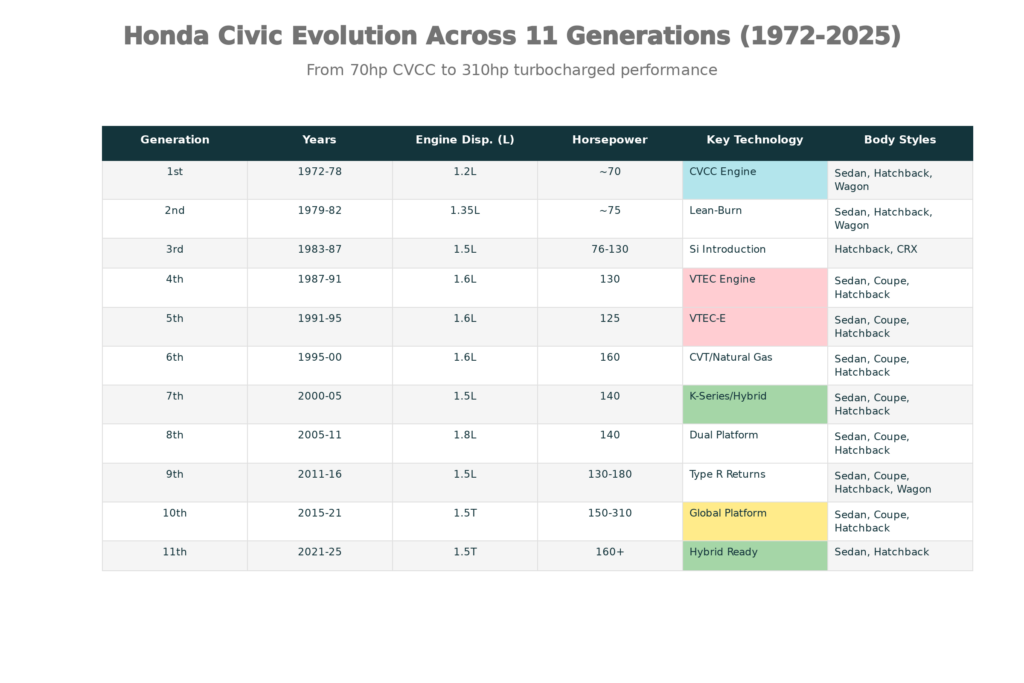
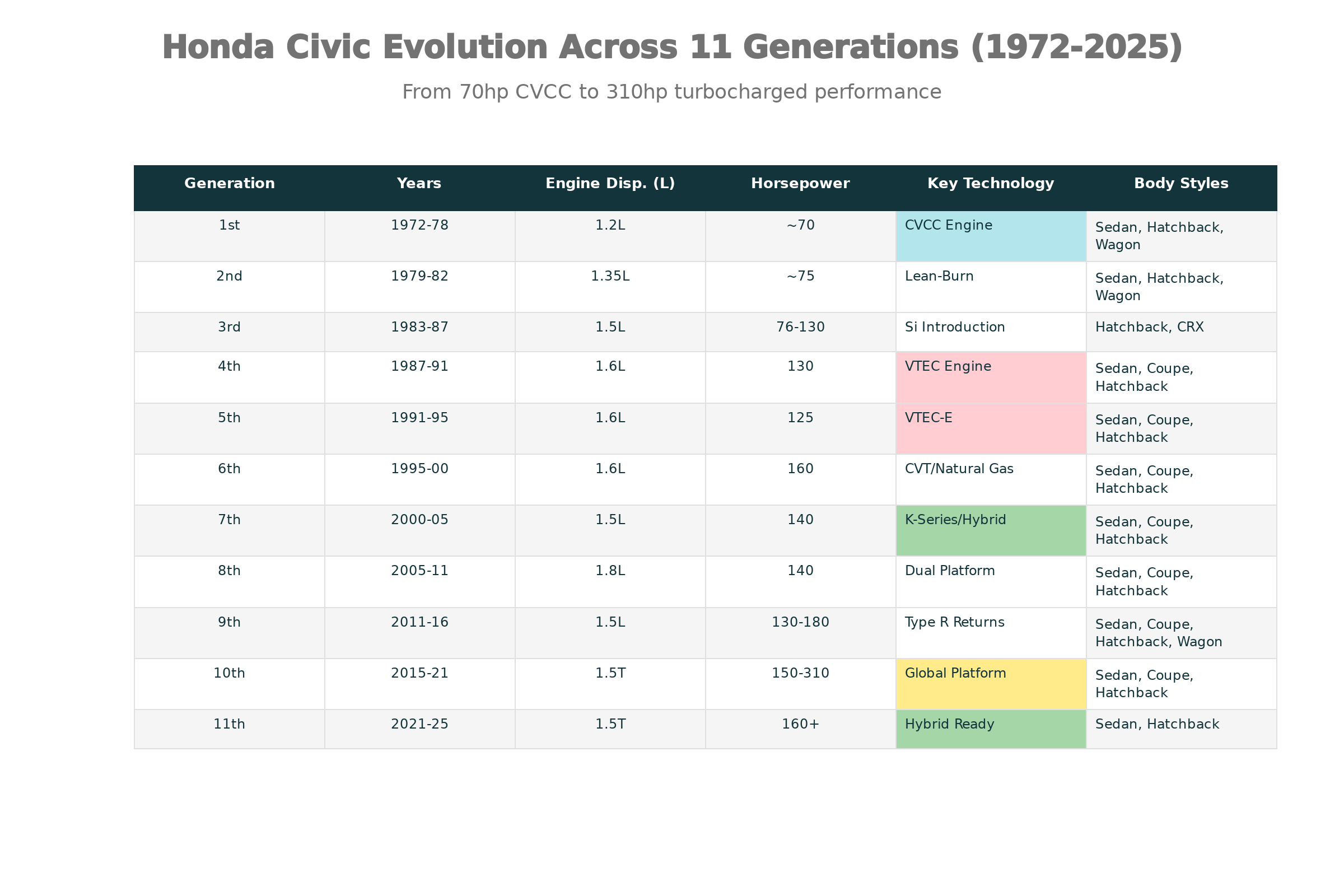
The Honda Civic has evolved through 11 generations, each bringing substantial improvements while maintaining the core philosophy of delivering maximum value and performance in a compact package. Each generation reflects the technological capabilities and consumer preferences of its era, yet the fundamental virtues of the original remain.
Generation 1: 1972-1979
The original Civic set the template for all successors. Launched with a 1,169 cc engine producing 75 horsepower in base form and 76 horsepower in the RS variant, it could accelerate from 0-60 mph in approximately 12.5-13 seconds and achieve a top speed near 110 mph. The car was available as a two-door fastback sedan (initially) and three-door hatchback. By 1975, the revolutionary CVCC engine arrived, adding a third valve per cylinder and lean-burn swirl combustion technology that allowed the Civic to exceed U.S. emission standards without losing performance. Optional engines grew to include 1.3-liter (63 horsepower) and 1.5-liter (72 horsepower) variants. Four-speed manual transmissions came standard on base models, with five-speed manual and two-speed Hondamatic semi-automatic options available. The first-generation established Honda’s reputation for engineering excellence, proving that a car could be affordable, efficient, reliable, and fun to drive simultaneously.
| Specification | Details |
|---|---|
| Engine | 1,169 cc CVCC 4-cylinder |
| Horsepower | 60-76 hp |
| 0-60 Time | 12.5-13 seconds |
| Top Speed | ~110 mph |
| Transmission | 4 or 5-speed manual |
| Production Years | 1972-1979 |
Generation 2: 1980-1983
The second-generation Civic arrived in 1979 (sold as 1980 model) with significant growth and refinement. The car became noticeably larger, featuring a more angular design that improved aerodynamics and interior space. All engines now used CVCC technology with lean-burn combustion. A 1,335 cc engine producing 67 horsepower became the base offering, with an optional 1,488 cc variant generating 75 horsepower. Transmission options expanded to include four-speed manual (base models), five-speed manual, and the two-speed Hondamatic semi-automatic. The second generation was available as three-door hatchback, four-door sedan, five-door hatchback, and five-door wagon, offering unprecedented bodystyle diversity. Most significantly, Honda introduced the CRX during this generation—a compact, lightweight two-seat coupe that would become a legend in its own right. The Civic continued to dominate global markets, establishing itself as the default choice for buyers seeking reliability without sacrificing practicality.
| Specification | Details |
|---|---|
| Engine | 1.3L or 1.5L CVCC 4-cylinder |
| Horsepower | 67-75 hp |
| 0-60 Time | 11-12 seconds |
| Top Speed | ~115 mph |
| Key Improvements | More angular styling, improved HVAC, CRX coupe variant |
| Production Years | 1980-1983 |
Generation 3: 1984-1987
The third-generation Civic (1983-1987) continued Honda’s tradition of thoughtful refinement. The wheelbase increased to 96.5 inches, allowing improved interior space while maintaining the compact footprint. Engine options expanded dramatically with the introduction of the fuel-injected 1.5-liter variant and the iconic 1.6-liter Si model, featuring a 1.6-liter DOHC engine producing 133 horsepower—an extraordinary figure for a compact car of that era. The Si introduced in 1984 represented the first truly performance-oriented Civic variant. Bodystyles included three-door hatchback, four-door sedan, four-door “Shuttle” wagon, and the two-seat CRX coupe. For 1986, the Civic received flush-mounted headlights as a styling update. In 1987, the four-wheel-drive wagon received an innovative real-time four-wheel-drive system with automatic viscous coupling. This generation established the template for the Civic Si lineage that would define performance-minded Civics for decades.
| Specification | Details |
|---|---|
| Engine | 1.3L-1.6L DOHC 4-cylinder |
| Horsepower | 60-133 hp (Si) |
| 0-60 Time | 10-13 seconds |
| Top Speed | ~125 mph (Si) |
| Key Innovations | Si performance variant, 4WD wagon, fuel injection |
| Production Years | 1984-1987 |
Generation 4: 1988-1991
The fourth-generation Civic (1987-1991) introduced revolutionary technologies that would define performance cars for years to come. Critically, Honda introduced VTEC (Variable valve Timing and lift Electronic Control) technology, which debuted on the legendary 1.6-liter SiR model producing 160 horsepower in Japan. This groundbreaking technology allowed the engine to run economically at low speeds using one camshaft profile, then automatically switch to a high-performance profile at higher RPMs, delivering unprecedented power from a naturally-aspirated 1.6-liter engine. The American Si received a 1.6-liter DOHC 16-valve engine rated at 108 horsepower. The base 1.5-liter engine produced 92 horsepower, while the top-spec SiR delivered 150-160 horsepower depending on market. The suspension featured a new double-wishbone design in front with independent rear suspension. The wheelbase grew to 98.4 inches. A minor facelift in 1989 updated exterior styling. The fourth generation established the Civic Type R/Si lineage as serious performance machines.
| Specification | Details |
|---|---|
| Engine | 1.5L-1.6L DOHC VTEC 4-cylinder |
| Horsepower | 108-160 hp (SiR) |
| 0-60 Time | 8.1-10 seconds |
| Top Speed | ~140 mph |
| Key Innovations | VTEC engine technology debuts, double-wishbone suspension |
| Production Years | 1988-1991 |
Generation 5: 1992-1995
The fifth-generation Civic (1991-1995) continued VTEC refinement with available 1.5-liter and 1.6-liter engines. The Si and EX models received the 1.6-liter variant with 125 horsepower, while lower trims used 1.5-liter engines producing 102 horsepower. The body grew larger while maintaining the compact proportions. Bodystyles expanded to include sedan, coupe, hatchback, and wagon variants. This generation introduced the accessible performance of the Si to broader audiences, establishing it as an aspirational model for enthusiasts. Safety systems improved with available ABS on premium models. The dashboard was redesigned with better ergonomics and improved climate control. This generation witnessed the beginning of the tuning culture that would eventually make the Civic a canvas for personalization.
| Specification | Details |
|---|---|
| Engine | 1.5L or 1.6L VTEC 4-cylinder |
| Horsepower | 102-125 hp |
| 0-60 Time | 8.5-9.5 seconds |
| Top Speed | ~130 mph |
| Key Improvements | Refined VTEC, ABS availability, improved interior |
| Production Years | 1992-1995 |
Generation 6: 1996-2000
The sixth-generation Civic (1995-2000) introduced significant styling evolution with a rounder, more refined appearance than its angular predecessor. The Si model gained the 1.6-liter VTEC engine now producing 160 horsepower in some markets. The base models received improved 1.5-liter and 1.6-liter engines with enhanced fuel injection systems. Transmission options expanded with the introduction of continuously variable transmission (CVT) on some models. Safety systems improved with standard dual airbags and optional stability control. Interior refinement advanced with improved sound insulation and better climate control. The sixth generation witnessed further expansion of the tuning subculture, particularly in Japan where the platform became hugely popular. By the end of this generation, the Civic had sold over 16.5 million units worldwide, with 7.3 million in the United States alone.
| Specification | Details |
|---|---|
| Engine | 1.5L-1.6L VTEC 4-cylinder |
| Horsepower | 106-160 hp (Si) |
| 0-60 Time | 7.5-9 seconds |
| Top Speed | ~135 mph |
| Key Innovations | CVT introduction, improved styling, enhanced safety |
| Production Years | 1996-2000 |
Generation 7: 2001-2005
The seventh-generation Civic (2000-2005) represented a revolutionary design leap. Interior space increased dramatically through a flat rear floor design while exterior dimensions remained similar to the previous generation. The chassis switched from double-wishbone to MacPherson strut front suspension to reduce costs and improve engine bay space. Most significantly, Honda introduced the K-series engine family, replacing the legendary D-series. The base 1.3-liter four-cylinder produced 115 horsepower, while the available 1.7-liter generated 127 horsepower. Most importantly, 2003 saw the introduction of the Civic Hybrid, Honda’s first production hybrid vehicle. Featuring a 1.3-liter gasoline engine paired with electric motors, the Hybrid produced a combined 93 horsepower and achieved remarkable 46 mpg city / 51 mpg highway fuel economy. The Si returned with a turbocharged 1.6-liter DOHC engine producing 140 horsepower in European markets. The fourth consecutive Car of the Year Japan award confirmed the generation’s excellence. This generation established Honda as an innovator in hybrid technology.
| Specification | Details |
|---|---|
| Engine | 1.3L-1.7L K-series 4-cylinder |
| Horsepower | 115-127 hp (gas); 93 hp (hybrid) |
| 0-60 Time | 9-10 seconds |
| Top Speed | ~125 mph |
| Key Innovations | Civic Hybrid debuts, K-series engine, improved interior space |
| Production Years | 2001-2005 |
Generation 8: 2006-2011
The eighth-generation Civic (2005-2011) continued the refined K-series engine lineup with 1.3-liter (100 hp), 1.5-liter (115 hp), and 1.8-liter (140 hp) variants. The Si received a 2.0-liter naturally-aspirated K20Z engine producing 201 horsepower and 152 lb-ft of torque. The Hybrid returned with improved performance, now producing 110 horsepower combined. Styling became more angular and aggressive, reflecting contemporary design trends. The chassis further evolved with improved suspension tuning and steering feedback. Safety systems advanced with the introduction of Honda Sensing on some models. The eighth generation witnessed explosive growth in the tuning subculture, particularly following the cultural impact of The Fast and the Furious film franchise, which featured modified Civics prominently. By this point, the Civic had become the most tuned and modified car in the world.
| Specification | Details |
|---|---|
| Engine | 1.3L-1.8L K-series 4-cylinder |
| Horsepower | 100-201 hp (Si) |
| 0-60 Time | 7-8.5 seconds (Si) |
| Top Speed | ~140 mph (Si) |
| Key Improvements | 2.0L Si engine, improved Hybrid, angular styling |
| Production Years | 2006-2011 |
Generation 9: 2012-2015
The ninth-generation Civic (2011-2015) arrived during the global financial crisis. Initially developed with the expectation that consumers would demand affordability over luxury, the Civic emerged as a remarkable value proposition. Engine options included 1.8-liter (140 hp) and hybrid variants (110 hp combined). The Si received a turbocharged 1.6-liter producing 205 horsepower. Styling became sleeker with a longer body. The interior featured improved materials and technology. Safety systems continued advancing with more comprehensive Honda Sensing deployment. This generation proved that even during economic uncertainty, the Civic’s core virtues of reliability, efficiency, and value remained compelling.
| Specification | Details |
|---|---|
| Engine | 1.8L K-series or 1.6L turbo 4-cylinder |
| Horsepower | 140-205 hp (Si) |
| 0-60 Time | 7-8 seconds (Si) |
| Top Speed | ~140 mph (Si) |
| Key Innovations | Turbocharged Si, refined Hybrid |
| Production Years | 2012-2015 |
Generation 10: 2016-2021
The tenth-generation Civic (2015-2021) brought dramatic styling and engineering evolution. The platform adopted a new 2.0-liter K20C2 naturally-aspirated engine producing 158 horsepower alongside a 1.5-liter turbocharged variant (174-180 hp). The Type R debuted in this generation with a turbocharged 2.0-liter producing 306 horsepower, featuring a manual transmission and aggressive aerodynamics. A facelift in 2019 introduced revised front-end styling and made Honda Sensing standard on all models. The tenth generation achieved remarkable critical acclaim, establishing the Civic as a serious contender against European competitors. The Type R specifically earned praise as one of the finest hot hatches ever created. Bodystyles included sedan, coupe, and hatchback. This generation reestablished the Civic as a driver-focused machine that could genuinely excite enthusiasts.
| Specification | Details |
|---|---|
| Engine | 2.0L K20C2 or 1.5L turbocharged 4-cylinder |
| Horsepower | 158-306 hp (Type R) |
| 0-60 Time | 5.8-7.5 seconds (Type R) |
| Top Speed | ~169 mph (Type R) |
| Key Innovations | Type R turbocharged, enhanced Sensing suite |
| Production Years | 2016-2021 |
Generation 11: 2022-Present
The eleventh-generation Civic (2022-present) introduces the most comprehensive powertrain options in model history. The base model features a 2.0-liter K20C4 naturally-aspirated engine producing 150 horsepower (revised for 2025 to 158 hp with improved low-end torque). The Si variant returns with a turbocharged 1.5-liter producing 200 horsepower, featuring manual transmission and rev-matching technology. Most significantly, the 2024 model year saw the return of the Civic Hybrid after a 17-year absence. The new hybrid system features a 2.0-liter Atkinson-cycle engine paired with two electric motors producing a combined 200 horsepower and 232 lb-ft of torque, achieving an estimated 49-50 mpg combined. For 2025, Honda introduced a refreshed front-end design with an enlarged grille and revised headlights. The eleventh generation integrates Google-based infotainment with voice assistant functionality on premium models. The Type R FL5 variant produces 324 horsepower (up from 316 hp) with a 5.4-second 0-60 time and 171 mph top speed. The platform continues Honda’s commitment to driver engagement while embracing electrification.
| Specification | Details |
|---|---|
| Engine | 2.0L naturally-aspirated, 1.5L turbo, or 2.0L hybrid 4-cylinder |
| Horsepower | 158-324 hp (Type R) |
| 0-60 Time | 5.4 seconds (Type R) |
| Top Speed | ~171 mph (Type R) |
| Key Innovations | Civic Hybrid returns, Type R+ power, Google infotainment, electrification |
| Production Years | 2022-Present |
Cultural & Social Impact
In Films and Television
The Honda Civic achieved iconic status in popular culture primarily through its central role in The Fast and the Furious franchise. The 2001 original film featured multiple modified Civics representing the street racing community and tuner culture, with the production sourcing seven black Civic vehicles for key scenes. While these cars received only cosmetic modifications (with a $50 eBay muffler added purely for filming), the visual association between the Civic and high-performance street racing profoundly influenced automotive culture. The film immortalized the Honda Civic as the quintessential tuner car, establishing it as the platform of choice for enthusiasts worldwide. Remarkably, six of the seven Civics from the original film were recycled and repainted for use in the 2005 sequel “2 Fast 2 Furious,” extending their cultural presence. The filmmakers understood the deep roots of the Civic in tuner culture—a movement that predated the film—but The Fast and the Furious brought this underground subculture into mainstream awareness globally.
Celebrity Association
The Civic has maintained an unusually diverse celebrity ownership history, reflecting its appeal across demographic and economic boundaries. From young celebrities purchasing modified versions to established actors appreciating the mechanical engineering, the Civic transcends traditional luxury car hierarchies. The car became particularly significant in hip-hop and rap culture, appearing in music videos and becoming synonymous with street credibility. This cultural association expanded the Civic’s reach beyond traditional automotive enthusiast circles, making it aspirational for audiences far removed from racing communities. The car’s accessibility—offering genuine performance and modification potential at attainable price points—made celebrity ownership feel achievable for average fans, strengthening the emotional connection between brand and audience.
Social Meaning
The Honda Civic represents profound social meaning in contemporary culture. For millions, ownership of a Civic represents achievement and respectability, particularly in markets like India where the Honda City (Civic’s international variant) symbolizes middle-class aspiration. In Western automotive enthusiast circles, the Civic became the universal entry point for car culture—a reliable, affordable platform where young drivers could learn mechanical skills, express creativity through modification, and participate in community events. The car’s reliability meant that modest investments in modifications actually improved performance, democratizing the previously exclusive realm of automotive customization. However, this cultural association also invited criticism, with some viewing over-modified Civics as emblems of reckless driving and poor taste. Nevertheless, the Civic’s association with accessible performance, tuning potential, and authentic car culture remains unmatched among compact cars. It represents the notion that driving enjoyment and mechanical engagement shouldn’t be confined to luxury marques—concepts that fundamentally challenged established automotive hierarchies.
Technological Evolution
The Honda Civic has pioneered numerous technological advancements throughout its nearly five-decade history, evolving from a simple, efficient car into a sophisticated vehicle incorporating cutting-edge systems.
Engine Development
Engine technology represents the Civic’s most dramatic evolution. The original 1.2-liter CVCC four-cylinder producing 75 horsepower featured Honda’s legendary fuel economy and reliability. The revolutionary CVCC technology, which arrived in 1973, employed lean-burn combustion with a third valve per cylinder, allowing the engine to meet strict American emission standards while maintaining performance. Subsequent generations introduced the D-series engine family, known for exceptional reliability and high-revving capability. The fourth-generation introduced VTEC (Variable valve Timing and lift Electronic Control) technology, with the landmark B16A engine producing 160 horsepower from just 1.6 liters—a revolutionary power-to-displacement ratio. The seventh-generation transitioned to the K-series engine family, featuring increased displacement and greater power outputs. The turbocharging era began with the ninth-generation Si, introducing forced induction to the Civic lineup. Today’s engines range from naturally-aspirated 2.0-liter producing 158 horsepower to turbocharged variants delivering 200+ horsepower, culminating in the Type R’s turbocharged 2.0-liter producing 324 horsepower. The return of the hybrid powertrain in 2024 features an advanced two-motor system with 200 horsepower combined output and 49 mpg fuel economy—representing the pinnacle of efficiency engineering.
Safety Systems
Safety technology evolved from the Civic’s original power disc brakes (revolutionary for compact cars in 1972) to today’s comprehensive systems. Early generations featured structural innovations like the ACE (Advanced Compatibility Engineering) body design, which distributes impact forces efficiently. The introduction of dual airbags in the 1990s marked significant progress. By the seventh generation (2001), Honda Sensing became available, beginning with adaptive cruise control and collision warning systems. The eighth generation expanded Sensing capabilities substantially. The tenth generation (2019 facelift) made Honda Sensing standard equipment across the entire Civic lineup, including forward collision warning, adaptive cruise control, lane keeping assist, and lane departure warning. The eleventh generation now includes road departure mitigation, traffic jam assist, and traffic sign recognition. Modern Civics feature eight or more airbags, including side curtain airbags and rollover-sensing rear curtain airbags. Electronic stability control, traction control, and brake assist are universal features. The progression from basic mechanical braking to today’s comprehensive active safety systems represents evolution from passive to predictive safety—the vehicle now actively attempts to prevent accidents rather than simply protecting occupants when collisions occur.
Interior Features
Interior evolution reflects changing consumer expectations and technological capabilities. Early Civics featured vinyl seats, manual windows, and mechanical heating systems—all representing significant content for compact cars at the time. By the 1990s, cloth upholstery became standard, with automatic climate control appearing on upper trims. Power windows and door locks arrived progressively across generations. The seventh generation introduced touchscreen infotainment systems and began standardizing features like cruise control. The tenth generation brought Apple CarPlay and Android Auto compatibility, with 7-inch and 8-inch touchscreens depending on trim level. The current eleventh generation features Google-integrated infotainment on premium models, offering Google Maps navigation, Google Assistant voice control, and seamless smartphone integration. Modern Civics offer heated seats, heated steering wheels, automatic dimming mirrors, wireless phone charging, and ambient interior lighting on upper trims. The transformation from spartan utility to technology-rich environments demonstrates how the Civic evolved from affordable transportation to a vehicle offering technology previously restricted to luxury cars.
Driving Dynamics
Driving dynamics have progressed through distinct eras. The original Civic featured front-wheel drive (revolutionary for compact cars) with a rear drum brake setup, providing excellent agility for city driving. The third generation introduced the double-wishbone suspension on the Si model, improving handling precision. The fourth generation extended double-wishbone to the entire lineup, establishing the Civic as a driver-focused machine. The seventh generation switched to more cost-effective MacPherson struts but refined the geometry to maintain responsive characteristics. The tenth and eleventh generations reintroduced refined double-wishbone front suspension on Si and Type R models, optimizing handling dynamics. Modern Civics feature multi-link rear suspension with sophisticated geometry optimizing both comfort and control. The Si and Type R variants introduce adaptive dampers allowing drivers to select comfort or sport settings, and the newest Type R features a sophisticated dual-axis strut front suspension specifically designed to eliminate torque steer. Electric power steering evolved from the early hydraulic systems to modern versions offering variable assist ratios that provide excellent feedback at highway speeds while reducing steering effort in parking scenarios. The progression from basic mechanicals to electronically-managed suspension and steering systems represents a quiet revolution in how performance is delivered.
Performance & Capabilities
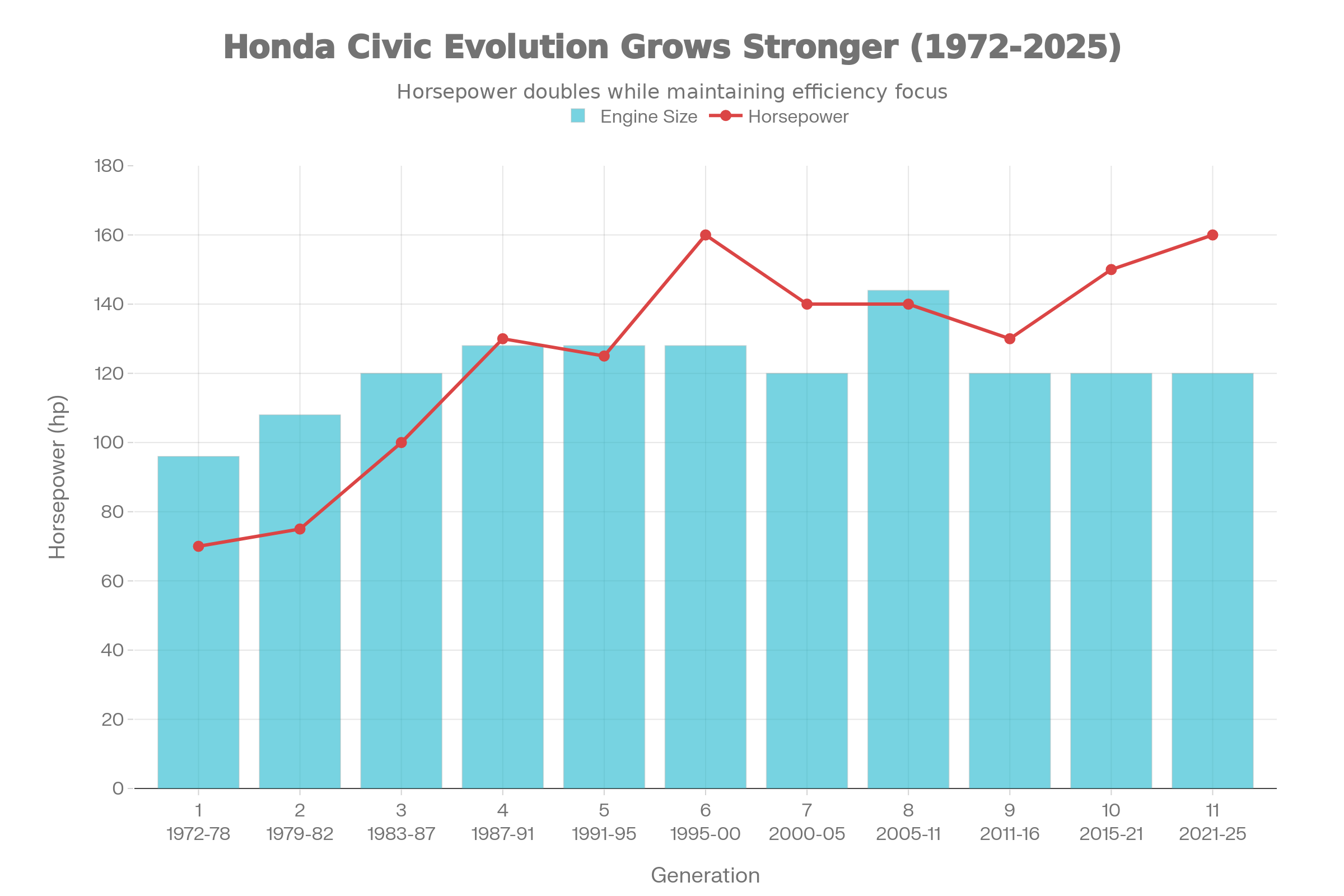
Performance specifications have improved dramatically across the Civic’s generational evolution, reflecting advances in engine technology, transmission sophistication, and chassis engineering.
| Metric | Gen 1 (1972) |
Gen 4 (1990) |
Gen 7 (2003) |
Gen 10 (2019 Si) |
Gen 11 (2025 Type R) |
|---|---|---|---|---|---|
| 0-60 Time | ~13 sec | 8.1 sec | ~10 sec | 6.4 sec | 5.4 sec |
| Top Speed | 110 mph | 140 mph | 125 mph | 140 mph | 171 mph |
| Horsepower | 75 hp | 160 hp | 127 hp | 201 hp | 324 hp |
| Fuel Economy | ~25 mpg | ~23 mpg | ~25 mpg | ~27 mpg | ~24 mpg |
The dramatic acceleration improvement—from 13 seconds to 60 mph in the original to 5.4 seconds in the Type R—represents not merely incremental progress but fundamental advances in engineering. Early Civics achieved their performance through lightweight construction and mechanical efficiency. Fourth-generation Civics introduced VTEC technology allowing high-revving naturally-aspirated engines to compete with turbocharged competitors despite displacement disadvantages. Modern Civics employ turbocharging, advanced fuel injection, variable valve timing, and sophisticated transmission systems to achieve previously unimaginable performance. Remarkably, fuel economy improvements have accompanied these performance gains. The original Civic’s 25 mpg economy, considered exceptional for its era, is now matched by performance variants delivering 15+ times more power. The eleventh-generation Civic Hybrid achieves 49 mpg combined while producing 200 horsepower—figures that would seem impossible to engineers of the 1970s. This efficiency-combined-with-performance represents the culmination of 50 years of engineering refinement and demonstrates how technological progress enables seemingly contradictory objectives: speed and efficiency, performance and economy, engagement and practicality.
Current Generation
What’s Available Today
The 2025 Honda Civic continues the eleventh generation introduced for 2022, offering the most comprehensive powertrain and feature options in model history. The lineup includes three distinct powertrains: a 2.0-liter naturally-aspirated engine (base model), a 1.5-liter turbocharged engine (Si), and a revolutionary 2.0-liter hybrid system. The sedan and hatchback body styles remain available, providing flexibility for different lifestyle needs. The base LX trim includes essential features like a 7-inch touchscreen, Apple CarPlay/Android Auto, Bluetooth connectivity, and Honda Sensing safety suite including collision mitigation braking, adaptive cruise control, lane keeping assist, and lane departure warning. Midrange trims add creature comforts like heated seats, automatic climate control, and enhanced audio systems. Premium trims feature Google-integrated infotainment with Google Maps navigation, wireless phone charging, and premium Bose audio systems. All 2025 models feature a refined front-end design with enlarged grille and revised LED headlights. The hybrid variant specifically attracts efficiency-minded buyers, offering remarkable 49 mpg combined economy alongside genuine performance with 200 horsepower.
Pricing & Variants
| Variant | Engine | Horsepower | Key Features |
|---|---|---|---|
| LX | 2.0L naturally-aspirated | 158 hp | Base features, 7-inch touchscreen, Honda Sensing, CVT automatic |
| Sport | 2.0L naturally-aspirated | 158 hp | Enhanced trim, sportier appearance, improved wheels |
| Sport Hybrid | 2.0L Hybrid system | 200 hp combined | 49 mpg economy, superior low-end torque, CVT automatic |
| Sport Touring Hybrid | 2.0L Hybrid system | 200 hp combined | Luxury features, Google infotainment, premium Bose audio |
| Si | 1.5L Turbocharged | 200 hp | 6-speed manual transmission, sport suspension, rev-matching |
| Type R | 2.0L Turbocharged | 324 hp | 6-speed manual, adaptive dampers, aggressive aerodynamics |
Modern Features
The current generation Civic represents the most technologically advanced iteration in model history. Honda Sensing suite comes standard on all models and includes forward collision warning, collision mitigation braking system, adaptive cruise control with low-speed follow, lane keeping assist, lane departure warning, traffic jam assist, and traffic sign recognition. Driving safety involves an advanced camera system integrated with radar, enabling the vehicle to monitor multiple aspects of the driving environment simultaneously. The Google-integrated infotainment system on premium models offers seamless Google Maps navigation with real-time traffic integration, voice commands understood through natural language processing (not keyword matching), and the ability to control vehicle settings through voice. The two-motor hybrid system deserves specific mention for its sophistication. Using parallel motor placement, the system delivers maximum torque instantly at launch through the electric motors, achieving 0-60 times competitive with turbocharged gas variants while maintaining outstanding fuel economy. Regenerative braking can be adjusted across four levels via steering wheel paddles, allowing drivers to customize the regen experience. The hybrid’s two-motor architecture also enables direct-drive operation at highway speeds where only the gasoline engine powers the wheels, maximizing efficiency. The Type R variant includes additional sophistication like adaptive dampers allowing drivers to toggle between comfort and sport settings, electronic torque vectoring through intelligent brake control, and a data-logging system building real-time track performance metrics into the infotainment display for enthusiasts tracking their lap times.
Special Variants & Performance Models
Beyond standard models, the Honda Civic has inspired legendary high-performance and special edition variants that define enthusiast car culture.
Civic Type R
The Civic Type R represents the apex of Honda’s performance engineering philosophy. First introduced in 1997 in the Japanese market with a B16B VTEC engine producing 215 horsepower, the Type R established itself as an affordable, accessible performance machine that could shame far more expensive cars in real-world driving. Early generations (1997-2001) featured aggressive styling with large rear wings, specialized suspension tuning, and iconic red wheel designs. The FK2 generation (2015+) introduced turbocharging with a 2.0-liter engine producing 310 horsepower, available in European and American markets for the first time. The FL5 generation (2023+) represents the current pinnacle, featuring 324 horsepower (up from 316 hp), sophisticated dual-axis strut front suspension designed to eliminate torque steer, adaptive dampers, and a built-in data-logger for track performance monitoring. The current Type R achieves 0-60 mph in 5.4 seconds, a top speed of 171 mph, and demonstrates lap times competitive with six-figure European supercars. The Type R philosophy emphasizes engagement and driver involvement over raw power—the manual transmission is standard (automatic not available), ensuring direct mechanical connection between driver inputs and vehicle response.
Civic Si
The Civic Si represents the sweet spot between everyday practicality and performance. Introduced in the third generation with a 1.6-liter DOHC engine producing 133 horsepower, the Si established itself as the thinking driver’s performance car—offering genuine driving engagement without the specialized maintenance or premium fuel costs of the Type R. The current eleventh-generation Si features a 1.5-liter turbocharged engine producing 200 horsepower paired exclusively with a 6-speed manual transmission featuring sophisticated rev-matching. The suspension features sport-tuned springs and dampers, providing responsive handling without sacrificing daily usability. The interior features leather-wrapped steering wheel and shift knob alongside aggressive exterior styling. The Si’s philosophy emphasizes authentic driver engagement—the manual transmission, responsive steering, and sport suspension combine to create a car that rewards skillful driving without requiring track expertise. The Si appeals to drivers who reject the false dichotomy between performance and practicality, seeking to maximize driving enjoyment within the context of real-world driving.
Civic Hybrid
The Civic Hybrid represents Honda’s commitment to delivering performance and efficiency without sacrifice. After a 17-year absence, the Hybrid returned for 2024 with revolutionary architecture. Rather than simply adding electric motors to an existing design, Honda engineered a sophisticated two-motor hybrid system featuring a 2.0-liter Atkinson-cycle four-cylinder engine paired with two electric motors (one for driving, one for generating). The resulting powertrain produces 200 horsepower and 232 lb-ft of torque while achieving 49 mpg combined fuel economy. The hybrid’s direct-drive architecture delivers maximum torque instantly at launch through electric motors, providing responsive acceleration that surprises drivers expecting typical hybrid meekness. The system seamlessly transitions to engine-only operation at highway speeds, maximizing efficiency where needed most. Four selectable regenerative braking levels (adjustable via steering wheel paddles) allow drivers to customize the feel and recuperation intensity. Honda projects the Civic Hybrid will represent over 40% of total Civic sales in North America, reflecting significant consumer demand for vehicles combining efficiency with performance. The Hybrid directly competes with Toyota Corolla Hybrid and Hyundai Elantra Hybrid but offers the most engaging driving experience in the category.
Racing Heritage
The Honda Civic has achieved legendary status on racing circuits worldwide, translating motorsport expertise back into production vehicles while establishing itself as a platform for enthusiast racing programs.
Motorsport Success
Honda’s racing program with the Civic spans multiple racing series and global markets. The Civic Type R achieved prominence in the World Touring Car Championship (WTCC), where Honda introduced a European Civic 5-door specifically developed for racing in 2012. Despite entering the championship with just three races remaining in 2012 and scoring a podium at the Race of Macau, Honda’s racing program accelerated. The 2013 season proved revolutionary—the Civic won four races, achieved three pole positions, recorded 20 podium finishes, and helped Honda secure the WTCC Manufacturers’ World Championship. This maiden championship demonstrated that a Japanese compact car platform could compete against European rivals with far larger budgets. Honda’s WTCC Civics continued competitive campaigns through 2016, consistently winning races and nearly claiming additional championships before Citroën’s superior budget enabled dominance. The TCR (Touring Car Racing) program proved even more successful. JAS Motorsport developed three Civic variants (FK2, FK7, FL5) for the global customer-based TCR category. These Civic variants have won over 600 races and 125 championships across multiple international series including Asian, Australian, British, European, Italian, and Spanish TCR championships. The FL5 Civic was named global TCR Model of the Year for 2024. The Civic’s TCR success extended to specialized events like the Nürburgring 24 Hours, Fuji 24 Hours, and Macau Guia Race.
Notable Racing Programs
The Civic’s racing heritage encompasses multiple prestigious programs. In the British Touring Car Championship (BTCC), the Civic Type R competed from 2002-2004, achieving 14 wins and second-place manufacturer finishes. The BTCC program was succeeded by a more successful campaign with the Civic featuring Matt Neal, who won the drivers’ championship in 2005 and 2006 alongside multiple manufacturer titles. The British program continued winning championships in 2012, 2013, and 2015 with various drivers. In rallycross competition, the Civic Type R dominated the FIA European Rallycross Championship Division 2 in 2007 and 2008. Honda entered the Global RallyCross Championship from 2016-2017 with the Civic Coupe, achieving 10 podiums and a victory while finishing third in the manufacturers’ championship both seasons. These diverse racing programs demonstrate the Civic platform’s versatility—from road racing circuits to rallycross muddy terrain, Honda engineers successfully adapted the Civic to compete against purpose-built racing machines.
Impact on Road Models
Racing success directly influenced production Civic development, embodying Honda’s philosophy that road cars should benefit from motorsport expertise. The Civic Type R’s aggressive aerodynamics, suspension geometry, and performance calibrations derive directly from racing program learnings. The current Type R’s dual-axis strut front suspension represents innovations from track testing. The manual transmission remains standard on Type R and Si variants specifically because racing success demonstrated that drivers genuinely prefer mechanical engagement over perceived convenience of automatics. Regenerative braking levels adjustable via paddle shifters on the Hybrid variant evolved from racing paddle-shift systems. The advanced data-logging system building lap time metrics into the Type R infotainment display represents knowledge transfer from racing telemetry systems. Even seemingly minor details like rev-matching on manual transmissions and engine braking behavior tuning reflect lessons learned on racing circuits where engineers observed optimal driver interactions. The philosophy emphasizing authentic driver engagement over raw power figures permeates the entire lineup, reflecting how racing success with inherently underpowered platforms (the WTCC Civic competes against larger turbocharged engines) taught Honda engineers to maximize driver satisfaction through precise throttle response, responsive steering, and engaging suspension dynamics.
The Future of the Honda Civic
Next Generation Plans
Honda has not publicly confirmed details regarding the twelfth-generation Civic, expected to arrive in the latter half of 2027 or 2028. However, the company’s broader electrification strategy indicates the next Civic will feature more aggressive hybrid and possibly plug-in hybrid offerings. The successful reintroduction of the Civic Hybrid for 2024, accounting for over 40% of sales in some markets, validates consumer demand for efficiency-focused variants. The next generation will likely expand plug-in hybrid options, following Honda’s strategy of offering multiple electrification pathways. The Civic’s foundational role in Honda’s global lineup suggests the next iteration will prioritize the core attributes that built the brand’s reputation: reliability, affordability, driving engagement, and efficiency. However, increasing regulatory pressure toward electrification will necessitate fundamental powertrain changes while the platform simultaneously accommodates full-electric powertrains.
Electrification Strategy
Honda’s comprehensive electrification roadmap directly impacts future Civic variants. The company targets 40% electrified sales in North America by 2030 and 80% by 2035, with full zero-emission capability by 2040. The Civic Hybrid’s current two-motor architecture will likely evolve with improved efficiency and increased power output. Honda announced a next-generation hybrid system in development for 2026-2027 introduction, featuring even lighter construction, new battery technology shared between compact and mid-size models, and improved direct-drive efficiency. The “S+ Shift” feature providing simulated gear shifts with paddle shifters on future hybrids directly addresses enthusiasts concerned that electrification means abandoning engagement. Plug-in hybrid (PHEV) variants remain possible, offering electric-only driving for commutes while retaining gasoline engines for longer journeys. A full-electric Civic variant cannot be ruled out, particularly given Honda’s planned North American EV production at the Ohio EV Hub facility. The company’s $700 million investment retooling existing plants for EV manufacturing indicates serious commitment to electrified vehicle production at scale.
Autonomous Features
The progression toward autonomous driving capability will accelerate in future Civics. Current Honda Sensing systems represent Level 2 autonomy—the vehicle can control acceleration, braking, and steering under specific conditions but requires continuous driver monitoring. Future Civic generations will likely integrate Level 3 autonomy capabilities (conditional automation where the vehicle manages most driving tasks under defined conditions and the driver can safely transfer control). The integration of Google’s services into recent Civics suggests Honda will leverage cloud-based processing for enhanced autonomous capabilities. Sophisticated camera arrays, radar sensors, and potentially lidar technology will provide superior environmental awareness. The data-logging capabilities introduced on the Type R represent early stages of understanding driver behavior and vehicle telemetry—data collection now will inform autonomous system development tomorrow. However, it remains uncertain whether the Civic brand will prioritize autonomous capability development given its association with driver engagement. The Type R and Si variants will almost certainly resist full autonomy implementation, preserving driver control as integral to the brand identity.
Market Outlook
The Civic’s future market position remains robust despite fundamental industry transformation. The compact sedan segment has declined in North America but remains critical in Asia and emerging markets where the Civic remains aspirational. The successful Civic Hybrid reintroduction demonstrates continued consumer desire for practical, reliable, efficient vehicles—demand that electric vehicles will serve better within years. The Civic’s evolution path likely mirrors Honda’s broader strategy: hybrid variants dominating initial growth, plug-in hybrids offering bridge solutions, and full-electric variants eventually arriving as manufacturing capability and consumer acceptance mature. The Type R and Si variants face uncertainty in markets mandating electric powertrains—Honda must decide whether future performance variants will embrace electrification or retire as internal combustion engines face legislative restrictions. History suggests Honda will find innovative solutions, as it did when transitioning from naturally-aspirated VTEC engines to turbocharged variants without compromising the performance character that defines these nameplates. Global competition from Toyota Corolla, Hyundai Elantra, Mazda3, and others intensifies, but the Civic’s established brand equity, proven reliability, and enthusiast community provide durable competitive advantages. Market analysts project the Civic will remain Honda’s core compact vehicle globally, though the compact segment itself may contract as consumers move toward SUVs. The Civic’s ultimate destiny likely involves transformation—from traditional sedan to perhaps electric hatchback—while maintaining the efficiency, reliability, and driver engagement that defined the original.
Why It Endures: Legacy & Lasting Appeal
The Honda Civic’s survival for over 50 years amid radical industry transformation, economic crises, and fundamental consumer preference shifts reflects rare combination of virtues that transcend generational evolution.
Design Timelessness
The Civic’s aesthetic has evolved without losing essential identity. The original trapezoidal hatchback profile, revolutionary in 1972, established a distinctive silhouette that designers have maintained through refinement rather than reinvention. Each generation features slightly elongated proportions, refined details, and contemporary styling cues, yet the fundamental Civic proportions remain recognizable across 50+ years. This design consistency contrasts sharply with competitors undergoing radical transformations requiring model rebranding. The Civic’s recognizable profile allows the brand to maintain heritage equity while incorporating modern design language. Recent generations employ more aggressive stances, sharper angles, and contemporary LED lighting treatments, yet the overall proportions maintain the accessibility and friendliness that originally distinguished the Civic from European compact cars. This design evolution validates that timelessness requires intelligent evolution, not stagnation. The Civic proves that a car can feel contemporary without abandoning identity—a lesson many automakers fail to internalize.
Emotional Connection
The Civic generates emotional attachment unusual for practical machines. First-time car buyers form profound connections through ownership of their initial Civic, remembering the freedom and independence it provided. Parents purchasing Civics for teenage children perpetuate the cycle across generations. Enthusiasts maintain unshakeable loyalty to the platform despite manufacturer changes and technological disruption. This emotional bond transcends product quality metrics—competitors may offer equal reliability or performance, yet owners emotionally prefer their Civics. The Civic appears prominently in personal narratives: first car memories, musical references, cultural touchstones. This emotional resonance explains why Civics remain highly valued used purchases despite age—people specifically seek them out rather than accepting comparable alternative vehicles. The Fast and the Furious franchise consciously leveraged this emotional connection, understanding that Civic modification culture possessed organic authenticity decades before film immortalization. The brand transcends functional transportation to represent aspirational achievement, mechanical engagement, and community belonging.
Quality & Reliability
The Civic’s reputation for exceptional reliability and longevity fundamentally underlies its endurance. From the earliest generations, Honda’s engineering prioritized durability and mechanical simplicity. First-generation Civics from the 1970s remain roadworthy today because Honda engineers designed them for longevity rather than planned obsolescence. This commitment to manufacturing quality meant Civics retained resale value while competitors depreciated, making them accessible to secondhand buyers. The reliability reputation created positive feedback loops—early Civics exceeded owner expectations, driving enthusiastic word-of-mouth marketing more powerful than advertising. Used Civic buyers became owners of newer generations. The quality commitment extended to service parts availability and repair documentation, enabling owner maintenance and third-party repair rather than forcing dealership dependence. Modern Civics maintain this heritage, consistently ranking among the most dependable vehicles in J.D. Power and Consumer Reports reliability surveys. This reputation translates into ownership confidence—buyers trust that Civic purchases represent sound long-term investments. The mechanical simplicity philosophy (despite advancing technology) means older Civics remain repairable by independent mechanics, preserving value and accessibility across generations.
Continuous Innovation
The Civic has endured by continuously evolving while preserving core identity. Each generation introduced innovations—CVCC emission control, VTEC variable valve timing, turbocharging, hybrid powertrains, advanced safety systems—yet maintained the fundamental Civic character of efficient, engaging, reliable transportation. Honda resisted the temptation to radically transform the brand, instead undertaking incremental improvements that accumulated into genuine progress. When emission standards tightened, Honda innovated to meet regulations while improving performance. When fuel costs spiked, the Civic maintained efficiency without sacrificing driving character. When consumers demanded performance, Honda introduced Si and Type R variants rather than abandoning the platform. The company invested in motorsport programs that directly benefited road vehicles, proving that racing knowledge could enhance everyday transportation. Most critically, Honda avoided the trap of assuming consumer preference dictated by market analysts—instead, the company offered multiple variants (base economy, enthusiast-oriented Si, extreme performance Type R, efficiency-focused Hybrid) allowing consumers to select vehicles matching their values. This approach contrasts with competitors who sometimes dictate single dominant variants, eliminating consumer choice. The Civic’s continuous innovation while respecting heritage explains its survival where competitors faced obsolescence.
The Bottom Line
The Honda Civic represents an extraordinary achievement in automotive engineering, marketingand cultural significance. For over 50 years and 27+ million sales, the Civic has delivered one fundamental promise: maximum value through intelligent engineering. It emerged from a company’s crisis as a revolutionary alternative to established compact cars, proving that Japanese manufacturers could deliver world-class vehicles at affordable prices. The Civic established Honda as a global automotive leader, fundamentally reshaping industry perceptions about Japanese quality. Each subsequent generation improved upon its predecessors while maintaining the core philosophy that driving enjoyment and mechanical engagement should not be restricted to luxury vehicles. The Civic became a cultural touchstone—immortalized in films, celebrated in music, cherished by enthusiasts who modified millions of examples. It democratized performance through VTEC and turbocharging technologies that delivered superb power outputs from small engines. It pioneered efficiency without sacrificing driving character. It validated that practical, affordable cars could simultaneously satisfy function and emotion. Today’s Civic hybrid exemplifies this evolution—delivering 200 horsepower alongside 49 mpg fuel economy, feats that would seem impossible to the original engineers who created the 75-horsepower original. The current generation balances continued driver engagement with advancing autonomous capabilities, traditional performance variants with electrified alternatives. Whatever future generations bring—whether fully electric powertrains, advanced autonomous systems, or technologies yet unimagined—the Civic enters its next 50 years with an established legacy as perhaps the most influential compact car ever created. It transformed an industry, inspired a subculture, and demonstrated that greatness could emerge from a commitment to maximum value and continuous improvement. The Honda Civic remains alive, evolving, and relevant precisely because Honda understood that enduring products must honor heritage while embracing transformation.