Origins and the Mustang Replacement Controversy
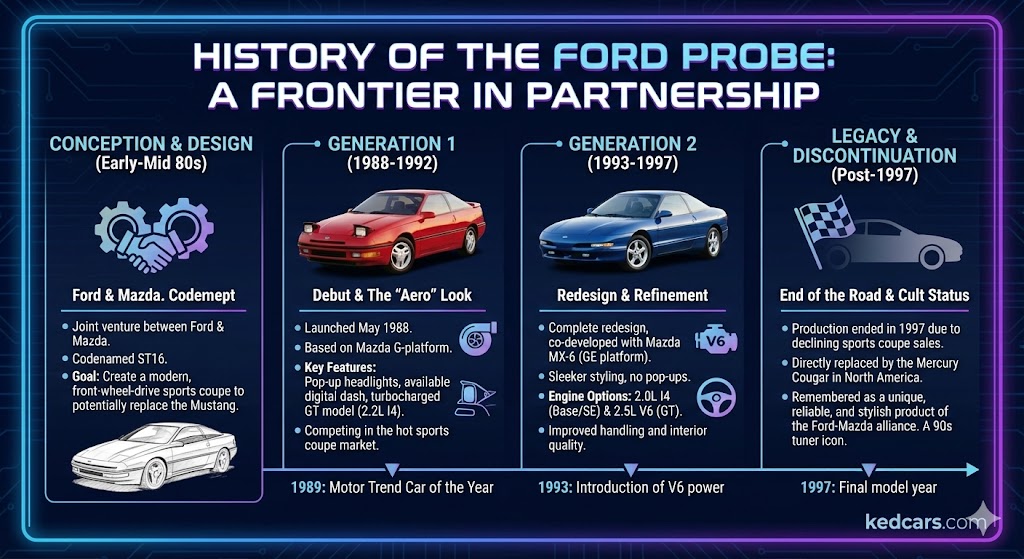
The “ST-16” Project and the FWD Mustang Concept
The genesis of the Ford Probe emerged from strategic discussions within Ford during the mid-1980s, when automotive industry analysts pessimistically predicted the imminent demise of rear-wheel-drive sports cars. The oil crises of the 1970s had fundamentally disrupted American consumer preferences, with fuel efficiency becoming paramount in purchasing decisions. Pony car sales—particularly the Mustang—had stagnated dramatically compared to the booming 1960s and early 1970s.
Ford’s strategic response derived from its substantial ownership stake in Mazda, a relationship established during the 1970s through collaborations including the Ford Courier and Mazda-supplied powertrains. Ford executives proposed an ambitious concept under the internal codename “ST-16”: a complete redesign of the Mustang platform utilizing Mazda’s proven front-wheel-drive technology and efficient four-cylinder engines.
Designer Toshi Saito, a North American-based Ford stylist, took the lead in envisioning design directions for the front-wheel-drive Mustang. His design was chosen and finalized in early 1984, then transferred to Mazda’s design facilities in Hiroshima, Japan. The plan appeared audacious yet strategically sound: gradually phase out the aging Fox-body Mustang under the designation “Mustang Classic,” eventually replacing it with the ST-16 as the new-generation Mustang.
The Backlash and Brand Identity Crisis
When information regarding the proposed front-wheel-drive Mustang leaked to automotive publications in early 1987, the response proved instantaneous and overwhelming. Mustang enthusiasts—a particularly passionate demographic protecting a model that had defined American car culture since 1965—flooded Ford’s mailroom with thousands of angry letters. Many correspondents expressed fury at what they perceived as a betrayal of Mustang heritage. Some letters reportedly contained death threats.
The criticism transcended ordinary consumer dissatisfaction. Mustang fans articulated genuine philosophical objections: a traditional Mustang represented rear-wheel drive, V8 power, extensive customization options, and American engineering. The ST-16 offered none of these characteristics. Instead, it promised Japanese-sourced components, front-wheel drive (widely perceived as undignified for a sports car), and four-cylinder turbocharged power—a complete departure from Mustang tradition.
Facing this unprecedented backlash, Ford executives recognized a critical mistake. Continuing with the plan risked destroying the Mustang brand entirely while alienating an entire generation of loyal customers. Simultaneously, fuel prices began declining in the mid-1980s, reducing the economic imperative that had driven the FWD Mustang concept. Sales of conventional pony cars—particularly the Mustang—began recovering as American consumers regained interest in performance-oriented vehicles.
The Probe Emerges: From Failed Mustang to Independent Coupe
Strategic Repositioning and the Probe Nameplate
Rather than abandoning the ST-16 project entirely, Ford executives made a decisive strategic decision: continue developing the front-wheel-drive sports coupe, but position it as an independent model rather than a Mustang replacement. The car would be named “Probe,” resurrecting a designation from Ford’s celebrated series of aerodynamic concept cars developed during the late 1970s and early 1980s.
The Ford Probe I (1979), Probe II (1980), Probe III (1981), and Probe IV (1983) had showcased Ford’s commitment to advanced aerodynamics and futuristic design. These concept vehicles featured drag coefficients as low as 0.30—exceptional efficiency for vehicles predating contemporary aerodynamic standards. Transferring the Probe nameplate from concept vehicles to the production model lent credibility while deliberately distancing the vehicle from Mustang lineage.
The 1989 Ford Probe debuted as a completely different market proposition: an affordable, efficient, Japanese-engineered sports coupe positioned alongside the Mustang rather than replacing it. This dual-model strategy, while confusing to consumers and critics alike, represented Ford’s pragmatic compromise between corporate vision and market reality.
First-Generation Architecture and Design Philosophy
The first-generation Probe (1989-1992) was based on the Mazda GD platform, which also underpinned the Mazda 626 and MX-6 coupe. Unlike the MX-6, which retained Mazda’s more conservative styling, the Probe received distinctive Ford-specific design language emphasizing aerodynamic efficiency and aggressive proportions. Designed by Toshi Saito’s team at Ford’s North American Design Center, the Probe featured a drag coefficient of 0.30, enabling exceptional fuel efficiency.
The Probe’s exterior design proved controversial. To traditional automotive enthusiasts, the vehicle appeared feminine and underpowered, contradicting Mustang’s muscular heritage. To design-conscious observers, the Probe represented remarkable achievement in aerodynamic efficiency combined with dramatic visual presence. The pop-up headlights, rakish windscreen, and streamlined proportions evoked the concept cars from which the nameplate derived.
Production commenced at Ford’s Flat Rock, Michigan assembly plant, a facility built in 1987 through Ford-Mazda collaboration. Initial pricing positioned the Probe aggressively: the base GL model started at approximately $10,943, nearly $2,000 less than the entry-level Mustang, despite offering superior fuel economy and more advanced engineering.
Powertrain Development: Multiple Engine Options and Performance Variants
The Mazda F2 and F2T Engines
The first-generation Probe offered multiple powertrain options reflecting Ford’s strategy to serve diverse buyer preferences. The base engine was the Mazda F2 2.2-liter naturally-aspirated four-cylinder, producing 110 horsepower at 4,700 RPM and 130 foot-pounds of torque at 3,000 RPM. This willing if unspectacular engine delivered adequate performance for basic transportation needs, achieving approximately 27 miles per gallon highway efficiency.
For performance-oriented customers, Ford offered the Mazda F2T 2.2-liter turbocharged variant, featuring 145 horsepower at 4,300 RPM and 190 foot-pounds of torque at 3,500 RPM. The F2T incorporated an IHI RHB5-VJ11 turbocharger, intercooler, knock sensor, and electronic boost controller. Boost pressure was maintained at 7.3 PSI, delivering legitimate performance: the turbocharged GT variant achieved 0-60 mph in approximately 7.0 seconds, matching or exceeding contemporary compact sports cars.
The F2T’s turbocharger, however, plagued owners with notorious torque steer—a disconcerting tendency for the steering wheel to jerk violently during hard acceleration as power overwhelmed the front-wheel-drive chassis. This characteristic became a defining limitation of early Probe GTs, deterring performance enthusiasts seeking predictable, confidence-inspiring acceleration.
The Ford Vulcan V6 Option
Beginning in 1990, the mid-level LX trim gained access to the Ford 3.0-liter Vulcan V6, a pushrod engine also powering the Taurus, Ranger, Tempo, and Aerostar. The Vulcan produced 140-145 horsepower and 160-165 foot-pounds of torque, delivering smoother power delivery than the turbocharged four-cylinder while weighing approximately 200 pounds more.
The V6 option proved significant: it remained the only six-cylinder available on the Mazda GD platform, making the Probe unique among front-wheel-drive sports coupes. By 1990, even the Mustang had discontinued its six-cylinder option, concentrating exclusively on four-cylinder base and V8 performance models. The V6 Probe achieved approximately 9.0 seconds 0-60 mph acceleration, positioning it as the optimal balance between refinement and performance within the Probe range.
The Second-Generation Probe (1993-1997): Redesign and Market Decline
Complete Redesign and Platform Continuation
For the 1993 model year, Ford and Mazda undertook a complete redesign of the Probe and its sibling, the MX-6. Notably, both vehicles continued using the Mazda G platform architecture, with the new generation designated GE. This platform inheritance reflected cost-containment considerations: developing a new platform would have exceeded justifiable investment for declining coupe markets.
Designer Alberto Dilillo at the Lancia Style Centre directed initial design development during 2006-2007, prior to the Fiat-Chrysler merger. The resulting design incorporated relatively few modifications from original conception, suggesting either exceptional design stability or budget constraints limiting radical changes.
The second-generation Probe featured improved proportions compared to its predecessor, appearing less awkward while maintaining aggressive design language. Importantly, the platform remained functionally identical underneath, featuring the same front-wheel-drive architecture, four-cylinder turbo and V6 options, and five-speed manual or four-speed automatic transmissions.
Engine Evolution and Market Positioning
The second-generation Probe continued with the 2.0-liter Mazda engine producing 115-120 horsepower as base power, alongside the 2.5-liter V6 delivering 163-166 horsepower in GT models. These revised powertrains represented evolutionary refinement, maintaining the fundamental character while meeting increasingly stringent emissions standards.
By the mid-1990s, however, market dynamics had shifted fundamentally. Fuel prices remained relatively stable, reducing efficiency advantages that had justified the FWD transition. Consumer preferences had reverted to performance-oriented vehicles, with the newly redesigned 1994 Mustang (SN-95) offering V8 power, rear-wheel drive, and traditional pony car character. In direct comparison, the Probe appeared underpowered and technically complex.
Commercial Failure and Market Decline
Sales Trajectory and Production Figures
Initial Probe sales proved surprisingly robust, with 162,889 units sold in 1989 and over 100,000 units annually through 1993. Yet the decline proved dramatic: 1994 sales dropped to approximately 80,000 units, continuing declining to less than 20,000 units by 1997. Total Probe production across all eight years reached approximately 750,000 units globally, yet this accumulated volume masked catastrophic year-over-year sales collapses.
By comparison, the Ford Mustang—the vehicle the Probe was never supposed to replace—consistently outsold the Probe by factor of five or more. In 1997, the Probe’s final year, Ford sold 108,000 Mustangs compared to fewer than 20,000 Probes, definitively demonstrating that consumers preferred traditional pony car character over Japanese-engineered efficiency.
The Fundamental Market Problem
The Probe’s decline reflected a fundamental marketing and positioning failure. Rather than establishing its own identity, the Probe existed perpetually in the Mustang’s shadow, with consumers regarding it as a poor Mustang substitute rather than a legitimate independent vehicle. The name itself carried ambiguous connotations—neither clearly conveying the vehicle’s sports car character nor its efficient engineering credentials.
Additionally, the Probe faced a crowded competitive segment. The Honda Prelude offered superior interior quality and handling refinement. The Toyota Celica provided reliable, unpretentious transportation with legitimate performance variants. The Mazda MX-6, despite sharing the identical platform, received superior marketing and design appreciation, particularly for its four-wheel steering availability. Most significantly, customers increasingly returned to the newly revitalized Mustang, particularly after the 1994 SN-95 redesign reestablished pony car credibility with V8 power and rear-wheel drive.
The Mustang Replacement Legacy: What Could Have Been
Strategic Crossroads and Historical Significance
The Probe’s greatest significance lies not in commercial success but rather in the strategic crossroads it represented for Ford. Had the company proceeded with the ST-16 plan—replacing the Mustang with a front-wheel-drive, turbocharged, Japanese-engineered coupe—the pony car segment might have disappeared entirely during the 1990s. General Motors, facing similar market pressures, eventually killed the Camaro and Firebird, essentially abandoning the segment.
The Mustang enthusiasts’ passionate backlash prevented this scenario. By forcing Ford to maintain the Mustang as a distinct product line, consumers inadvertently preserved an entire automotive segment that would experience remarkable resurgence during the 2000s. The 2005 Mustang redesign, returning to rear-wheel drive and V8 power, triggered unexpected market enthusiasm that revitalized the pony car category.
This irony defines the Probe’s legacy: a vehicle that failed commercially because it represented everything consumers didn’t want in a Mustang successor, yet its existence preserved the Mustang heritage that would eventually flourish beyond anyone’s 1980s expectations.
Design and Cultural Impact
Aerodynamic Achievement and Styling Controversy
Despite commercial failure, the Probe represented genuine achievement in aerodynamic design. The 0.30 drag coefficient positioned the Probe among the most efficient vehicles of its era, rivaling dedicated sports cars while delivering superior fuel economy. This aerodynamic sophistication derived from extensive wind-tunnel testing and incorporation of active suspension systems capable of electronically adjusting ride height to reduce drag at highway speeds.
Yet this technical achievement failed to translate into marketing advantage. Consumers purchasing sporty coupes during the 1990s prioritized engine character, styling distinctiveness, and emotional engagement over efficiency metrics invisible to casual observers. The Probe’s efficient aerodynamics symbolized engineering pragmatism, while the Mustang’s muscular proportions symbolized automotive passion.
Cult Status and Collector Interest
Today, the Probe experiences unexpected collector appreciation as enthusiasts recognize its technical sophistication and underappreciated design. Surviving examples, particularly well-preserved GT variants with turbocharged powertrains or second-generation V6 models, command respectful prices among enthusiasts valuing 1990s automotive authenticity. The Probe’s failure has paradoxically enhanced its appeal among collectors seeking understated vehicles overlooked by mainstream markets.
The Bottom Line
The Ford Probe’s eight-year production run—from its ambitious 1989 debut as a revolutionary Mustang replacement through its ignominious 1997 discontinuation—represents one of automotive history’s most instructive commercial failures. Approximately 750,000 units manufactured globally masked the dramatic sales collapse that defined the Probe’s market trajectory.
The Probe’s significance derives not from engineering innovation or performance achievement, but rather from demonstrating the enduring importance of automotive heritage and emotional engagement. Ford’s 1989 Probe represented rational strategic thinking: smaller, more efficient, technologically advanced. Yet consumers repeatedly demonstrated that automobiles satisfy emotional needs transcending pure functionality.
The Probe’s greatest legacy may be preserving the Mustang itself. Had Ford proceeded with the ST-16 plan, transforming the Mustang into a front-wheel-drive Japanese-engineered coupe, the pony car segment might have vanished entirely. Instead, passionate consumer backlash forced Ford to maintain Mustang identity, ultimately enabling the brand’s remarkable 2005 resurgence that established rear-wheel-drive, V8-powered performance as permanently desirable.
As automotive manufacturing transitions toward electrification and autonomous technologies, the Ford Probe reminds us that consumer preferences transcend economic logic. The vehicle was more efficient, more technologically advanced, and strategically superior to the aging Mustang. Yet customers overwhelmingly chose heritage, character, and tradition over pragmatic improvement—principles that ensure emotionally-engaging automobiles will remain eternally relevant regardless of technological disruption.