Quick Facts:
First Year: 1964 | Units Sold: 10.2+ Million | Country: USA | Creator: Ford Motor Company
Introduction
The Ford Mustang stands as one of the most revolutionary vehicles in automotive history. Introduced on April 17, 1964, it transformed American car culture overnight and created the entire pony car segment.
No other car has captured American identity quite like the Mustang. Since its debut, over 10.2 million Mustangs have been sold worldwide. The car became a symbol of freedom, rebellion, and the pursuit of affordable performance.
The Mustang proved that American manufacturers could build cars that combined style, performance, and affordability. It established Ford as a design and engineering powerhouse and influenced generations of drivers and designers.
Key Significance: The Mustang invented the pony car category and demonstrated that a car could become a cultural phenomenon by understanding what young Americans actually wanted.
Origins & Early Years
The Vision Behind the Mustang
Lee Iacocca, a visionary Ford executive, recognized an emerging market: young Americans entering the workforce and buying their first cars. The traditional industry dismissed this demographic as unprofitable.
Iacocca faced significant internal resistance. Ford’s conservative leadership had just absorbed the massive failure of the Edsel. They were skeptical of any new vehicle program, especially one targeting young buyers. Iacocca needed a strategy that minimized investment risk.
The solution was ingenious. Rather than engineering a new platform, Iacocca approved using the existing Ford Falcon chassis. This approach reduced development costs dramatically while allowing designers freedom to create something visually distinctive.
The Secret Development
Iacocca assembled what became known as the “Fairlane Committee”—a group of young product planners meeting secretly at the Fairlane Inn Motel. They operated without formal approval, developing concepts for a car that would be affordable, stylish, and performance-oriented.
Designer Lee Jayson and his team created a long-hood, short-deck fastback proportioned car. The design language was simple but striking: clean lines, an aggressive grille, and integrated bumpers that didn’t interrupt the body.
The car would be offered with a four-cylinder engine for economy-minded buyers or optional V8s for performance enthusiasts. Multiple body styles—fastback, hardtop, and convertible—would appeal to diverse preferences.
Launch and Instant Success
The 1965 Mustang debuted at the New York World’s Fair on April 13, 1964. Iacocca delivered an impassioned speech describing a car “created for citizens and cities.”
Ford set conservative sales goals: 100,000 Mustangs in the first year would be considered a success. The actual result was stunning. In the first year alone, Ford sold 418,812 Mustangs. By 1966, annual production exceeded 600,000 units.
The one-millionth Mustang rolled off assembly lines in 1966—faster than any other car in history. Ford generated $1.1 billion in net profits from Mustang sales alone in just two years.
Generational Breakdown
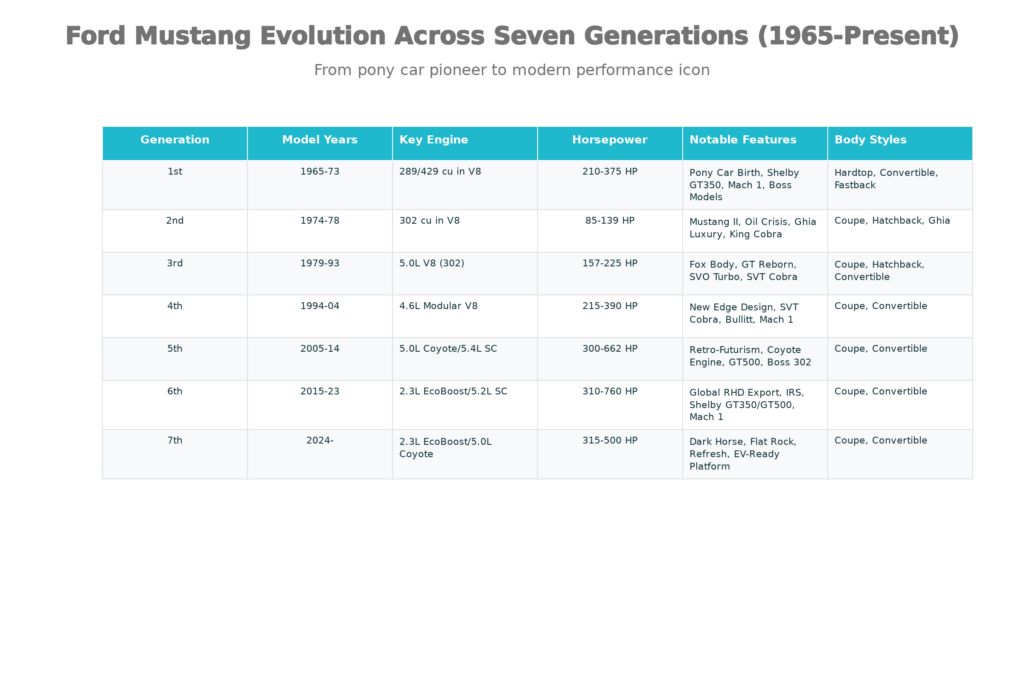
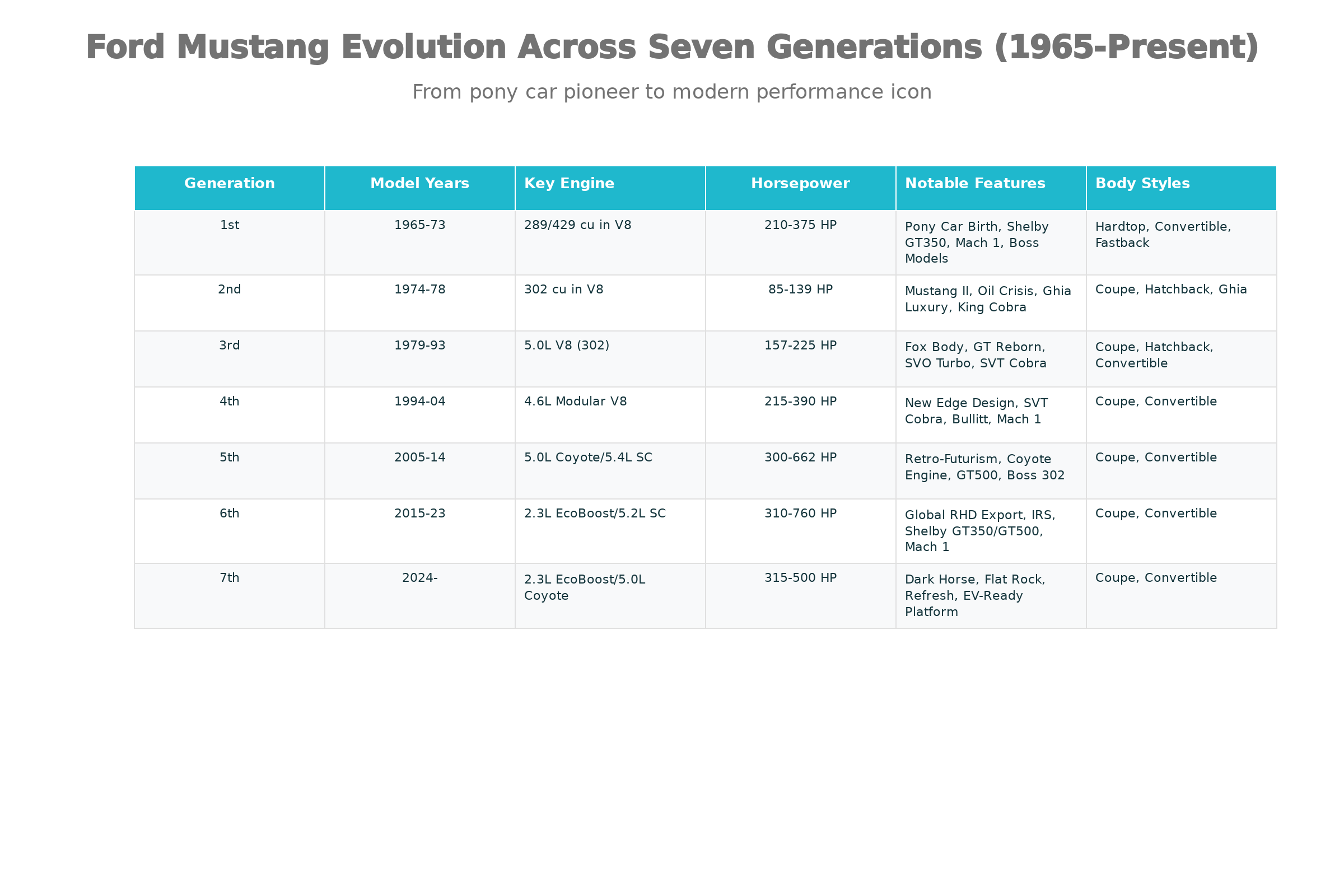
The Mustang’s seven generations reveal how a single automotive concept evolved to remain relevant across six decades while maintaining core identity.
Generation 1: 1964-1973
The first-generation Mustang established the formula that defines the nameplate. The iconic long hood and short rear deck proportions remain instantly recognizable today.
Engine options began with a 200-cubic-inch six-cylinder (120 horsepower) and three-speed automatic transmission. Performance enthusiasts selected 289-cubic-inch V8s (195-225 horsepower), with the legendary 427-cubic-inch big block arriving later.
| Specification | Details |
|---|---|
| Base Engine | 200 cu-in six-cylinder |
| Horsepower Range | 120-225 hp |
| 0-60 Time (V8) | 8-10 seconds |
| Top Speed | ~120 mph |
| Body Styles | Fastback, hardtop, convertible |
| Production | 2.98 million units |
The first generation sold 2.98 million vehicles—a staggering achievement. Muscle car performance intensified with each year. By the late 1960s, the Mustang became truly a performance machine, with Boss and Mach 1 variants dominating American muscle car culture.
Generation 2: 1974-1978
The second-generation Mustang arrived during the global oil crisis. Consumers demanded efficiency. Ford responded by downsizing significantly, introducing the Mustang II based on the Pinto platform.
Many enthusiasts view this generation as a low point. The Mustang II featured smaller dimensions, reduced power outputs, and softer styling. The largest engine option was a 302-cubic-inch V8 producing just 140 horsepower.
Despite criticism from purists, the Mustang II sold 1.1 million units. It proved there was demand for a compact, fuel-efficient car wearing the Mustang badge. This generation kept the nameplate alive during difficult economic times.
| Specification | Details |
|---|---|
| Base Engine | 2.3L four-cylinder |
| Max Horsepower | 140 hp (302 V8) |
| Fuel Economy | ~20 mpg |
| Production Years | 1974-1978 |
| Total Sales | 1.1 million units |
Generation 3: 1979-1993
The third-generation Mustang, called the Fox Body, represented a return to form. Introducing a new platform, the car grew longer and more angular while recapturing the original’s aggressive aesthetic.
Power gradually returned. Early models featured 2.3-liter turbocharged four-cylinders (175 horsepower) and naturally-aspirated 5.0-liter V8s (147-225 horsepower). By the late 1980s, the 5.0L produced 225 horsepower, making it competitive again.
This generation lasted 15 years—the longest of any Mustang generation. It sold 2.6 million units, proving the Fox platform’s success and durability. This generation restored the Mustang’s performance credibility.
Notable variants included the SVO (Shelby Vendor Option) with its turbocharged four-cylinder, and the GT models with V8 power. The 1987-1993 models became especially desirable, establishing the Fox Body as a collector car.
| Specification | Details |
|---|---|
| Engine Options | 2.3L turbo or 5.0L V8 |
| Horsepower | 175-225 hp |
| Notable Variants | SVO, GT, LX |
| Production Years | 1979-1993 |
| Total Sales | 2.6 million units |
Generation 4: 1994-2004
The fourth-generation arrived for the Mustang’s 30th anniversary. Ford designed it to evoke the original while incorporating modern engineering. The result was the SN-95 platform, which became the foundation for Mustang success for a decade.
Early models offered a 3.8-liter V6 (190 horsepower) and the venerable 5.0-liter V8 (215 horsepower). In 1996, the SVT Cobra debuted with a 4.6-liter V8 producing 305 horsepower, advancing performance significantly.
By 2004, the 4.6-liter modular V8 produced 325 horsepower in GT trim, with SVT Cobra models reaching 400+ horsepower. The platform proved remarkably adaptable to evolving technology.
This generation sold over 1.7 million vehicles and re-established the Mustang as a performance leader. Enthusiasts could buy a five-speed manual GT for under $20,000 that could embarrass far more expensive competitors.
| Specification | Details |
|---|---|
| Engines | 3.8L V6 or 4.6L V8 |
| Horsepower | 190-400+ hp (SVT) |
| 0-60 Time | 5.9-6.3 seconds (GT) |
| Key Innovation | SVT Cobra variant |
| Production Years | 1994-2004 |
Generation 5: 2005-2014
The fifth-generation Mustang debuted in 2004 for the 2005 model year, designed by J. Mays using what he called “retro-futurism.” The styling heavily referenced the original 1964-1967 fastback while incorporating modern proportions.
Base models featured a 3.7-liter V6 (210 horsepower) while GT models used a 4.6-liter V8 (300 horsepower initially, increasing to 412 horsepower by 2011). The 2010-2014 Boss 302 paid tribute to the legendary 1969 original with 444 horsepower.
This generation brought a completely new platform offering independent rear suspension and modern safety technology. The Shelby GT500 (2007+) featured a supercharged 5.4-liter V8 producing 500+ horsepower.
Production of over 900,000 units confirmed continued demand for classic-inspired performance. This generation established the formula that continues today: retro styling with modern engineering.
| Specification | Details |
|---|---|
| Base Engine | 3.7L V6 |
| GT Engine | 4.6L V8 (300-412 hp) |
| Shelby GT500 | 5.4L supercharged (500+ hp) |
| Key Feature | Independent rear suspension |
| Production Years | 2005-2014 |
Generation 6: 2015-2023
The sixth-generation Mustang premiered in 2013, debuted simultaneously in six global markets, signaling Ford’s commitment to making it a worldwide icon. The platform was completely redesigned yet maintained the iconic proportions.
Engine options expanded significantly. The base EcoBoost 2.3-liter turbocharged four-cylinder produced 310 horsepower. The 5.0-liter V8 generated 435 horsepower initially, increasing to 480 horsepower by 2018.
The Shelby GT350 debuted with a flat-plane-crank 5.2-liter V8 producing 526 horsepower. The GT500 introduced a supercharged 5.2-liter producing 750+ horsepower, establishing supercar-level performance credentials.
For the first time, the Mustang was available with right-hand drive, expanding sales to right-hand-drive markets including Australia. A 10-speed automatic became standard on premium models.
This generation sold over 667,000 units globally, with the EcoBoost variant attracting daily drivers while GT and Shelby models satisfied performance enthusiasts.
| Specification | Details |
|---|---|
| Base Engine | 2.3L EcoBoost turbo |
| GT Engine | 5.0L V8 (435-480 hp) |
| GT350 Engine | 5.2L flat-plane (526 hp) |
| GT500 Engine | 5.2L supercharged (750+ hp) |
| Production Years | 2015-2023 |
Generation 7: 2024-Present
The seventh-generation Mustang introduced for 2024 represents the latest evolution. The S650 platform debuted with subtle restyling that maintains the sixth-gen’s proportions while incorporating modern design details.
The 2.3-liter EcoBoost continues as the base engine with 315 horsepower. The 5.0-liter V8 is revised, producing 480 horsepower (486 with active exhaust). A completely new 5.0L variant in the Dark Horse produces 500 horsepower.
Technology improvements include a fully digital instrument cluster, Google-integrated infotainment, and advanced driver assistance systems. A new RTR Spec 5 variant, developed with drift legend Vaughn Gittin Jr., delivers 870 horsepower.
Ford committed to keeping the Mustang gasoline-powered through the next decade, rejecting earlier plans for an all-electric variant. A hybrid option is planned before 2030, maintaining the engine while improving efficiency.
| Specification | Details |
|---|---|
| EcoBoost | 2.3L turbo, 315 hp |
| GT | 5.0L V8, 480 hp |
| Dark Horse | 5.0L V8, 500 hp |
| RTR Spec 5 | Modified V8, 870 hp |
| Production Years | 2024-Present |
Cultural & Social Impact
Hollywood’s Most Famous Car
The Mustang appeared in over 500 movies and 33,000 film scenes. No other car has achieved such consistent Hollywood presence across decades of cinema.
The first notable film appearance came in the 1964 James Bond film “Goldfinger,” where Tilly Masterson drives a white Mustang convertible. However, the most iconic moment came in 1968 with Steve McQueen’s Highland Green 1968 Mustang GT 390 Fastback in “Bullitt.”
That legendary San Francisco car chase sequence—featuring McQueen’s Mustang pursuing a Dodge Charger through urban streets and over hills—defined what a muscle car could be in cinema. The Highland Green Mustang became as famous as McQueen himself.
Modern classics continue the tradition: the 1967 Shelby GT500 “Eleanor” in “Gone in 60 Seconds,” Nicolas Cage’s reimagined machine in the same film, and Keanu Reeves’ 1969 Boss 429 in the “John Wick” franchise. Television shows from “Knight Rider” to “Charlie’s Angels” featured Mustangs prominently.
Symbol of American Culture
Ford marketers understood something fundamental: filmmakers use cars to define characters. A character behind a Mustang wheel instantly communicates coolness, toughness, and independence.
The Mustang’s name itself evokes wild horses galloping across open plains—freedom without constraints. This symbolism transcends American borders. The car represents a lifestyle accessible to ordinary people, not just the wealthy.
In music, the Mustang became iconic in country, rock, and hip-hop. Artists referenced Mustangs in songs, with the car representing achievement and status. The name became synonymous with masculine energy and automotive passion.
Muscle Car Culture
The Mustang defined American muscle car culture. It proved that performance didn’t require exotic engineering or luxury price tags—a combination of cubic inches, smart design, and manufacturing efficiency could deliver thrills.
Competitors immediately responded. Pontiac’s GTO, Dodge’s Charger, and Chevrolet’s Camaro followed Iacocca’s formula. The pony car segment became fundamental to American automotive culture, generating loyalty that persists today.
The Mustang appealed across demographic boundaries. Young factory workers, college students, suburban families, and celebrities all valued Mustang ownership. It was truly a car for “the people.”
Technological Evolution
Engine Development
The Mustang’s engine evolution traces American automotive technology progress. The original 200-cubic-inch six-cylinder was reliable but modest. Early buyers selected 289-cubic-inch V8s for genuine performance.
The legendary 427-cubic-inch big block engines arrived mid-generation, producing over 400 horsepower in race form. The Boss 302 and Boss 429 variants (1969-1970) represented performance engineering at its peak, with serious racing credentials.
The Fox Body era introduced the 5.0-liter V8, which dominated American performance for decades. The 1987-1993 5.0L GTz models became street legends, capable of embarrassing far more expensive sports cars.
Modern Mustangs employ sophisticated naturally-aspirated and turbocharged engines. The current 5.0L V8 produces 480-500 horsepower without supercharging, through optimized breathing, variable valve timing, and direct injection. The flat-plane-crank 5.2L in the GT350 achieves 526 horsepower.
Ford rejected all-electric powertrains, recognizing that Mustang identity requires engine character. However, a hybrid V8 variant is planned, offering performance with improved efficiency.
Transmission Evolution
Early Mustangs offered three-speed automatic transmissions with available four-speed manual. This simple architecture provided adequate performance for the era.
The five-speed manual became standard performance equipment by the 1980s. The T5 and later T56 transmissions offered close ratios for racing and highway overdrive for efficiency.
Modern Mustangs offer six-speed manuals with rev-matching technology that automatically blips the throttle during downshifts. The 10-speed automatic provides superior performance and efficiency.
Suspension Technology
Original Mustangs featured independent front suspension with coil springs and a live axle rear suspended by leaf springs. This architecture was standard for American cars of the era.
The fifth and sixth generations introduced independent rear suspension, improving handling precision significantly. The current generation employs multi-link rear suspension with sophisticated geometry.
Modern Mustangs offer adaptive dampers on premium models, allowing drivers to select comfort or sport settings. The Dark Horse variant features specially tuned suspension for extreme track performance.
Safety and Technology
Original Mustangs featured basic mechanical systems with drum brakes and minimal safety equipment. Seatbelts were optional upgrades.
Modern Mustangs include comprehensive airbag systems, stability control, traction control, and advanced braking systems. The current generation features Ford Co-Pilot360+ safety systems including forward collision warning, lane departure warning, and blind spot monitoring.
Infotainment systems evolved from AM/FM radios to today’s Google-integrated systems with voice control, navigation, and smartphone integration. The new digital instrument cluster displays performance metrics and customizable driving information.
Performance & Capabilities
Mustang performance metrics illustrate the technological revolution across 60 years of automotive development.
| Metric | Gen 1 (1965) |
Gen 3 (1987) |
Gen 5 (2011) |
Gen 6 (2018) |
Gen 7 (2025) |
|---|---|---|---|---|---|
| 0-60 Time | ~8 sec | ~5.9 sec | ~4.1 sec | ~3.9 sec | ~4.1 sec |
| Top Speed | ~120 mph | ~135 mph | ~160 mph | ~165 mph | ~170 mph |
| Horsepower | 225 hp | 225 hp | 412 hp | 450 hp | 500 hp |
| 0-150 Time | N/A | N/A | ~14 sec | ~13 sec | ~12 sec |
The acceleration improvement from approximately 8 seconds to 60 mph to the modern 4.1-second figure represents profound engineering advances. Engine efficiency has improved dramatically while outputs increased four-fold.
The original 289-cubic-inch V8 produced 225 horsepower through naturally aspirated power at modest RPMs. Modern 5.0L V8s achieve double the output through superior engine design, precision fuel injection, variable valve timing, and optimized combustion chamber geometry.
Current Generation
The 2025 Mustang Lineup
The 2025 Mustang offers unprecedented choice for buyers seeking different priorities. Three distinct powertrains address performance, efficiency, and value considerations.
The EcoBoost variant provides an accessible entry point. The 2.3-liter turbocharged four-cylinder produces 315 horsepower and 350 lb-ft of torque, achieving 0-60 mph in 4.5 seconds. This engine delivers 22 mpg city/33 mpg highway efficiency.
The GT model features the iconic 5.0-liter V8 producing 480 horsepower and 418 lb-ft of torque. With the optional active exhaust, output increases to 486 horsepower. The six-speed manual transmission remains available, preserving the mechanical engagement purists demand.
The Dark Horse variant represents the ultimate naturally-aspirated performance. Its revised 5.0L Coyote engine produces 500 horsepower and 418 lb-ft of torque. With specialized suspension tuning and track-focused calibration, it achieves 0-60 mph in 4.1 seconds.
Available Trims and Technology
| Trim | Engine | Horsepower | Key Features |
|---|---|---|---|
| EcoBoost | 2.3L turbo | 315 hp | 10-speed auto, fuel efficiency, modern tech |
| GT | 5.0L V8 | 480 hp | 6-speed manual, active exhaust option, performance |
| Dark Horse | 5.0L V8 | 500 hp | Sport suspension, track-tuned, electronic drift brake |
| RTR Spec 5 | Modified V8 | 870 hp | Street-legal track car, Vaughn Gittin Jr. edition |
Technology features include a fully digital gauge cluster, optional Google-integrated infotainment with real-time navigation, and wireless smartphone charging. The new curved instrument display provides extensive customization.
Safety systems feature Ford Co-Pilot360+ including forward collision warning, lane keeping assist, and blind spot monitoring. The available BlueCruise 3.5 system enables hands-free highway driving on mapped routes.
Available Body Styles
The 2025 Mustang continues as both fastback coupe and convertible. Both configurations maintain the iconic proportions while offering different driving experiences. The convertible adds 900 pounds but preserves the Mustang’s open-air appeal.
Special Variants & Performance Models
The Boss Mustangs (1969-1970)
The Boss 302 and Boss 429 variants represent the absolute peak of first-generation Mustang performance. Introduced in 1969, they were race-homologation cars designed for SCCA Trans-Am competition.
The Boss 302 featured a 302-cubic-inch V8 with Cleveland cylinder heads and 290 horsepower (actually producing 350+ in real-world form). The engine’s high-rpm power delivery made it competitive despite smaller displacement than competitors.
The Boss 429 packed a massive 429-cubic-inch V8 producing 375 horsepower (closer to 450 in actual form). Despite its massive size, the engine barely fit in the engine bay, requiring the battery relocation to the trunk.
Both variants featured aggressive styling, including functional hood scoops, distinctive paint schemes, and specialized suspension. Only two model years of Boss Mustangs were produced, making them increasingly collectible.
Shelby Mustangs
Shelby American’s Mustang variants represent the ultimate expression of the nameplate. The original 1965 GT350 was purpose-built for racing, featuring a 289-cubic-inch V8 with 306 horsepower in street form.
The GT350R (race version) featured only 34 examples specifically built for SCCA competition. These cars won the B-Production championship for three consecutive years, establishing the Shelby-Mustang as a serious racing machine.
The 1967-1969 GT500 introduced a 428-cubic-inch FE V8 producing 355 horsepower. The legendary Super Snake prototype, equipped with a 427-cubic-inch engine, produced 650 horsepower and was capable of over 170 mph—extraordinary for 1967.
Modern Shelby variants continue this tradition. The current generation GT500 features a 5.2-liter supercharged engine producing 760 horsepower, making it the most powerful production Mustang ever built.
The Mach 1
The Mach 1 debuted in 1969 as the ultimate first-generation performance statement. Rather than emphasizing raw power, the Mach 1 combined aggressive visual cues with optional powerful engines.
The distinctive hood scoops, bold stripe graphics, and unique wheels made Mach 1s instantly recognizable. Available with engine options ranging from the 250-cubic-inch six to the 428-cubic-inch Cobra Jet producing 335 horsepower.
The Mach 1 remained in production through 1978, embodying muscle car culture throughout the 1970s. Its combination of style, performance options, and relative affordability made it an achievable dream car for young drivers.
Racing Heritage
Trans-Am Dominance
The Mustang established itself as a serious racing platform from the beginning. The Shelby GT350 dominated SCCA B-Production racing in the mid-1960s, winning three consecutive championships.
When the SCCA Trans-Am series began in 1966, Mustangs competed immediately. Early results were modest, but by 1970, the Boss 302 Mustang achieved a watershed moment: complete dominance of the season.
Parnelli Jones and George Follmer piloted the iconic “Bud Moore” school-bus yellow Grabber Orange Boss 302 Mustangs to the 1970 Trans-Am championship, winning multiple races against all competitors.
Trans-Am success established the Mustang as an American racing icon. That championship validated the Boss 302’s design philosophy: sophisticated engineering producing competitive performance without exotic technology.
Le Mans and International Racing
Ford engine technology used in Mustangs supported Ford’s legendary Le Mans racing program. The 302-cubic-inch engine that powered Ford’s Le Mans-winning GT40s in 1968 and 1969 also powered Trans-Am Mustangs.
This technology transfer exemplified Ford’s philosophy: successful racing engines could be adapted for production vehicles. The Cleveland cylinder heads developed for racing eventually powered production Mustangs.
Modern Racing Programs
Shelby continues building track-focused Mustangs. The limited-production Shelby Terlingua models feature over 750 horsepower, race-specific suspension, and Brembo braking systems.
The new RTR Spec 5 variant, developed with drift legend Vaughn Gittin Jr., produces 870 horsepower and features electronic drift brakes and performance calibration. It represents the Mustang’s evolution as a modern performance machine.
The Future of the Ford Mustang
Gasoline Power Through 2030s
Ford CEO Jim Farley explicitly stated: “We will never make an all-electric Mustang.” This definitive commitment contrasts with broader industry electrification trends.
Ford recognizes that Mustang identity is inseparable from engine character. The distinctive exhaust note, throttle response, and mechanical engagement define the Mustang experience in ways electric motors fundamentally cannot replicate.
Instead of all-electric transition, Ford plans evolution. The Mustang will remain gasoline-powered through at least the early 2030s. A hybrid V8 variant is planned before 2030, combining traditional power with improved efficiency.
Electrification Strategy
The hybrid variant will employ a V8 engine paired with electric motors, delivering performance enhancements. This approach allows the Mustang to meet future efficiency regulations without abandoning its core character.
The separate Mustang Mach-E electric SUV fulfills Ford’s electrification commitment while preserving the traditional Mustang’s identity. The Mach-E offers supercar-level performance (480 horsepower in GT trim) while demonstrating electric powertrains can deliver exciting driving experiences.
Generational Evolution
A refresh of the current generation is planned for late 2026, followed by a complete redesign in 2029. The 2029 generation will introduce the planned hybrid powertrain alongside traditional V8 engines.
Ford will maintain the Mustang’s iconic proportions and design language. The next generation will incorporate more aggressive styling while remaining immediately recognizable as a Mustang.
Digital technology will advance significantly. The instrument cluster will likely become more advanced. Autonomous driving features will expand while preserving manual transmission availability for performance variants.
Why It Endures: Legacy & Lasting Appeal
Affordable Performance Philosophy
The Mustang’s fundamental appeal remains unchanged: it delivers genuine performance at accessible prices. A 2025 Mustang GT with 480 horsepower costs less than many luxury vehicles with a quarter of the power.
This value proposition attracts buyers across demographic boundaries. College students, working professionals, and retired enthusiasts all find the Mustang relevant to their needs and budgets.
Competitors have attempted to capture this formula. The Chevrolet Camaro, Dodge Challenger, and Dodge Charger all offer similar value propositions. Yet the Mustang consistently outsells them, suggesting something beyond mere performance metrics.
Iconic Design Language
The long-hood, short-deck proportions established by the original remain instantly recognizable. Every generation maintains these proportions while incorporating contemporary styling details.
This design consistency is rare. Most cars undergo radical transformations requiring model name changes. The Mustang proves that evolution can occur without abandoning identity.
Modern Mustangs feel contemporary yet retain visual continuity with the 1964 original. A 2025 Mustang and a 1965 Mustang share proportions and visual character despite six decades of change.
Cultural Significance
The Mustang transcends automotive function to represent American values: freedom, independence, and self-determination. The wild horse name evokes boundless potential.
This cultural resonance extends globally. The Mustang represents a distinctly American automotive philosophy that resonates worldwide: combining engineering excellence with style and performance at accessible prices.
The Mustang appears in American popular culture constantly. Musicians reference it in lyrics. Films use it to define characters. The nameplate carries weight beyond transportation.
Community and Enthusiasm
The Mustang community is vast and passionate. Enthusiast clubs, online forums, and social media groups number in the thousands. Owners maintain Mustangs for decades, creating multi-generational family connections.
The fact that first-generation Mustangs remain valuable and desirable 60 years later speaks to the enduring quality of the original design. Used Mustang values remain strong, making ownership financially practical.
The Bottom Line
The Ford Mustang represents one of automotive history’s greatest success stories. Introduced as a response to identified market needs—young buyers seeking affordable performance and style—it accidentally created an entirely new market segment.
Over 10.2 million Mustangs sold across seven generations spanning 60 years demonstrate remarkable longevity. Few automobiles achieve such consistency while remaining contemporary and desirable.
The Mustang’s cultural impact extends beyond sales figures. It symbolizes American automotive culture globally. It established benchmarks for pony car design that competitors continue pursuing. It proved that genuine performance need not be exclusive to luxury marques.
As the automotive industry transitions toward electrification, the Mustang’s planned hybrid future demonstrates wisdom. Rather than abandoning its core identity for technology trends, Ford preserves what makes the Mustang special while embracing necessary evolution.
The next generation arriving in 2029 will face unprecedented challenges: meeting emissions standards while preserving performance character, incorporating autonomous technology while maintaining driver engagement, evolving design while maintaining recognition.
Yet the Mustang has faced and overcome challenges throughout its history. The fuel crisis nearly killed it. Competition emerged from multiple directions. Market preferences shifted dramatically. Yet it endured by adapting while respecting its heritage.
The Ford Mustang will likely still be produced 100 years after its introduction, because it represents something deeper than transportation. It embodies the idea that great design combined with smart engineering and authentic character creates something timeless. Whether powered by gasoline, hybrid systems, or technologies yet unimagined, the Mustang will endure because it fundamentally understands what drivers want: affordable thrills, iconic style, and the freedom of the open road.