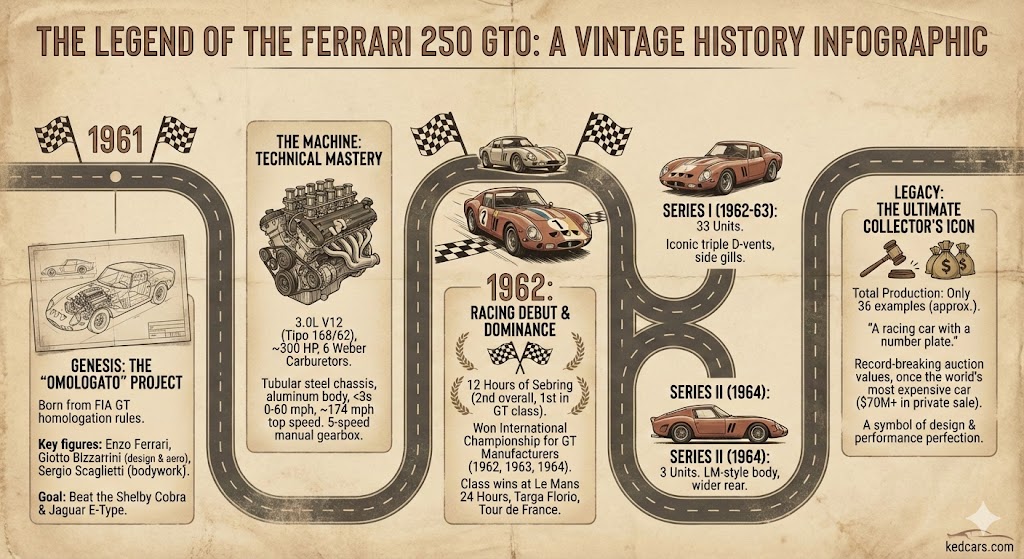
The Ferrari 250 GTO – Gran Turismo Omologato (Grand Touring Homologated) – stands as perhaps automotive history’s most perfect convergence of racing dominance, mechanical excellence, and financial value. Produced across merely three years (1962-1964), only 36 examples were manufactured, yet these 36 automobiles achieved an unparalleled competitive record: three consecutive FIA World Championships for GT Manufacturers (1962, 1963, 1964), victories at Le Mans, the Targa Florio, Sebring, and the grueling Tour de France Automobile.
Designed under engineer Giotto Bizzarrini’s initial direction before the controversial “Palace Revolt” of November 1961, the 250 GTO combined a sophisticated 3.0-liter Colombo V12 engine producing 300 horsepower, refined aerodynamic discipline developed through wind tunnel testing, and hand-crafted aluminum coachwork into a machine whose competitive dominance proved absolute across every major racing venue of the early 1960s. The 250 GTO’s ultimate significance transcends motorsport achievement: contemporary auction values have established it as the world’s most valuable automobile – recent examples selling for $48-$51+ million, validating that the 250 GTO represents not merely a historical racing success but rather a cultural artifact of supreme significance, recognized across collecting communities as the definitive automotive treasure.
Genesis: Crisis Response and Engineering Audacity
The Jaguar E-Type Threat and Regulatory Motivation
The Ferrari 250 GTO’s development emerged from crystalline competitive necessity. In 1961, Jaguar’s legendary E-Type debut – with its sophisticated design, independent suspension, and formidable performance – created profound consternation within Ferrari’s management. General manager Girolamo Gardini, surveying Jaguar’s prototype racing heritage and the E-Type’s competitive trajectory, concluded that Ferrari’s aging 250 GT SWB faced extinction without radical intervention.
Simultaneously, the FIA established new Group 3 Grand Touring Car regulations requiring homologated production vehicles for championship competition. Rather than developing all-new platforms, Ferrari executives recognized that a comprehensively revised 250 GT could satisfy both regulatory requirements and competitive necessity. This convergence created opportunity: Ferrari tasked engineer Giotto Bizzarrini with transforming the 250 GT into a machine capable of defeating the E-Type across international racing venues.
Giotto Bizzarrini’s Design Revolution: From “Il Mostro” to Production
Bizzarrini, already renowned for innovative engineering, approached the project with characteristic methodology: he focused obsessively on aerodynamics as the fundamental lever enabling performance improvements. Unlike competitors pursuing raw displacement increases, Bizzarrini recognized that reducing aerodynamic drag and improving downforce through wind tunnel optimization would deliver superior competition results.
His first prototype – built entirely in the Ferrari racing department without formal design drawings – appeared at Monza in September 1961 bearing the nickname “Il Mostro” (The Monster), a derisive reference to its crude, rough-hewn appearance. The prototype featured a steeply raked two-piece windscreen and an ungainly extended nose bearing little aesthetic refinement. This raw mechanical pragmatism masked engineering sophistication: wind tunnel testing at Pisa University, combined with extensive road and track iteration, refined the aerodynamic package into genuine competitive advantage.
The Palace Revolt and Leadership Transition
At precisely the moment when development momentum accelerated, a dramatic organizational crisis unfolded. In November 1961, Giotto Bizzarrini and several key Ferrari engineers abruptly departed the company – an event becoming known as the “Palace Revolt,” attributed to escalating tensions with Enzo Ferrari’s wife Laura’s increasing involvement in factory management decisions.
This personnel departure proved fortuitous rather than catastrophic. Mauro Forghieri assumed development leadership, and with inputs from accomplished racing driver Giancarlo Baghetti’s extensive testing at Monza, the GTO underwent critical refinements: the introduction of a rear spoiler (Kamm tail), Watt’s linkage for rear axle location and stability, and numerous suspension adjustments. The result: the 1962 debut model arrived at the 12 Hours of Sebring as a complete, competitive racing machine – second overall, winner of the GT class, validating that Ferrari had achieved its competitive objective.
Engineering Excellence: The Perfect Racing Machine
The Colombo V12: Proven Power Refined
Rather than developing an exclusive powerplant, Ferrari engineers selected the proven Tipo 168/62 Colombo V12 – the same 3.0-liter engine that had delivered repeated Le Mans victories in the 250 Testa Rossa. This conservation of resources represented sophisticated decision-making: Ferrari prioritized chassis and aerodynamic development over engine innovation, recognizing that proven reliability would prove more valuable than incremental power gains.
The 250 GTO’s engine featured all-aluminum alloy construction, dry-sump lubrication, six 38DCN Weber carburetors, twin overhead camshafts per bank with two valves per cylinder, and sophisticated mechanical systems enabling safe operation at 7,500+ rpm. Power output reached approximately 300 PS (296 bhp) at 7,500 rpm with 294 Nm (217 lb-ft) torque at 5,500 rpm – impressive performance considering displacement, though hardly revolutionary by contemporary standards. The engine’s fundamental virtue transcended numerical output: absolute mechanical reliability, refined breathing characteristics, and a sophisticated powerband enabling competitive success across diverse racing venues.
Aerodynamic Innovation: Wind Tunnel Discipline
The 250 GTO’s most significant engineering achievement emerged through systematic aerodynamic optimization. Bizzarrini’s insistence on wind tunnel testing at Pisa University established a methodological precedent: rather than aesthetic speculation regarding aerodynamic virtue, the GTO’s proportions reflected scientific analysis and validation.
Key aerodynamic features included a long, low nose minimizing radiator inlet area, distinctive air intakes on the nose with removable covers for heat management, and the distinctive Kamm tail (truncated rear) that improved both downforce and stability. The fastback profile, small radiator inlet, and low-slung engine compartment design enabled the GTO to achieve approximately 0.31 drag coefficient – respectable by period standards. This attention to aerodynamic discipline distinguished the 250 GTO from competitors pursuing merely visual aggression, establishing principles that would influence racing vehicle design for decades.
Chassis and Suspension: Precision Construction
The 250 GTO employed a hand-welded tubular steel frame, tightly integrated with reinforcement members optimizing structural efficiency. The wheelbase of approximately 2,450 millimeters (8 feet) provided excellent proportioning, while independent A-arm front suspension and a live rear axle controlled by Watt’s linkage delivered responsive handling characteristics that belied the era’s suspension limitations.
Four-wheel disc brakes – still exceptional in 1962 – provided stopping power matching the GTO’s performance envelope. The complete package weighed approximately 880-1,100 kilograms (1,940-2,425 pounds), enabling acceleration achieving 0-100 km/h in approximately 6 seconds and top speeds exceeding 280 km/h (174 mph) – extraordinary performance for the period.
Technical Specifications and Performance Data
Complete Performance Envelope
| Performance Parameter | Specification | Era Context |
|---|---|---|
| Engine Displacement | 3.0L (2,953 cc) | FIA GT class standard |
| Power Output | 300 PS (296 bhp) @ 7,500 rpm | ~100 hp/liter – exceptional efficiency |
| Torque | 294 Nm (217 lb-ft) @ 5,500 rpm | Mid-range torque emphasis |
| Compression Ratio | Approximately 7.7-9.0:1 | Optimized for racing fuel |
| Top Speed | ~280 km/h (174 mph) | Fastest production GT of era |
| 0-100 km/h Acceleration | Approximately 6.0 seconds | State-of-the-art 1960s performance |
| 0-60 mph | Estimated 5.8-6.2 seconds | Supercar-competitive acceleration |
| Fuel Consumption | Approximately 4-5 mpg (competition) | Racing specification, short range |
| Wheelbase | 2,450 mm (8.04 ft) | Compact racing proportions |
| Overall Length | 4,325-4,358 mm (~14.2 ft) | Moderate GT dimensions |
| Curb Weight | 880-1,100 kg (1,940-2,425 lbs) | Extreme lightness for comfort |
| Power-to-Weight Ratio | ~270 bhp/ton | Superb for era |
All performance specifications represent factory claims or professional testing documentation. Actual on-track performance frequently exceeded these conservative estimates, particularly with optimal tuning and professional driver skill.
Racing Dominance: Three Consecutive World Championships
1962 Season: The Inaugural Triumph
The Ferrari 250 GTO’s competitive debut at the 12 Hours of Sebring in May 1962 delivered an emphatic statement: driven by Phil Hill and Olivier Gendebien, the GTO finished second overall but won the GT class comfortably. This performance established the competitive template: the GTO would dominate its regulatory category while competing credibly against more powerful sports prototype machinery.
The defining victory came at Le Mans 1962, where the GTO’s #19 entry driven by Pierre Noblet and Jean Guichet won the GT class twelve laps ahead of the nearest competitor and finished second overall – separated by merely five laps from the outright winners. This devastating performance sealed the 1962 International Championship for GT Manufacturers for Ferrari: after five competitive rounds, Ferrari accumulated an unassailable 45 points while Jaguar, with three E-Types entered, managed merely 16 points.
1963 and 1964: Sustained Excellence
The 250 GTO’s dominance proved relentless across 1963 and 1964. Key victories included Le Mans GT class wins (1962, 1963), Tour de France Automobile victories extending Ferrari’s streak to 9 consecutive years, Targa Florio GT class triumphs across the entire three-year span, and victories at Goodwood Tourist Trophy, the Nürburgring 1000 km, and countless additional international events.
The GTO secured three consecutive FIA World GT Championships (1962, 1963, 1964), a dominance that transcended mere statistical achievement to establish the 250 GTO as the definitive racing machine of the early 1960s. By 1964, only Shelby Cobra AC competition – with significantly larger displacement engines – provided genuine competitive challenge, forcing a narrow championship margin (six points) in the final year compared to near-total dominance in earlier seasons.
Notable Performances and Legendary Drivers
The 250 GTO attracted motorsport’s elite talent: Phil Hill (American Formula 1 World Champion, multiple Le Mans victor), Jean Guichet (Works driver of extraordinary skill and consistency), Stirling Moss (legendary British driver), Graham Hill (Formula 1 World Champion), and Lorenzo Bandini (promising Ferrari star) piloted the machine to victories across Europe’s most demanding racing venues. This driver caliber confirmed that the 250 GTO satisfied elite standards: these professionals recognized the machine as genuinely competitive and worthy of their talent.
Automotive Treasure: The World’s Most Valuable Car
Limited Production Establishes Scarcity
Only 36 examples of the Ferrari 250 GTO were manufactured between 1962 and 1964 – a production figure sufficient to satisfy FIA homologation requirements (100 units over two years) yet deliberately minimal compared to competitor production volumes. Legend maintains that Enzo Ferrari moved the same vehicles between various locations whenever FIA inspectors arrived, creating the impression of full production compliance. Whether this apocryphal tale holds historical truth remains disputed, but the principle resonates: 36 automobiles constitute extraordinary rarity for machines with extensive racing provenance.
Auction Record Prices: From $18,000 to $51 Million
The 250 GTO’s collector status trajectory reflects automotive investment history. Original purchase price: $18,000 (1962) – substantial yet accessible to serious enthusiasts. For decades, 250 GTOs sold in ranges of $500,000-$5 million, respectable but not extraordinary.
Contemporary collector market dynamics have transformed valuations beyond historical precedent: a 1962 example sold for $38.1 million at Bonhams (Carmel, 2014), subsequently exceeded by $48.4 million at RM Sotheby’s (Monterey, 2018). Most recently, a red 250 GTO achieved $51.7 million at Sotheby’s New York. Private transaction rumors suggest examples commanding $50-$70+ million, establishing the 250 GTO as definitively the world’s most valuable automobile ever produced.
Collector Appeal and Heritage Significance
The 250 GTO’s elevated valuations reflect multiple convergent factors: extreme rarity (36 examples across all production), unparalleled racing success (three World Championships, 40+ major victories), timeless design by Pininfarina, hand-crafted construction by Scaglietti, and historical significance as the homologation special that established categorical precedent. Additionally, ownership provenance matters profoundly: examples driven by legendary figures command extraordinary premiums.
The 250 GTO transcends conventional automobile classification – it represents simultaneously a historical artifact, a design masterpiece, a racing legend, and an investment asset. Museums recognize its cultural significance; collectors pursue it as the definitive automotive treasure; enthusiasts celebrate it as the convergence of mechanical excellence and aesthetic refinement.
The Bottom Line
The Ferrari 250 GTO – conceived as an emergency response to Jaguar’s E-Type threat, developed under extraordinary organizational circumstances, and produced across merely three years in unprecedented quantities of just 36 units – achieved competitive dominance transcending any comparable racing vehicle. Three consecutive FIA World Championships, victories across motorsport’s most demanding venues, and enduring design integrity established the 250 GTO as definitively the greatest racing car of its era.
More profoundly, the 250 GTO vindicated Enzo Ferrari’s fundamental philosophy: that hand-crafted construction, meticulous engineering, and authentic mechanical excellence transcended fashion and trend. Six decades subsequent to its 1962 debut, the 250 GTO remains visually stunning, mechanically sophisticated, and culturally significant – qualities transcending temporary circumstances to establish permanent automotive immortality.
The 250 GTO’s trajectory from $18,000 purchase price (1962) to $51+ million contemporary valuations validates that authentic excellence compounds across decades: rarity, achievement, beauty, and historical significance converge to establish value that transcends conventional economic metrics. The Ferrari 250 GTO stands as final testimony to the proposition that when engineering discipline, aesthetic refinement, and competitive ambition unite completely, the result achieves immortality.

Kudos!