The Dodge Viper stands as one of automotive history’s most uncompromising expressions of raw power and mechanical honesty, representing an era when American manufacturers pursued absolute performance without apologizing for consequences. Produced continuously from 1992 through 2017—spanning 25 years across five distinct generations with approximately 31,850 examples manufactured worldwide—the Viper embodied a singular design philosophy: deliver supercar performance through brute mechanical force and driver engagement, rejecting the electronic sophistication and safety features that competitors increasingly embraced. Named after the venomous snake and featuring a distinctively menacing design language, the Viper achieved more track records than any production automobile in history, establishing itself not merely as a street-legal sports car but as a legitimate racing machine available to enthusiasts willing to accept its raw nature.
The Viper’s exceptional significance derived from its defiant approach to automotive design during an era when manufacturers increasingly prioritized accessibility and electronic mediation. While competing supercar manufacturers pursued turbocharging, advanced driver assistance systems, and computerized power delivery management, Dodge pursued systematic mechanical simplicity. The Viper provided superb performance without traction control, without power steering until later generations, and without the technological complexity that defined competing supercars. The Viper proved that enthusiasts worldwide would purchase automobiles emphasizing raw power, mechanical engagement, and driver responsibility over safety systems and convenience features.
Origins and the Shelby Cobra Vision
The Lutz Initiative and Modern Cobra Concept
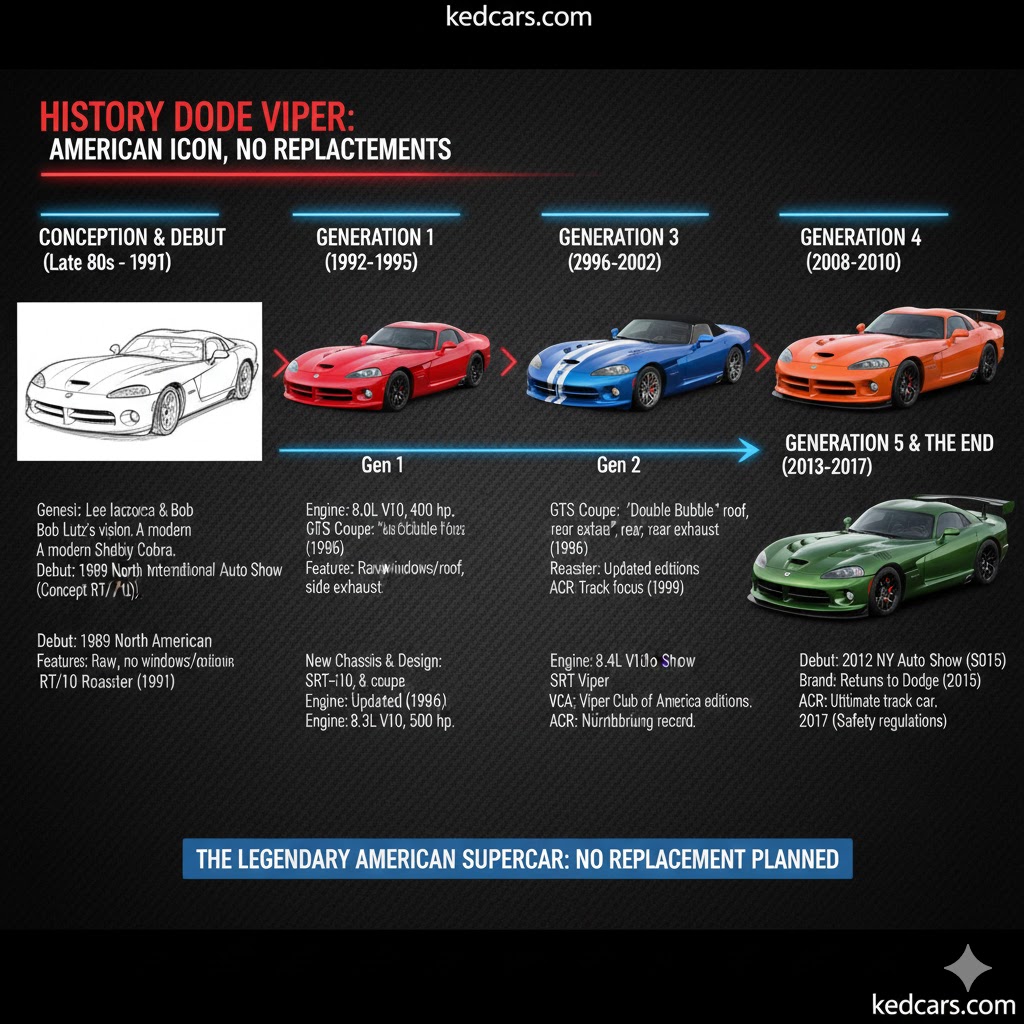
The Dodge Viper originated from a singular visionary question posed in late 1988 by Bob Lutz, then Chrysler’s president of operations: What if the American automobile manufacturer created a modern interpretation of the Shelby Cobra—a legendary hand-built, brutally powerful roadster that had dominated racing during the 1960s? This conceptual inquiry proved transformative, launching a development effort that would deliver a production automobile within approximately three years.
Lutz’s vision emphasized uncompromising performance through raw mechanical power rather than technological sophistication. He envisioned an automobile that would emphasize driver engagement, mechanical simplicity, and superb acceleration over convenience features and electronic mediation. The concept attracted attention from Carroll Shelby himself, the legendary engineer and racer who had created the original Cobra, and from Lee Iacocca, Chrysler’s chairman and CEO, who authorized the project in May 1990 despite severe financial constraints facing the company.
The Development Process and Lamborghini Partnership
Official development commenced in March 1989 when Chrysler assembled a specialized team of 85 engineers designated “Team Viper” under the leadership of Bob Sjoberg. The team faced extraordinary challenges: developing a completely new engine, creating an entirely novel chassis, and designing a production body—all within a severely constrained budget of approximately $70 million, modest by supercar development standards.
The most significant technical challenge involved the engine. Team Viper requested that Lamborghini—then a Chrysler subsidiary—design and cast an aluminum engine block for the new automobile. Lamborghini engineers, working with Chrysler technical staff, developed the revolutionary V10 engine based on the Chrysler LA V8 platform, extending it with two additional cylinders and a longer stroke. By February 1990, the prototype V10 ran successfully, establishing the powertrain architecture that would define all subsequent Viper generations.
The First Generation: Raw Simplicity (1992-2002)
The 1992 Debut and Indianapolis 500 Pace Car Honor
The Dodge Viper made its official public debut in November 1991 when Carroll Shelby piloted a pre-production example as the pace car for the Indianapolis 500 race—an extraordinary honor that connected the new automobile directly to Shelby’s legendary racing heritage. The first retail shipments commenced in January 1992, introducing an automobile that defied conventional supercar conventions.
The original 1992 Dodge Viper RT/10 arrived with almost spartan simplicity. The roadster featured a tubular steel frame with resin-transfer-molded fiberglass body panels, weighing merely 3,280 pounds—extraordinary lightness for an automobile powered by an 8.0-liter engine. The cabin provided essential controls but rejected luxury appointments: the steering wheel was unassisted, traction control was absent, anti-lock brakes were unavailable, and air conditioning was optional. The focus remained singular: deliver raw performance to drivers willing to accept the responsibility.
The Legendary V10 Engine and Performance Specifications
The original Viper V10 displaced 7,990 cubic centimeters (8.0 liters), establishing the largest engine displacement in any contemporary production automobile. The naturally-aspirated engine produced 400 horsepower at 4,600 rpm and 450 pound-feet of torque at 3,600 rpm, paired exclusively with a six-speed manual transmission driving the rear wheels. This powertrain delivered extraordinary performance: the 1992 Viper achieved 0-60 mph acceleration in approximately 4.0 seconds and reached a top speed of 180 mph.
This performance emerged from mechanical simplicity rather than technological sophistication. The engine featured sequential multipoint fuel injection with bottom-fed injectors, dual throttle bodies, and dual plenums, along with cast aluminum block and heads with magnesium valve covers—engineering that emphasized lightweight construction and responsive power delivery. The V10 represented the most powerful naturally-aspirated engine available in any production automobile of its era.
GTS Variant and Production Expansion (1996-2002)
In 1996, Dodge introduced the Viper GTS, a closed-coupe variant of the roadster featuring modern aerodynamic bodywork and enhanced weather protection. The GTS proved more practical for daily driving without sacrificing performance credentials. The engine received incremental refinement, achieving 450 horsepower at 5,200 rpm and 490 pound-feet of torque at 3,700 rpm in 1996 configuration.
Production volume established the Viper as a genuine commercial success: approximately 8,000 RT/10 roadsters and 3,000 GTS coupes were manufactured during the first-generation run (1992-2002), demonstrating that buyers worldwide would purchase uncompromising, deliberately difficult automobiles emphasizing mechanical engagement. The first generation established the Viper’s fundamental character: snake-like aggression, brutal power delivery, and rejection of electronic mediation.
The Second Generation: Evolution and Refinement (2003-2010)
The Third and Fourth Generation Power Evolution
The third-generation Viper, introduced for 2003, featured expanded engine displacement to 8,285 cubic centimeters (8.3 liters), increasing output to 510 horsepower at 5,600 rpm and 535 pound-feet of torque at 4,200 rpm. These increases maintained the naturally-aspirated philosophy while delivering superb performance: the 2003 Viper achieved 0-60 mph in 3.9 seconds and reached 190 mph top speed.
The fourth-generation Viper, introduced for 2008, witnessed further refinement of the basic formula. The engine displacement increased marginally to 8,382 cubic centimeters (8.4 liters), with sophisticated engineering developed in collaboration with McLaren delivering 600 horsepower at 6,100 rpm and 560 pound-feet of torque at 5,000 rpm. The 2008 Viper SRT10 achieved 0-60 acceleration in 3.7 seconds and approached 200 mph top speed—supercar-level performance from a naturally-aspirated engine.
The Fifth Generation and Track Dominance (2013-2017)
The Final Evolution and Peak Performance
The fifth and final generation Viper, reintroduced after a brief hiatus in 2013 under the SRT (Street and Racing Technology) brand, represented the apex of naturally-aspirated performance. The V10 engine achieved 645 horsepower at 6,200 rpm and 600 pound-feet of torque at 5,000 rpm—claims of highest torque output of any naturally-aspirated automotive engine in the world. The 2013-2017 Viper achieved 0-60 mph in 3.3 seconds and surpassed 200 mph top speed, establishing performance figures rivaling purpose-designed supercars.
The final generation witnessed improved aerodynamic efficiency and refined chassis dynamics while maintaining the fundamental Viper character: manual transmission exclusively, rear-wheel-drive layout, and mechanical engagement without electronic mediation (though traction control and stability systems became available by final years). The final Dodge Viper rolled off assembly lines in August 2017, concluding 25 years of continuous production.
Racing Heritage and Track Record Achievement
Le Mans and International Competition
Beyond street performance, the Viper achieved legendary status through motorsport competition. The Viper GTS-R variant competed extensively in international racing series, including the prestigious 24 Hours of Le Mans, where Viper entries demonstrated consistent reliability and speed against purpose-designed racing machines. The 1997 Viper GTS-R team achieved the FIA GT2 Championship, establishing the Viper as a legitimate racing platform despite its full street-legal configuration.
The final generations of Viper achieved extraordinary track performance. The Viper ACR (American Club Racer) variant accumulated more track records than any production automobile in history. Notably, a 2016 Dodge Viper ACR piloted by professional driver Randy Pobst established a 1:28.65 lap record at Laguna Seca—a time exceeding the capabilities of significantly more technologically advanced supercars. This achievement validated the Viper’s fundamental philosophy: raw power and mechanical excellence could produce performance transcending contemporary automotive technology.
Design Language and Visual Identity
Aggressive Proportions and Menacing Aesthetics
The Viper’s distinctive design language emphasized aggressive, menacing proportions that conveyed the automobile’s dangerous character. The design featured wide, muscular bodywork with pronounced hood sculpting, distinctive side strakes running from fender to rear quarter panel, and aggressive front fascia with prominent air inlets. The proportions communicated danger: the Viper looked fast standing still.
Visual continuity across generations maintained design coherence despite mechanical evolution. The third, fourth, and fifth generations retained proportions and styling treatments recognizable from the original 1992 design, yet incorporated contemporary aerodynamic refinements and subtle styling evolution. The twin racing stripes that decorated most Viper examples became iconic visual identifier, evoking the legendary Shelby Cobra livery that inspired the entire design philosophy.
Production Discontinuation and Final Years (2015-2017)
The Heritage Editions and Final Production
As production conclusion approached, Dodge introduced special Heritage Editions celebrating Viper history. The 1:28 Edition ACR commemorated the Laguna Seca lap record, limited to 28 units. The GTS-R Commemorative Edition, limited to 100 units, paid tribute to the 1998 Championship Edition featuring white bodywork with blue racing stripes. These final variants acknowledged the Viper’s racing legacy while celebrating the nameplate’s approaching discontinuation.
The final Dodge Viper—a red GTS coupe—rolled off assembly lines in August 2017, reserved for Chrysler’s heritage collection. Production totaled approximately 31,850 examples across all five generations and 25 years, establishing the Viper as a remarkable commercial success for an uncompromising, deliberately difficult supercar. The discontinuation reflected market realities: sports car sales declined, regulatory requirements necessitated increasingly complex engineering, and consumer preferences shifted toward utility-focused vehicles.
The Viper’s Uncompromising Legacy
The Dodge Viper’s 25-year production run and approximately 32,000-unit sales volume stands as testament to the enduring appeal of uncompromising automotive philosophy. In an industry increasingly pursuing electronic sophistication, driver assistance systems, and safety features, the Viper rejected those conventions, delivering raw performance and mechanical engagement to drivers willing to accept responsibility.
The Viper proved that supercar performance required neither turbocharged complexity nor hybrid-electric systems, but rather disciplined mechanical engineering and courageous manufacturing decisions. The automobile achieved more track records than any competing production car, establishing performance credentials exceeding machines with significantly greater technological sophistication. The Viper demonstrated that driver skill, mechanical reliability, and raw power could overcome electronic mediation and computerized assistance.
Today, surviving Vipers enjoy strong enthusiast appreciation and collector interest. First-generation examples command premium valuations for historical significance. Later generations, particularly the track-focused ACR variants, achieve strong secondary-market prices reflecting their genuine performance capability. The Viper’s discontinuation elevated rather than diminished its significance: as automotive industry trends accelerated toward electrification and autonomous technology, the Viper’s final years represented the last expression of an earlier automotive philosophy emphasizing driver engagement over technological sophistication.
For drivers and collectors, the Dodge Viper endures as proof that uncompromising engineering principles could deliver superb performance and genuine driving pleasure. The Viper required more from drivers, demanded more from owners, and offered more to enthusiasts willing to accept responsibility for operating a genuinely powerful automobile. In that measure, the Viper represents one of American automotive history’s most significant and culturally important creations—a vehicle that refused to apologize for its nature and celebrated the pure joy of mechanical performance.