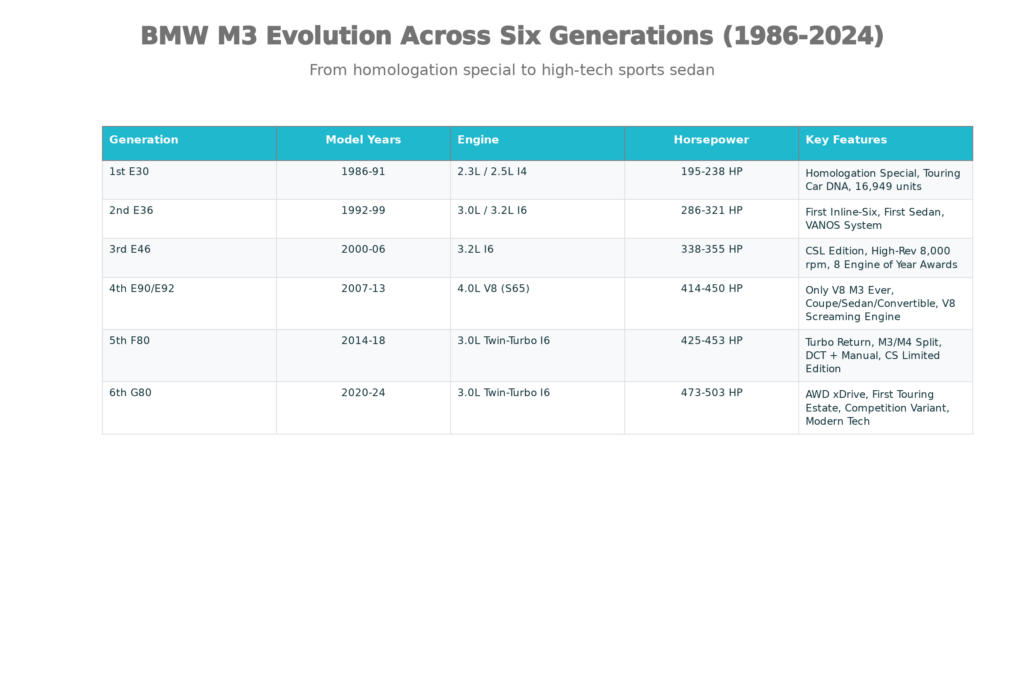
The BMW M3 stands as one of automotive history’s most significant performance achievements, representing the pinnacle of high-performance sedan engineering across six distinct generations spanning four decades since its groundbreaking 1986 debut. Born from motorsport necessity as a homologation special designed to compete in the Deutsche Tourenwagen Meisterschaft (DTM), the original E30 M3 evolved from a niche competition vehicle into a global performance icon that fundamentally redefined expectations for affordable, road-legal performance cars. With approximately 1.2 million M3 variants manufactured through 2024, combined with broader M division sales exceeding 206,582 vehicles annually, the BMW M brand represents the most successful high-performance vehicle manufacturer globally, consistently outselling Mercedes-AMG and other competitors by significant margins. The M3’s continuous evolution from a lightweight, naturally-aspirated four-cylinder homologation special through turbocharged straight-sixes, legendary V8-powered generations, and contemporary twin-turbocharged engines demonstrates BMW’s commitment to technological innovation balanced against the preservation of driver engagement and mechanical authenticity that defines the marque’s motorsport DNA.
Origins and the Homologation Imperative
The 1986 Frankfurt Motor Show Debut and DTM Connection
The BMW M3 made its historic public debut at the Frankfurt Motor Show in September 1985, presented as the model that would become the most successful touring car in motorsport history. The original E30-generation M3 emerged directly from motorsport requirements: Group A touring car regulations mandated that manufacturers produce a minimum of 5,000 road-legal examples within a twelve-month period to homologate racing variants for competition. Rather than viewing this requirement as a constraint, BMW Motorsport GmbH engineers recognized an extraordinary opportunity to create a street-legal performance vehicle that could simultaneously serve racing ambitions and consumer desires for accessible high performance.
The first production BMW M3 commenced manufacturing in March 1986, initially offered exclusively in coupé body style with a limited production run of convertible variants arriving subsequently. The design represented a masterclass in lightweight engineering discipline: engineers stripped unnecessary components, employed aluminum body panels wherever structurally feasible, and focused on mechanical simplicity that enabled owner maintenance rather than dealer-dependent complexity. Despite these weight-reduction efforts, the first generation actually exceeded customer expectations in production volumes – approximately 16,949 examples were manufactured through June 1991, far exceeding the 5,000-unit homologation requirement and demonstrating genuine consumer enthusiasm for BMW’s performance philosophy.
The Four-Cylinder Revolution and Motorsport Validation
The original E30 M3 employed a high-revving inline four-cylinder engine producing 200 horsepower initially, with evolution variants reaching 238 horsepower through displacement increases from 2.3 to 2.5 liters. This engine configuration, derived from the legendary BMW M1 race car’s cylinder head technology, operated at sensational revolutions – the racing variant achieved 8,200 rpm peak power delivery, extraordinary for production-era engines. The straightforward mechanical simplicity enabled any competent technician to understand and maintain the powerplant, establishing the foundation for M3 reliability reputation that persists across contemporary models.
Motorsport success arrived immediately and persistently: in the 1987 World Touring Car Championship debut season, the racing M3 secured victories across multiple international championships including the WTCC, ETCC, DTM, and Australian Touring Car Championship – an unprecedented sweep of major touring car competitions. Between 1987 and 1992, the E30 M3 accumulated 41 DTM victories, establishing the platform as the most successful touring car in the championship’s early history. This racing pedigree translated directly into road car credibility: potential customers understood that M3 technology had proven itself repeatedly against dedicated racing machinery and established competitors.
Generational Evolution and Performance Escalation
The E36: The Straight-Six Era (1992-1999)
The second-generation E36 M3 initiated a fundamental philosophical shift: rather than emphasizing lightweight agility and high-revving mechanical engagement, the E36 pursued raw power and technological sophistication. The new naturally-aspirated three-liter straight-six engine produced 286 horsepower at 7,000 rpm, representing a dramatic 86 horsepower increase over the previous generation’s peak output. This engine configuration established the six-cylinder foundation that would define M3 character through subsequent generations – a high-revving, mechanically sympathetic design that delivered emotional engagement alongside genuine performance.
The E36 generation produced approximately 27,000 examples through 1999, establishing the M3 as a genuinely desirable enthusiast vehicle rather than a limited-production homologation special. The introduction of the sedan variant in 1994 expanded the market significantly: until this point, high-performance vehicles remained largely confined to coupe and convertible body styles. The M3 sedan proved that four-door practicality and serious performance could coexist – a revolutionary concept that subsequent generations would elaborate upon.
The E46: The Balanced Perfect (1999-2006)
The third-generation E46 M3 achieved near-universal acclaim among enthusiasts and journalists as potentially the most balanced, engaging high-performance sedan ever manufactured. The power increased to 333 horsepower from a 3.2-liter naturally-aspirated straight-six engine, yet the primary advancement involved superior chassis dynamics and refined suspension geometry. The E46 achieved legendary status through its combination of sophisticated engineering, accessible performance, and emotional mechanical engagement – attributes that contemporary observers frequently cite as the M3’s golden era.
Approximately 65,000 E46 M3 variants were manufactured across both coupe and sedan configurations through 2006. The legendary E46 M3 CSL variant, produced in limited quantities, represented the ultimate expression of this generation: the carbon fiber roof, aluminum bonnet, composite body kits, and lightened rear window glass reduced curb weight by 110 kilograms compared to base M3 models, enabling exceptional performance delivery from the base engine configuration. Contemporary evaluations rank the E46 generation as the quintessential driver’s M3 – the architecture that balanced performance capability with mechanical simplicity in proportions never subsequently replicated.
The E90: The V8 Exception (2007-2013)
The fourth-generation E90 M3 introduced a remarkable anomaly in M3 history: an eight-cylinder engine. The S65 V8, derived from the legendary S85 V10 employed in the contemporary M5, produced 420 horsepower while weighing slightly less than the predecessor straight-six despite featuring two additional cylinders. The engine operation extended to an astonishing 8,400 rpm redline, making it the highest-revving series V8 ever developed by BMW. Contemporary observers debated whether this four-hundred pound weight penalty compared to lighter E46 models actually compromised the M3 formula, despite the engine’s undeniable theatrical appeal and mechanical sophistication.
The E90 M3 produced approximately 38,000 examples through 2013, marking a return to coupe-focused production emphasis after the E46’s balanced sedan popularity. The introduction of the M-DCT dual-clutch transmission alongside the available six-speed manual provided customers with a technological choice previously unavailable. The E90 generation demonstrated that raw power and technical sophistication could deliver performance that transcended the E46’s elegant restraint – a purely subjective assessment that continues generating passionate debate among M3 enthusiasts regarding whether earlier simplicity or contemporary complexity delivered superior driving experiences.
The F80: The Turbo Transition (2014-2020)
The fifth-generation F80 M3 initiated the most controversial transformation in the nameplate’s history: the complete replacement of naturally-aspirated straight-six engines with twin-turbocharged alternatives. The S55 engine produced 431 horsepower initially, escalating to 460 horsepower in Competition variants – delivering extraordinary low-end torque previously unavailable through naturally-aspirated configurations. This turbo orientation fundamentally altered M3 character: instead of the responsive, linear power delivery of naturally-aspirated predecessors, drivers experienced instantaneous acceleration from 2,000 rpm onward, with the accompanying boost pressure creating a distinctly different emotional connection to acceleration.
The F80 generation produced approximately 66,000 examples globally. The introduction of the M xDrive all-wheel-drive system, though controversial among purists who valued the rear-wheel-drive simplicity of earlier generations, delivered genuinely superior traction and performance delivery in demanding conditions. Contemporary evaluations divided sharply: turbocharged proponents celebrated the power delivery and efficiency improvements, while traditionally-minded enthusiasts lamented the perceived loss of mechanical delicacy and high-revving mechanical response that defined earlier generations.
The G80: The Contemporary Sedan Renaissance (2020-Present)
The sixth-generation G80 M3, debuting in 2020, represents the current evolutionary pinnacle. The S58 twin-turbocharged straight-six engine produces 480 horsepower in standard configuration, escalating to 510 horsepower in Competition variants. The introduction of the M3 Touring variant in 2021 marked a historic milestone: the first M3 estate configuration in the nameplate’s thirty-five year history. This development reflected BMW’s recognition that serious enthusiasts increasingly preferred practical cargo capacity alongside performance capability – a demographic shift that previous generations largely ignored.
The G80 generation introduces all-wheel-drive capability through the M xDrive system, offering sophisticated torque distribution configurations spanning from predominantly rear-biased street driving through completely drift-oriented rear-wheel-drive engagement. The contemporary M3 sedan delivered approximately 47,000 units annually through 2024, with the M3 Touring achieving unexpected popularity representing 57 percent sales growth year-over-year. The technological sophistication escalates substantially compared to predecessors: fully digital instrument clusters replace mechanical gauges, adaptive suspension systems adjust hundreds of times per second, and integrated driver assistance systems approach autonomous capability levels.
Motorsport Dominance and Competitive Legacy
DTM Dominance: The Most Successful Touring Car Ever
The E30 M3’s motorsport pedigree established standards that subsequent vehicles built upon. Between 1987 and 1992, the original M3 secured 41 DTM victories alongside numerous European Touring Car Championship successes, establishing the platform as the most successful touring car of that era. This immediate competitive validation proved transformative for BMW’s brand positioning: racing success translated directly into consumer confidence in M3 reliability, performance, and engineering sophistication.
BMW’s DTM dominance extended across multiple generations. Following BMW’s return to DTM competition in 2012 after a twenty-year hiatus, the contemporary M3 DTM variants secured 10 victories, 9 pole positions, 7 fastest laps, and multiple manufacturer and driver championships through 2013. Between 2012 and 2020 in DTM Class 1 racing, BMW achieved 40 victories across nine seasons, establishing competitive consistency that reinforced M division credibility. The contemporary GT3 era beginning in 2021 sustained this motorsport trajectory, with BMW teams achieving championship-level results across multiple racing disciplines.
Global Racing Success and Competitive Breadth
Beyond DTM competition, M3 variants achieved success across diverse international racing categories. Twenty-four-hour endurance racing represented a particular strength: BMW 3-series derivatives won the Nürburgring 24-hour race multiple times, and contemporary M3-based entries continue achieving podium finishes against purpose-designed racing machinery. This breadth of competitive application – from single-make series through international endurance racing – demonstrated the M3’s engineering robustness and adaptability across vastly different competitive environments.
Engine Evolution and Technical Achievement
The S14: Lightweight Four-Cylinder Origins (1986-1992)
The original S14 four-cylinder engine represented engineering discipline applied to modest displacement. Utilizing 2.3-liter and 2.5-liter variants, this mechanically simple powerplant delivered its peak power at extraordinary revolution rates – 8,200 rpm in racing specification – enabling rapid throttle response and mechanical engagement unavailable through low-revving turbocharged designs. The straightforward port and polished cylinder head technology ensured any competent mechanic could diagnose and repair the powertrain without requiring proprietary diagnostic equipment.
The S50/S52: Straight-Six Establishment (1992-2006)
The transition to naturally-aspirated straight-six engines established the configuration that BMW M would employ continuously through 2019. These engines, derived from standard 325i base platforms but extensively modified through enhanced cylinder heads, variable valve timing systems, and carefully optimized intake and exhaust configurations, delivered exceptional specific output – horsepower per liter – that contemporary competitors struggled to match. The S54 variant in the E46 generation produced 333 horsepower from 3.2 liters, achieving 104 horsepower per liter – an exceptional metric for naturally-aspirated production engines.
The S65: The V8 Interlude (2007-2013)
The S65 V8, derived from the S85 V10 race engine, represented BMW’s most technically exotic M3 powerplant. Operating at 8,400 rpm peak power delivery, this engine achieved specific output exceeding 105 horsepower per liter – a remarkable achievement for a 4.0-liter naturally-aspirated V8. The engine required premium fuel, sophisticated cooling systems, and regular high-revving operation to function optimally, establishing an high-maintenance character that distinguished it from more mechanically forgiving alternatives.
The S55 and S58: The Turbocharged Contemporary Era (2014-Present)
The transition to twin-turbocharged straight-six engines represented the most significant powertrain philosophy shift since the V8 interlude. The S55 engine in the F80 generation produced 431-460 horsepower from 2.9 liters, establishing a new emphasis on low-end torque delivery and efficiency rather than high-revving mechanical response. The contemporary S58 variant, displacing 3.0 liters, produces 480-510 horsepower depending on configuration, delivering genuine supercar-equivalent acceleration while maintaining reasonable fuel consumption and emissions compliance.
These turbocharged engines employ sophisticated direct injection systems, variable valve timing, and electronically controlled wastegate technology that enables precise boost pressure management across accelerating and decelerating conditions. The dual-scroll turbocharger configuration, employing lightweight designs with electronic wastegates, delivers progressive boost delivery that avoids traditional turbo-lag characteristics while enabling effortless acceleration from low revolution rates.
Design Language and Generational Aesthetics
The M3’s design evolution reflects careful balance between mechanical function and visual communication. From the original E30’s understated aggression through the dramatic E46 proportions to the contemporary G80’s sophisticated menace, each generation communicates performance capability through strategic aerodynamic elements rather than flashy cosmetics. The characteristic quad exhaust outlets, aggressive front air intakes, and flared rear fenders establish visual M3 identity without requiring revolutionary exterior reshaping.
Importantly, each M3 generation remains visually and mechanically distinguishable from contemporary non-M 3-series variants – a design principle ensuring M3 exclusivity remains apparent at visual glance. The distinctive design language, refined iteratively across six generations, maintains visual coherence while embracing contemporary styling influences appropriate to each era.
Contemporary Market Performance and Sales Success
BMW M Division Dominance
The BMW M division achieved record performance in 2024, delivering 206,582 vehicles globally – the highest annual total in BMW M history. This unprecedented volume encompasses both full M performance models like the M3 and M-Performance variants including the M340i and M3-based vehicles. The M3 specifically accounted for significant portion of these sales, with the M3 Touring variant alone experiencing 57 percent year-over-year sales growth as customers discovered the practical utility of performance estate configurations.
By comparison, Mercedes-AMG delivered 68,202 vehicles in the first half of 2025, placing the German competitor dramatically behind BMW M’s pace. This market dominance reflects sustained customer preference for BMW’s performance philosophy across diverse vehicle categories and geographic markets. North American markets particularly embraced the contemporary M3: 2026 model year pricing begins at approximately $79,300 for base M3 sedans, with M3 Competition variants starting near $83,500, positioning genuine six-cylinder performance within reach of affluent but budget-conscious buyers.
Regional Market Penetration
The M3 achieves exceptional market penetration across Europe, North America, and developing Asian markets. The introduction of the M3 Touring variant proved particularly popular in European markets, where practical cargo capacity frequently influences high-performance vehicle purchasing decisions. Chinese markets similarly embrace the M3 positioning, with contemporary generation models achieving sustained demand despite broader luxury vehicle market softness affecting competitors.
The M3 Touring: Breaking Tradition
The First-Ever M3 Estate Configuration
The BMW M3 Touring G81, debuting in 2021, represents a watershed moment in M division history. Despite decades of speculation regarding potential estate variants, the original plan contemplated a one-off E46 M3 Touring test mule constructed in 2016 – merely confirming that the concept was technically feasible. The production reality arrived five years later, demonstrating BMW’s commitment to delivering practical solutions alongside performance capability.
The M3 Touring delivers authentic high-performance capability while providing genuine cargo capacity that sedans cannot match. The extended wheelbase – 911 millimeters longer than the sedan variant – accommodates expanded interior packaging without visually compromising proportions. The initial year sales demonstrated unexpected enthusiasm: approximately 7,000 units were delivered in 2021, with subsequent years sustaining approximately 5,000-6,000 annual sales representing nearly half the sedan variant’s volume. The M3 Touring proved that serious enthusiasts increasingly prioritize practical versatility alongside performance authenticity.
Electrification and Future Direction
BMW’s Multi-Powertrain Strategy
BMW’s leadership confirmed in early 2025 that combustion-powered M3 variants will coexist alongside electric alternatives as long as regulation permits. The commitment to maintaining gasoline and hybrid engine options reflects BMW’s acknowledgment that mechanical engagement and driving authenticity remain valuable attributes that significant customer segments prioritize. Rather than pursuing wholescale electrification, BMW engineers a deliberately measured transition incorporating diverse powertrain options.
The confirmed roadmap indicates all-electric M3 (branded iM3) arrival in 2028, employing quad-motor architecture delivering reportedly 746 kilowatts output. Simultaneously, a combustion-powered M3 variant will arrive, likely featuring a hybrid-enhanced S58 engine incorporating mild-hybrid technology rather than the plug-in hybrid systems employed in the contemporary M5. This dual-powertrain approach enables customers to select preferred propulsion technology – a customer-centric strategy that acknowledges diverse preferences regarding driving characteristics and powertrain philosophies.
The Hybrid S58 Future
Evidence increasingly suggests that the next-generation gasoline M3 will feature a mild-hybrid S58 engine incorporating battery-assisted acceleration and recuperative energy recovery. This implementation would preserve the distinctive characteristics of contemporary M3 driving experience – high-revving mechanical engagement, responsive throttle feedback, and linear power delivery – while achieving Euro 7 emissions compliance required by increasingly stringent European environmental regulations. The hybrid implementation would provide instantaneous supplementary power during initial acceleration phases, effectively addressing turbo-lag characteristics while reducing thermal strain on the turbocharged engine.
The Bottom Line
The BMW M3’s four-decade evolution from a lightweight, naturally-aspirated homologation special into a sophisticated, turbocharged performance sedan represents one of automotive history’s most successful generational transformations. Over 1.2 million examples manufactured across six distinct generations, coupled with sustained market leadership overshadowing competitors across multiple geographic markets, establishes the M3 as fundamentally significant to automotive culture and engineering development. The nameplate’s ability to adapt continuously – transitioning from four-cylinders to six-cylinder naturally-aspirated engines, embracing V8 technology, and transitioning to turbocharged efficiency – while preserving core M philosophy regarding driver engagement and mechanical authenticity demonstrates remarkable strategic consistency across vastly different automotive eras.
The contemporary G80 M3, particularly the unprecedented Touring variant, represents perhaps the most versatile M3 generation ever produced. The combination of all-wheel-drive capability, adaptive suspension systems, sophisticated driver assistance technologies, and practical estate versatility ensures the M3 remains relevant to contemporary enthusiasts prioritizing both performance authenticity and everyday practicality. As automotive markets transition toward electrification, BMW’s commitment to maintaining combustion-powered alternatives through at least 2028 reflects mature understanding that driving pleasure derived from mechanical engagement possesses enduring appeal transcending technological fashion.
The BMW M3 endures as a testament to the possibility of meaningful vehicle evolution without abandoning foundational design principles. From the original E30’s motorsport-derived simplicity through contemporary G80 sophistication, successive generations refined engineering excellence while preserving the essential characteristic that distinguished the first M3: the conviction that genuine performance requires more than raw power – it demands balanced chassis dynamics, mechanical responsiveness, and emotional connection between driver and machine.