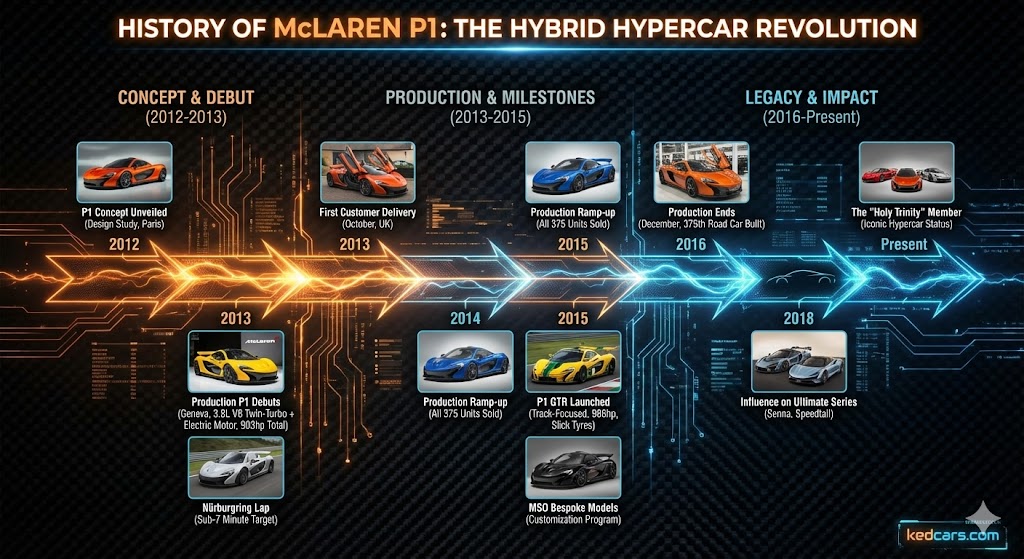
The McLaren P1 stands as one of automotive history’s most consequential expressions of engineering ambition and mechanical innovation, representing a watershed moment when hybrid technology transcended environmental compromise to become the preferred architecture for ultimate performance. Unveiled in September 2012 at the Paris Motor Show and produced through December 2015 with precisely 375 examples manufactured, the P1 established itself not merely as the spiritual successor to the legendary McLaren F1 but as a revolutionary statement of technological philosophy: that electric assistance could enhance rather than diminish driving dynamics, and that meticulous engineering could reconcile environmental responsibility with uncompromising performance.
The P1’s exceptional significance derived from its categorical rejection of convention. While competitors pursued turbocharging and traditional architecture refinement, McLaren pursued a deliberately contrarian path: combining a twin-turbocharged V8 engine with electric motor assistance to deliver 916 horsepower and 900 pound-feet of torque from modest displacement, achieving 0-60 mph acceleration in 2.8 seconds and 217 mph top speed. The P1 proved that hybrid technology need not compromise performance, legitimacy, or the essential joy of mechanical engagement—establishing the vehicle as part of the holy trinity of first-generation hybrid hypercars alongside the Ferrari LaFerrari and Porsche 918 Spyder.
Origins and the F1 Successor Vision
McLaren’s Strategic Imperative and Carbon Legacy
Development of the McLaren P1 commenced from a singular strategic realization: McLaren required a successor automobile to the legendary McLaren F1 (1992-1998), one of automotive history’s most consequential vehicles. The original F1, produced in merely 106 examples, had established McLaren as a manufacturer capable of conceiving and executing automotive excellence transcending conventional category definitions. Yet by the early 2010s, more than a decade had elapsed since the F1’s production conclusion without a true flagship model.
The P1 development team, led by McLaren’s engineering organization, faced extraordinary pressure to justify the nameplate. The designation itself—”P1″—referenced Formula One pole position, connecting the road car directly to McLaren’s racing DNA and establishing extraordinarily elevated performance expectations. The project commenced with unambiguous mandate: design and engineer “the best driver’s car in the world on both road and track,” leveraging McLaren’s 50 years of competitive racing experience and expertise in lightweight carbon fiber construction.
The Hybrid Advantage and Electric Motor Integration
Unlike competitors who pursued traditional turbocharged V8 configurations, McLaren engineers recognized an extraordinary opportunity: hybrid technology offered performance advantages rather than compromises when integrated intelligently. The electric motor would address the fundamental weakness of turbocharged engines—turbo lag—the momentary gap between throttle application and boost pressure establishment where power delivery remained absent.
The Instant Power Assist System (IPAS)—borrowed directly from Formula One technology—employed the electric motor to fill this power delivery gap. As the driver applied throttle, the electric motor would immediately produce maximum torque while the turbochargers spooled to operational boost pressure. The result: an effective powerband extending across 7,000 rpm rather than the typical turbocharged engine’s 5,000-6,000 rpm operational window, eliminating the lag that compromised responsiveness and enabling continuously linear power delivery throughout the acceleration band.
Development and the Paris Motor Show Debut (2012-2013)
The Design Philosophy and Aerodynamic Integration
The McLaren P1 design process employed absolute performance orientation rather than traditional styling convention. Designer Paul Howse’s concept philosophy emphasized “form follows function”—every visible element contributed to aerodynamic performance, cooling efficiency, or structural engineering rather than aesthetic embellishment. This disciplined approach distinguished the P1 from competitors pursuing more conventional beauty—the P1 appeared deliberately strange, with proportions optimized for wind tunnel verification rather than design studio consensus.
The most distinctive aerodynamic element involved the active rear wing, capable of extending up to 300 millimeters and adjusting its pitch angle to optimize downforce generation or drag reduction. The Drag Reduction System (DRS) button, inspired directly by Formula One technology, allowed drivers to flatten the rear wing for straightline speed, reducing aerodynamic drag by approximately 23%. Combined with sophisticated front flaps adjusting continuously based on driving dynamics, the P1 achieved 660 kilograms of downforce at 150 mph—generating aerodynamic grip rivaling many contemporary race cars.
The Revolutionary Hybrid Powertrain
At the P1’s heart resided a meticulously engineered hybrid system. The gasoline component featured a 3.8-liter twin-turbocharged M838TQ V8 engine producing 727 horsepower at 7,500 rpm and 720 pound-feet of torque. This engine, derived from McLaren’s experience with the MP4-12C, employed sophisticated direct injection and twin independent turbochargers that fed boost pressure through an intercooler system optimized for thermal management.
The electric component featured a single electric motor producing 176 horsepower and 260 pound-feet of torque, integrated with a sophisticated battery management system. The 17-kilowatt-hour battery pack provided sufficient charge for approximately 9 miles of all-electric driving at low speeds, enabling zero-emission urban commuting while maintaining full hybrid performance capability for demanding driving. The total system output reached 903 horsepower and 900 pound-feet of torque, achieved from relatively modest displacement through mechanical innovation rather than extreme displacement or engine fragility.
Production and Market Reality (2013-2015)
The 375-Unit Production Allocation and Manufacturing Process
When the production P1 was officially unveiled at the March 2013 Geneva Motor Show, McLaren surprised industry observers with a critical announcement: production would be limited to precisely 375 units. This arbitrary constraint reflected not manufacturing capability but rather deliberate scarcity marketing—McLaren understood that perceived exclusivity and actual unavailability would sustain collector desirability more effectively than unlimited production.
The strategy proved prophetic. All 375 production examples sold within mere months of unveiling, before the first retail delivery occurred. By November 2013, less than a year after Geneva presentation, McLaren had allocated all production capacity. The first P1 delivered to a retail customer arrived in October 2013, finished in Ice Silver with extensive carbon fiber detailing. Hand-assembled by a specialized team of 61 engineers working at a production rate of one vehicle daily, each P1 represented approximately 48 hours of dedicated labor.
Customization and Individualization Through Special Operations
McLaren’s Special Operations Department engaged in extraordinary customization programs, ensuring that no two P1 examples were mechanically or aesthetically identical. Owners could specify bespoke paint finishes, custom carbon fiber trim configurations, interior leather selections, and drivetrain calibrations. This approach transformed the P1 from standard production automobile into essentially hand-crafted bespoke vehicles, justifying the approximately $1.15 million base purchase price.
The final P1 delivered—in December 2015—exemplified this customization capability. Painted in Volcano Orange (a unique tinting process subsequently made available on other McLaren models), the final example featured exposed carbon fiber details, custom silver wheel specifications, and carbon-shell sports seats with black and orange Alcantara upholstery. McLaren reserved this final example for heritage collection consideration, yet ultimately sold it to a customer, concluding production with exceptional distinction.
Performance and Capabilities
Acceleration and Dynamics Verification
The P1 delivered performance credentials that transcended specification sheets. Independent testing confirmed 0-60 mph acceleration in approximately 2.8 seconds and 0-100 mph in under 5.2 seconds. Quarter-mile acceleration required approximately 9.8 seconds. These metrics positioned the P1 competitively with hypercars costing substantially more, whilst maintaining road legality and practical usability that dedicated racing machines could not match.
The suspension system featured hydro-pneumatic RaceActive Chassis Control (RCC), allowing ride height adjustment of approximately 50 millimeters between comfort and extreme performance configurations. In Race mode, the P1 lowered itself automatically, increasing ground effect suction and aerodynamic downforce whilst reducing aerodynamic lift. Combined with active aerodynamics, the suspension geometry created a vehicle that behaved like a Formula One car adapted for street use—continuously adjusting its mechanical stance to optimize performance based on driving inputs and road conditions.
Track Performance and the P1 LM Legacy
The Race-Only P1 GTR and Ultimate Track Variant
In 2015, McLaren introduced the P1 GTR, a race-only variant available exclusively to P1 owners. The GTR featured aggressive aerodynamic modifications, race-focused suspension geometry, and increased engine output of 986 horsepower—McLaren declining to disclose whether this enhancement derived from electrical boost modifications or V8 engine tuning. The GTR represented a genuine race car delivered in street-legal format, available for purchase for approximately $1.98 million with access to a global owner track day series.
Even more exclusive, the McLaren P1 LM emerged from collaboration with Lanzante Motorsports, converting five P1 GTR examples into road-legal variants incorporating even more aggressive aerodynamic packages and subtle engineering modifications. Most legendarily, a P1 LM achieved the Nürburgring Nordschleife lap record at 6:43.2, establishing the fastest production vehicle lap time around the world’s most challenging circuit—a record that persisted for years despite subsequent supercars attempting to exceed this achievement.
Design and Technical Achievement
Carbon Fiber Monocoque and Lightweight Construction
The P1’s chassis employed carbon fiber MonoCage construction, wherein the driver’s compartment, roof structure, and snorkel air intake formed an integrated composite structure. This architectural approach, borrowed from contemporary Formula One practice, achieved extraordinary rigidity with minimal weight—the entire carbon fiber chassis weighed merely 90 kilograms. The total vehicle kerb weight registered approximately 3,411 pounds (1,547 kg), extraordinarily light for a vehicle providing genuine passenger comfort and practical utility.
This weight discipline extended throughout the vehicle. The brake system featured bespoke carbon-ceramic discs developed in partnership with Akebono (McLaren’s Formula One supplier), delivering reliable stopping power across extreme thermal conditions. Stopping from 100 mph required merely 30.2 meters, competitive with contemporary supercars despite the P1’s absolute weight representing a genuine automobile rather than specialized machinery.
Collector Market and Contemporary Significance
Valuation and Investment Appreciation
The P1’s limited production of precisely 375 units transformed the automobile into an exceptionally exclusive collector vehicle. Original purchase prices commenced at approximately $1.15 million, yet contemporary resale values have escalated dramatically. Exceptional low-mileage examples command prices substantially exceeding original retail, with some transactions exceeding $2.0-2.5 million depending on specification, mileage, and service history.
The appreciation reflects genuine desirability transcending pure financial speculation. Buyers recognize the P1 as a watershed moment in automotive history: the vehicle that validated hybrid technology as genuinely superior architecture for uncompromising performance, rather than environmental necessity representing performance compromise. The P1’s achievement of track records and accelerated adoption of hybrid architectures across the industry established its historical significance independent of collectible rarity.
The P1’s Revolutionary Legacy
The McLaren P1’s extraordinary brief production run and enduring desirability testament to the transformative power of uncompromising engineering philosophy. In an automotive era increasingly prioritizing efficiency and regulatory compliance, the P1 refused compromise, delivering genuine supercar performance alongside environmental consciousness through disciplined hybrid integration.
The P1 proved definitively that hybrid technology need not represent automotive sacrifice. Instead, electric motor assistance enhanced driver engagement through elimination of turbo lag, improved power delivery linearity, and enabled multi-mode operation from silent electric commuting through extreme track performance. The vehicle vindicated McLaren’s vision of the future: lightweight, efficient, and uncompromisingly focused on driving excellence.
Today, the P1 stands alongside the Ferrari LaFerrari and Porsche 918 Spyder as the holy trinity of first-generation hybrid hypercars—vehicles that legitimized hybrid technology within supercar categories and established the architectural precedent for subsequent performance vehicles. As automotive industry continues transitioning toward electrification, the P1’s achievements remain influential: proof that mechanical excellence, lightweight construction, and disciplined engineering could deliver extraordinary performance transcending technological paradigm shifts.
The McLaren P1 represents one of automotive history’s most significant achievements: an automobile that successfully introduced revolutionary technology whilst maintaining performance credentials exceeding contemporary purely mechanical competitors. For engineers, designers, and driving enthusiasts, the P1 endures as validation of McLaren’s commitment to uncompromising excellence: the conviction that the best driver’s car on road and track requires no apology for its nature, regardless of powertrain architecture. In that measure, the P1 stands triumphantly among automotive engineering’s most successful and influential creations.