Origins: The Mission E Concept and Strategic Vision
The 2015 Frankfurt Debut and Electrification Commitment
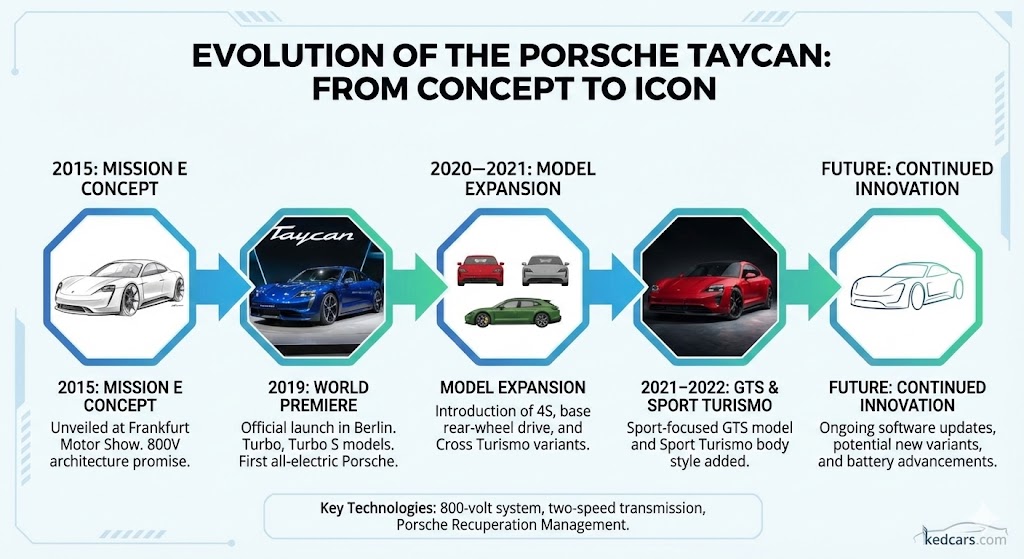
The genesis of the Porsche Taycan emerged from a bold strategic decision articulated at the 2015 Frankfurt International Motor Show, where Porsche unveiled the Mission E concept car. This four-door electric sports car represented Porsche’s public declaration of commitment to electrification—a strategic gamble that many industry observers considered existential risk to brand identity.
Chairman Dr. Oliver Blume articulated Porsche’s philosophical foundation: “We are resolutely taking on the challenge of electric mobility. Even with solely battery-powered sports cars, Porsche is remaining true to its philosophy and offering our customers the sportiest and technologically most sophisticated model in this market segment.” This statement established electrification not as compromise but as continuation of Porsche’s fundamental commitment to performance excellence.
The Mission E concept featured over 600 horsepower system output, over 500 kilometers driving range, and the industry’s first 800-volt electrical architecture—specifications that appeared theoretically achievable but practically unprecedented. Most significantly, the concept car established that Porsche electric vehicles would not sacrifice driver engagement, performance consistency, or emotional connection in pursuit of emissions reduction.
Development Philosophy and Weissach Innovation
Development of the production Taycan commenced at Porsche’s Weissach technical center, where engineers inherited 70 years of sports car DNA alongside responsibility for fundamentally reimagining Porsche identity through electrification. The development team, led by Heiko Mayer as drive unit project leader, established foundational principles emphasizing “intelligent performance”—a concept combining maximum acceleration capability with sustained output and exceptional efficiency.
The development process proved extraordinarily ambitious: prototype vehicles accumulated millions of testing kilometers across diverse global climates, from South Africa’s extreme heat (40+ degrees Celsius) to arctic cold conditions, validating that electric propulsion could deliver Porsche-grade reliability across environmental extremes. This comprehensive testing program reflected Porsche’s conviction that electrification could not compromise vehicle robustness or customer confidence.
On June 8, 2018, Porsche officially announced that the Mission E concept would become the production car, designated Porsche Taycan. The name derived from the Kyrgyz horse breed, conveying power, grace, and untamed spirit—qualities Porsche sought to embody through its electric sports car.
Revolutionary 800-Volt Architecture and Power Electronics
Dual Permanent-Magnet Synchronous Motors and Powertrain Innovation
The Taycan’s powertrain represented extraordinary technological achievement through dual permanently-excited synchronous motors (PSM)—one mounted on the front axle, one on the rear—delivering all-wheel-drive capability with independent torque control. The front motor operates through a single-speed gearbox with an 8.05:1 gear ratio, while the rear motor employs a sophisticated two-speed transmission featuring both a short planetary first gear (16:1 ratio) for maximum acceleration and a long second gear (8.05:1 ratio) for efficiency.
The rear two-speed transmission represented genuine innovation: the short first gear delivers maximum torque multiplication during initial acceleration, enabling the Taycan Turbo S to achieve 0-100 km/h in 2.4 seconds—performance rivaling dedicated hypercars. Engagement of the longer second gear at higher speeds maintains efficiency while supporting sustained performance, ensuring the Taycan can maintain full output across repeated acceleration cycles.
The dual-motor architecture delivered advantages transcending mere performance metrics. Independent front and rear motor control enabled sophisticated traction management during acceleration, enhanced cornering performance through coordinated torque vectoring, and exceptional braking regeneration—the Taycan could recover up to 400 kilowatts of energy during regenerative braking, recovering kinetic energy that competitors lost through conventional friction braking.
800-Volt System Architecture and Charging Revolution
The Taycan’s most revolutionary technical achievement was its 800-volt electrical system, double the 400-volt architecture standard across the broader electric vehicle industry. This higher voltage delivered cascading benefits: increased power delivery capability, reduced wiring weight, enhanced charging speed, and improved thermal efficiency through reduced resistive losses.
The 93-kilowatt-hour Performance Battery Plus (PB+) employed 33 modules with 12 LG Chem pouch cells each (396 cells total) operating at 723 volts nominal voltage, with a range of 610 to 835 volts. The battery doubled as a structural chassis component, lowering center of gravity and improving weight distribution. Ingeniously, designers incorporated “foot garages”—recesses into the battery pack—to increase rear-seat legroom without compromising luggage space.
The charging revolution proved profound: at compatible 800-volt DC fast chargers, the Taycan could charge from 10 to 80 percent capacity in just 18 minutes, adding approximately 180 kilometers of range during brief motorway stops. This charging speed eliminated what many observers considered electric vehicle’s fundamental limitation: range anxiety during long-distance travel. The Taycan transformed electric vehicles from weekend transporters into viable tools for long-distance road trips.
Sophisticated thermal management systems maintained optimal battery temperature through active liquid cooling during charging and driving, extending battery longevity while preserving performance across diverse environmental conditions. The battery could sustain 300+ kilowatts charging power for up to five minutes, enabling high-power charging across multiple rapid-charge sessions during extended road trips.
First-Generation Taycan (2019-2024): Powertrain Options and Performance Variants
Powertrain Hierarchy: From Base Models to Turbo S Extremes
The Taycan launched in September 2019 with the highest-performance variants: the Taycan Turbo and Taycan Turbo S. These flagship models delivered 500 and 560 kilowatts peak output (671 and 751 horsepower) respectively, with the Turbo S producing 1,050 Newton-meters of torque—exceeding many conventional supercars.
The Taycan Turbo achieved 0-100 km/h in 2.7 seconds, while the flagship Turbo S accomplished the same acceleration in 2.6 seconds—performance figures that dominated contemporary performance vehicles. More significantly, the Taycan delivered continuous sustained output of 460 kilowatts, enabling the vehicles to execute multiple consecutive hard acceleration runs without thermal throttling or performance degradation—a capability distinguishing the Taycan from many competitors that suffered performance loss after 1-2 aggressive acceleration cycles.
Subsequently, Porsche introduced more accessible variants: the 4S model with 390-420 kilowatts output (523-563 horsepower), the base Taycan with 300-350 kilowatts, and eventually the GTS variant with 440 kilowatts (590 horsepower) serving as the performance-focused option between 4S and Turbo models.
In 2021, Porsche introduced the Cross Turismo, a shooting brake variant combining the Taycan’s performance credentials with elevated seating position and expanded cargo capacity—expanding the Taycan’s addressable market to buyers prioritizing versatility alongside performance.
Battery Options and Range Evolution
The Taycan offered two battery configurations: the Performance Battery (PB) with 79.2 kilowatt-hour gross capacity (71 kWh usable) for base and 4S models, and the Performance Battery Plus (PB+) with 93.4 kilowatt-hour gross capacity (83.7 kWh usable) for premium variants. The PB option reduced total vehicle weight by approximately 76 kilograms, improving efficiency and acceleration at the cost of reduced range.
With the smaller battery, the base Taycan achieved approximately 280-300 kilometers real-world range, while PB+ variants delivered approximately 400-430 kilometers—genuine long-distance capability. The 2024 mid-cycle refresh increased battery capacity to 89 kilowatt-hours (PB) and 105 kilowatt-hours (PB+), improving range substantially while maintaining charging performance.
Market Competition and the Tesla Rivalry
Direct Competition with Tesla Model S
The Taycan entered a competitive landscape dominated by the Tesla Model S, which had enjoyed nearly a decade of electric performance dominance. Comparisons proved inevitable: the Taycan Turbo S with 751 horsepower and 1,050 Newton-meters torque closely matched the Tesla Model S Plaid’s 1,020 horsepower and 968 Newton-meters, though the Model S achieved fractionally superior acceleration (2.1 seconds versus Taycan’s 2.4 seconds in optimal conditions).
Yet the Taycan differentiated itself through distinct philosophical approaches: Tesla prioritized raw acceleration, maximum range, and autonomous driving sophistication, while Porsche emphasized driver engagement, chassis dynamics, sustained performance consistency, and premium interior craftsmanship. The Model S dominated specifications; the Taycan delivered superior ownership experience and emotional connection for drivers valuing traditional sports car character.
Pricing reflected these positioning differences: the 2024 Taycan Turbo S started at approximately $194,900 USD, while the Tesla Model S Plaid began near $104,900 USD—a $90,000 difference reflecting Porsche’s premium brand positioning and luxury manufacturing standards. The Taycan targeted affluent buyers willing to pay substantial premiums for heritage, craftsmanship, and Porsche’s legendary performance credentials.
Commercial Success and Market Evolution
Sales Performance and Production Ramp
Initial Taycan deliveries proved modestly below expectations: only 813 units were delivered in 2019, reflecting limited availability and market awareness. However, 2020 proved transformational, with 20,015 units delivered globally—approximately matching Porsche’s original production capacity targets despite a six-week production pause due to coronavirus disruptions.
The 2021 model year witnessed explosive growth to 41,269 deliveries, a doubling of sales even amid broader pandemic challenges. By this point, in certain European markets, the Taycan had become Porsche’s best-selling model, surpassing even the iconic 911 in unit volume. This remarkable commercial success vindicated Porsche’s decision to commit substantial engineering and manufacturing resources to electrification.
Cumulative global deliveries reached approximately 100,000 units by late 2025—extraordinary volume for a performance electric vehicle commanding premium pricing. The Taycan’s commercial viability demonstrated that consumers would accept significant price premiums in exchange for authentic performance credentials, heritage brand positioning, and refined driving experiences.
Market Challenges and 2025 Dynamics
However, Taycan sales declined beginning in 2022, reflecting broader market dynamics: expanding Tesla Model S production, growing competition from established luxury manufacturers entering electric performance vehicles, and consumer hesitation toward premium EV pricing amid economic uncertainty. By 2024, Taycan sales had stabilized at approximately 6,284 units in the US, suggesting the market had found equilibrium among enthusiasts willing to pay Porsche premium pricing.
The 2024 mid-cycle refresh and introduction of the revolutionary Turbo GT variant with 1,020 horsepower reignited performance interest. The Turbo GT shattered established lap records at prestigious circuits including the Nürburgring, demonstrating that electric vehicles could deliver not merely equivalent but genuinely superior performance to conventional combustion engines across real-world driving scenarios.
Design Philosophy and Brand Heritage Integration
Emotional Design Rooted in Porsche Tradition
The Taycan’s design maintained distinctive Porsche vocabulary while accommodating electrification requirements: the characteristic sloping hood, elongated front overhang, sculpted side profile, and truncated rear reflected seven decades of Porsche design language. Crucially, the four-door sedan configuration enabled rear-seat practicality while maintaining the performance character essential to Porsche identity.
The design achieved a remarkable drag coefficient of 0.22 (later improved to 0.20 with aerodynamic refinements), exceptional efficiency for a vehicle prioritizing performance over form-following-function extremism. The low 130-centimeter height conveyed sports car character despite the sedan body style, while integrated aerodynamic elements—subtle diffusers, low-drag mirrors, active rear wing—enhanced high-speed stability.
Interior design reflected Porsche’s philosophy of “openness” and “purist design”—expansive visibility, minimalist controls, and driver-focused ergonomics. The driver-centered cockpit, responsive controls, and responsive infotainment systems delivered the engagement expected from a marque built on racing heritage and performance obsession.
The Bottom Line
The Porsche Taycan’s extraordinary journey from Mission E concept through first-generation production and evolution toward 2025 leadership—achieving approximately 100,000 cumulative deliveries—represents one of automotive history’s most ambitious and ultimately successful strategic transformations. The Taycan demonstrated conclusively that electrification need not compromise performance, engagement, or the emotional connection that defines automotive passion.
Where the Porsche 911 endures through relentless evolutionary refinement of fundamental architecture, the Porsche Taycan endures through revolutionary acceptance of electrification while preserving core Porsche values. The Taycan established that an iconic performance brand could embrace complete electrification of its product portfolio without sacrificing authenticity, driver engagement, or performance excellence.
The Taycan’s 800-volt architecture established industry standards that competitors continue emulating. The vehicle’s sustained performance delivery—capable of executing multiple consecutive 0-60 acceleration runs without throttling or thermal degradation—set new expectations for electric vehicle robustness. The 18-minute charging capability transformed electric vehicles from charging-limited transportation to genuine long-distance viable alternatives.
As automotive manufacturing transitions toward universal electrification, the Porsche Taycan reminds manufacturers that consumers willingly accept premium pricing for authenticity, heritage, and genuine performance excellence. The Taycan vindicated Porsche’s strategic conviction that electrification represented opportunity rather than compromise, transformation rather than diminishment. The Taycan’s success established that the future of performance vehicles remains electrified, dynamic, and emotionally compelling—ensuring that Porsche’s legendary performance heritage remains eternally relevant to contemporary and future generations of driving enthusiasts worldwide.

It’s really a nice and helpful piece of information. I am happy that you simply shared this helpful info with us. Thanks for sharing.
Great work! This is the kind of info that are meant to be shared around the internet.
Disgrace on Google for not positioning this submit higher!