Genesis: The Four-Door Porsche Concept
Michael Mauer’s Design Vision and Controversial Reception
Michael Mauer, Vice President of Style at Porsche in 2004, inherited responsibility for designing a vehicle that challenged fundamental assumptions about Porsche identity. The directive proved deceptively simple yet profoundly demanding: create a four-door luxury sports sedan that maintained unquestionable Porsche performance character while accommodating rear-seat passengers, expanded cargo capacity, and all-weather practical usability.
Mauer’s design approach borrowed elements from the unrealized 989 prototype concept car from the late 1980s, adapting the 911’s characteristic bubble-butt rear proportions to a dramatically elongated sedan form. This controversial decision—extending the 911’s iconic visual language across a vehicle nearly 16 feet long—generated immediate skepticism and criticism. Mauer later acknowledged that board-mandated compromises significantly influenced the final design, with the designer regretting certain proportional decisions made to satisfy corporate requirements rather than purely design-driven ambition.
Technical Platform and Mechanical Engineering
The Panamera employed a front-mounted V8 or V6 engine in a rear-wheel-drive or all-wheel-drive configuration, fundamentally differentiating the sedan from Porsche’s traditional mid-engine 911 architecture. This front-engine layout, alongside the extensive rear overhang required to accommodate passengers and cargo, represented genuine engineering compromise from Porsche’s conventional performance principles.
Built alongside the Cayenne at Porsche’s Leipzig manufacturing facility in eastern Germany, the Panamera shared substantial technical commonalities with the larger SUV, including engines, transmission systems, and fundamental platform architecture. This shared engineering approach enabled cost-effective production while leveraging proven mechanical systems, though purists criticized the platform-sharing strategy as compromising Porsche’s exclusive engineering positioning.
The Shanghai Debut and Initial Reception
April 2009 Introduction and Market Positioning
The Panamera debuted to mixed critical reception: automotive enthusiasts praised genuine performance capability and dynamic chassis engineering, while design critics questioned the proportions and visual coherence of grafting 911 design language onto an extended sedan form. Autocar magazine infamously described the original Panamera as “extraordinarily ugly,” capturing sentiment among observers who considered the design commercially risky and aesthetically challenging.
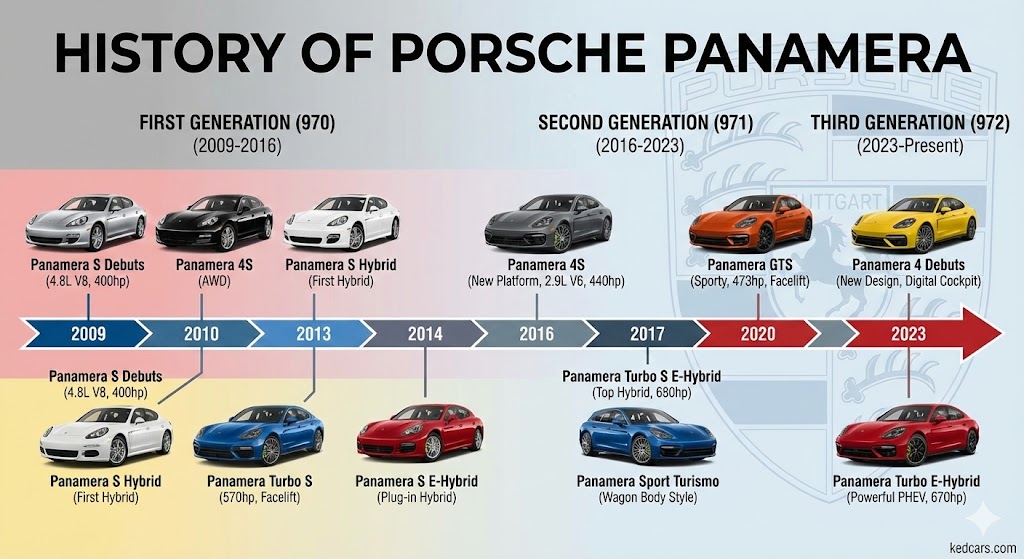
Initial powertrains reflected Porsche’s conservative approach: the Panamera S delivered 400 horsepower from a naturally-aspirated 4.8-liter V8, while the flagship Panamera Turbo produced 500 horsepower through twin-turbocharged V8 engineering. These power outputs positioned the Panamera competitively against Mercedes-Benz E63 AMG and BMW M5 competitors, establishing credible performance credentials despite the controversial styling.
Powertrain Evolution and Technical Development
From Naturally-Aspirated V8 to Hybrid Electrification
The Panamera’s mechanical complexity evolved dramatically across production. Initially, the lineup featured exclusively naturally-aspirated and turbocharged V8 engines. However, 2011 introduced Porsche’s first production hybrid vehicle: the Panamera S Hybrid, pairing a 3.0-liter supercharged V6 with electric motor technology for combined output of 380 horsepower—a remarkable figure for economy-focused hybrid performance.
The 2013 mid-cycle facelift (970.2) introduced the 3.0-liter twin-turbocharged V6, replacing traditional naturally-aspirated engines and establishing turbocharged efficiency as Porsche’s primary performance philosophy. Later, the Panamera S E-Hybrid introduced plug-in hybrid technology with 25.9 kilowatt-hour battery capacity, enabling approximately 90-96 kilometers of purely electric driving range—genuine capability for daily commuting without internal combustion engine assistance.
The Second Generation: Peter Varga’s Design Redemption
2016 Redesign and Critical Acceptance
The second-generation Panamera, designed by Peter Varga and introduced in 2016, achieved what Mauer’s first-generation design could not: widespread critical acceptance and positive public reception. Varga’s approach straightened the rear deck, emphasized horizontal lines rather than the earlier bulbous proportions, and created a distinctly more mature visual identity.
Beyond styling improvements, the second-generation incorporated genuine engineering advancement: the MSB (Modulare Standard Baukastensystem) platform provided superior rigidity, reduced weight, and improved interior spaciousness. The 971 generation demonstrated conclusively that Porsche had resolved the design challenges that plagued the original Panamera, delivering a vehicle that achieved commercial success, critical acceptance, and unquestionable Porsche performance character simultaneously.
Market Performance and Commercial Success
Sales Achievement and Market Leadership
The Panamera achieved remarkable commercial success: approximately 815,000 cumulative units delivered across all generations through 2025, establishing the model as one of Porsche’s most commercially significant products. In 2024 alone, Porsche delivered 29,587 Panamera units globally, with approximately 3,982 sales in the U.S. market.
This sustained commercial performance vindicated Porsche’s strategic gamble to expand beyond traditional sports car positioning. The Panamera demonstrated that sophisticated buyers willingly accepted Porsche’s controversial four-door sedan concept provided the vehicles delivered genuine performance, engineering authenticity, and the emotional engagement distinguishing Porsche from conventional luxury sedans.
The Third Generation: Electrification Strategy and Future Direction
2023 Introduction and Hybrid-First Philosophy
The third-generation Panamera, introduced in November 2023, represented comprehensive strategic reorientation toward electrification. The 972 generation abandoned traditionally-configured petrol engines in favor of four E-Hybrid powertrain variants, with Porsche responding to “enormous customer demand” for plug-in hybrid technology across global markets.
The new architecture incorporated 2.9-liter twin-turbocharged V6 paired with electric motors and 25.9 kilowatt-hour battery capacity, delivering combined output of 470-670 horsepower across variant levels. Porsche claimed the third-generation E-Hybrid achieved up to 70% greater electric-range capability compared to predecessors, enabling extended purely electric operation for daily commuting.
Performance Capability and Hybrid Technology Integration
The Panamera Turbo E-Hybrid achieved 2.8-second 0-60 mph acceleration with Sport Chrono package activation, demonstrating that hybrid electrification need not compromise authentic performance delivery. The sophisticated electric motor architecture, completely integrated within the transmission housing, optimized throttle response through reduced mass inertia while improving energy recuperation efficiency through regenerative braking technology.
Design Evolution and Market Differentiation
From Controversial Proportions to Accepted Luxury Standard
The Panamera’s design journey reflects broader automotive trends: the first-generation’s polarizing proportions—frequently criticized as “bloated” and “ungainly”—eventually found aesthetic defenders recognizing the design’s honest expression of mechanical requirements. The generous rear overhang accommodated passenger comfort, the elongated hood housed powerful V8 engines, and the overall proportions reflected functional honesty rather than arbitrary styling excess.
The second-generation’s design refinement achieved what Mauer could not: simultaneous commercial acceptance and critical appreciation. Peter Varga’s approach demonstrated that mature design philosophy, disciplined proportions, and thoughtful detail resolved the aesthetic challenges plaguing the original Panamera. By 2016, the Panamera had become a benchmark luxury performance sedan rather than an automotive curiosity.
The Bottom Line
The Porsche Panamera’s remarkable sixteen-year production run—from 2009 through present day, producing approximately 815,000 cumulative vehicles—represents one of automotive history’s most important transformations. The Panamera proved that Porsche could venture beyond traditional two-door sports car positioning while maintaining fundamental brand identity: authentic performance engineering, driver-focused dynamics, and mechanical excellence.
The Panamera’s controversial genesis, marked by polarizing styling and skeptical reception, eventually yielded comprehensive success: generations of buyers demonstrated that four-door practicality, family-oriented accommodation, and luxury amenities remained compatible with Porsche’s fundamental performance promise. The vehicle established that performance luxury sedans could achieve mass-market commercial viability while maintaining genuine driving engagement and mechanical authenticity.
As automotive manufacturing transitions toward universal electrification, the Panamera’s evolution from turbocharged V8 performance to sophisticated plug-in hybrid technology demonstrates Porsche’s willingness to embrace electrification without sacrificing performance heritage. The Panamera remains committed to the principle that drives all Porsche vehicles: mechanical excellence, emotional engagement, and the conviction that driving dynamics transcend powertrain configuration.
The Porsche Panamera stands as testament to the proposition that controversial ideas, pursued with uncompromising engineering excellence and genuine performance commitment, eventually achieve acceptance and acclaim. The Panamera proved that Porsche could expand its traditional boundaries while remaining eternally true to fundamental brand values—ensuring that the four-door sports sedan remains an increasingly important component of Porsche’s contemporary portfolio and future automotive vision.