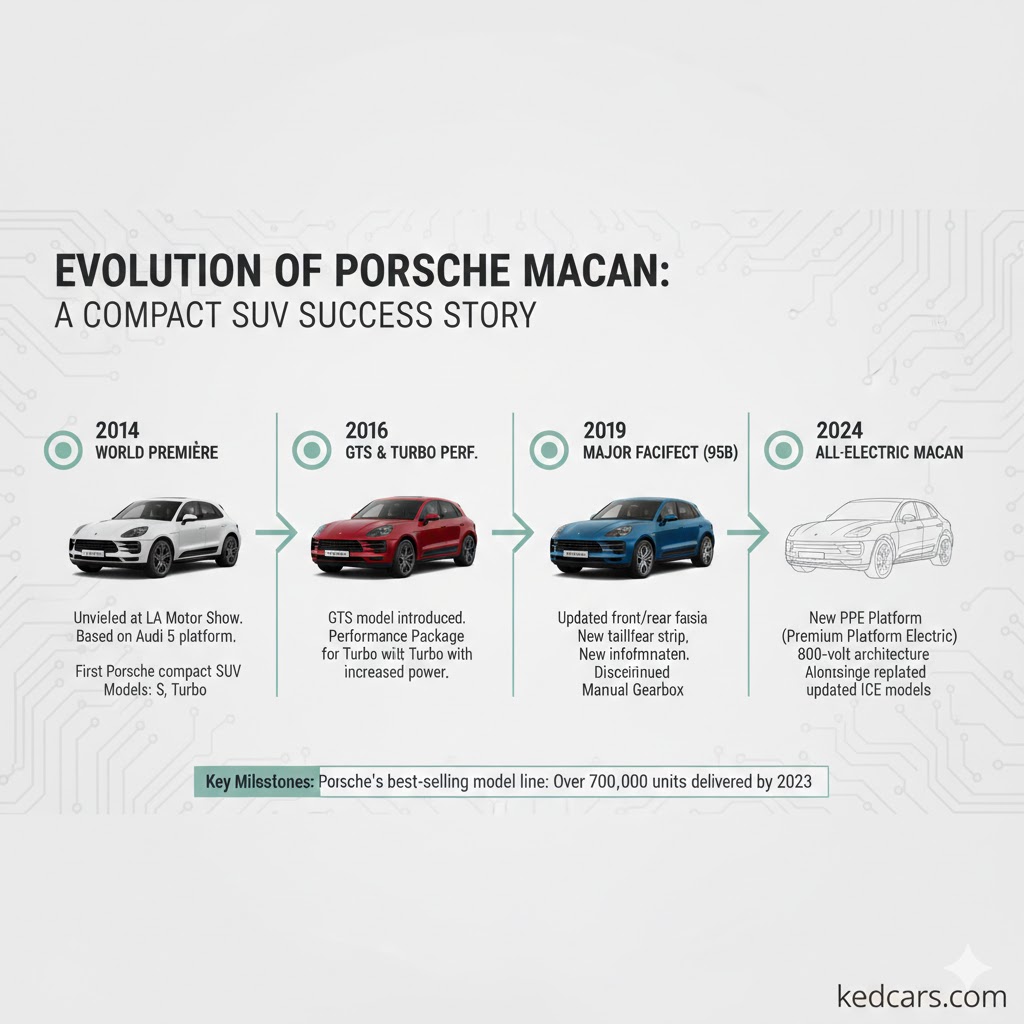
The Porsche Macan stands as one of the automotive industry’s most successful luxury compact SUV offerings, representing Porsche’s calculated entry into the burgeoning compact crossover segment that conventional competitors had begun dominating throughout the 2010s. Introduced in 2014 and continuously evolving through a decade of production with more than 600,000 examples delivered globally, the Macan transformed Porsche’s market positioning from sports car manufacturer to diversified automotive brand without compromising engineering excellence or performance standards. Named after the Indonesian word for tiger, the Macan embodied Porsche’s conviction that compact SUV buyers could experience sports car dynamics alongside practical utility – a proposition that market response validated definitively through exceptional sales performance that positioned the Macan as Porsche’s second-bestselling model line.
The Macan’s exceptional commercial and critical success derived from Porsche’s disciplined approach to platform sharing while maintaining uncompromising engineering standards. Rather than degrading Porsche’s identity through compromised design or passive engineering, the Macan inherited Porsche’s DNA of driver engagement, mechanical excellence, and performance-oriented development while offering customers the practical advantages of SUV packaging. The nameplate proved that enthusiasts and pragmatists could coexist within a single automobile: the Macan delivered legitimate performance credentials alongside real-world practicality, establishing itself as the gateway drug for Porsche ownership for an entirely new demographic of affluent buyers prioritizing versatility.
Origins and the “Cajun” Concept
The Development Vision and Project Codename
Development of the Porsche Macan commenced in the early 2010s when Porsche recognized the extraordinary market opportunity presented by the rapidly expanding luxury compact SUV segment. The project bore the internal codename “Cajun” – a playful reference combining “Cayenne” (Porsche’s larger SUV, introduced in 2002) with “Junior,” reflecting the strategic positioning of the new vehicle as a smaller, more agile alternative positioned below the Cayenne in both pricing and dimensional terms.
This market positioning proved prescient. By 2014, luxury compact SUVs had emerged as one of the automotive industry’s fastest-growing segments globally, driven by affluent consumers seeking practical transportation without sacrificing brand prestige or performance credentials. Porsche’s analysis recognized an exceptional opportunity: existing compact luxury SUV competitors (primarily Audi Q5 and BMW X3) delivered competent engineering but lacked genuine sports car dynamics. Porsche envisioned a vehicle delivering authentic Porsche performance character within the compact SUV packaging that market demand clearly validated.
Platform Strategy and Volkswagen Group Architecture
Rather than developing an entirely novel platform at extraordinary capital cost, Porsche adopted the Volkswagen Group MLB platform – the same architecture underpinning the Audi Q5, established Mercedes GLC, and numerous other luxury crossovers. This pragmatic decision enabled rapid development and production launch while preserving capital for engineering refinements that would distinguish the Macan from mere platform-sharing competitors.
The platform sharing reflected sophisticated understanding of modern automotive economics: fundamental architecture constraints imposed by safety requirements, emissions regulations, and manufacturing integration rendered unique platform development economically unjustifiable for a compact SUV. Instead, Porsche invested development resources systematically in chassis tuning, suspension refinement, engine calibration, and driver-interface ergonomics – the precise engineering elements that would deliver differentiated Porsche character upon fundamentally conventional architecture.
The First Generation: 2014-2018 Debut and Market Establishment
The Los Angeles Auto Show Premiere and Initial Specifications
The Porsche Macan made its official public debut in November 2013 at the Los Angeles Auto Show, though the press designation bore the original “Cajun” codename prior to the final market name introduction. The nameplate – referring to the tiger in Indonesian language – conveyed Porsche’s aspirational messaging: combining feline grace and agility with predatory capability.
The initial Macan lineup offered two distinct powertrain configurations. The Macan S featured a 3.0-liter twin-turbocharged V6 engine producing 340 horsepower and 339 pound-feet of torque, paired exclusively with a seven-speed Porsche-Doppelkupplungsgetriebe (PDK) dual-clutch automatic transmission driving all four wheels. The Macan Turbo variant featured a 3.6-liter twin-turbocharged V6 engine producing 400 horsepower and 406 pound-feet of torque, delivering substantially more aggressive performance while maintaining the same transmission and all-wheel-drive standard.
Performance Credentials and Dynamic Character
The Macan S achieved 0-60 mph acceleration in approximately 6.2 seconds, competitive with considerably larger luxury sedans from competing manufacturers. The substantially more potent Macan Turbo achieved 0-60 mph in 4.8 seconds, legitimately quick performance by any objective automotive measurement. Top speed reached 152 mph for the S variant and 160 mph for the Turbo, establishing the Macan as genuinely capable of genuine sports car performance delivery within practical SUV packaging.
Critically, Porsche engineers refused to compromise handling dynamics despite the practical constraints of SUV proportion and packaging. The Macan featured Porsche’s own suspension development with carefully calibrated geometry, damping characteristics, and roll-control architecture that preserved sports car-like response despite the vehicle’s increased mass and higher center of gravity compared to traditional Porsche sports cars. Road and track testing by independent automotive journalists repeatedly confirmed that the Macan delivered handling responses more consistent with sports cars than competing luxury SUVs.
Market Response and Production Volume
The market response proved overwhelming. Porsche delivered approximately 14,569 Macans throughout Europe in 2014 and 7,241 units in the United States, establishing the new nameplate as immediately successful. By 2016, European deliveries reached approximately 24,904 units while American sales surged to 19,332 units, confirming the Macan’s genuine market appeal rather than initial novelty.
Production volumes expanded progressively throughout the generation, with cumulative first-generation Macan deliveries exceeding 400,000 examples worldwide by the conclusion of production in 2021. These volumes established the Macan as Porsche’s second-bestselling model line after the Cayenne, validating the strategic decision to enter the compact luxury SUV segment.
The Mid-Cycle Refresh: 2019-2021 Evolution
The Second Facelift and Engine Evolution
For the 2019 model year, Porsche implemented a significant mid-cycle refresh incorporating aerodynamic refinements, interior technology updates, and crucially, powertrain enhancements. The standard four-cylinder turbocharged engine (optional from 2017 onward) received improvements, while the twin-turbocharged V6 offerings underwent substantial recalibration.
The 2019-2021 refresh introduced more aggressive engine tuning: the Macan S variant reached 348 horsepower (an 8-hp improvement), while a new Macan GTS variant delivered 360 horsepower from a refined 3.0-liter V6. Most significantly, 2020 and beyond model years introduced the sophisticated 2.9-liter twin-turbocharged V6 with central turbo placement, previously exclusive to higher-tier Porsche sedans, delivering 375 horsepower in the S variant and 434 horsepower in the Turbo model.
The introduction of the 2.9-liter twin-turbo engine proved transformative for the Macan Turbo, which now achieved 0-60 mph in 4.4 seconds, approaching the performance credentials of considerably more expensive supercars. This powertrain represented Porsche’s most potent naturally-aspirated V6 engine architecture, demonstrating the manufacturer’s commitment to preserving excellence across its expanded model lineup.
The Electric Transformation: 2024 and Beyond
The Second Generation All-Electric Macan
In 2024, Porsche introduced a revolutionary transformation: the second-generation Macan as a fully battery-electric vehicle built upon the dedicated Premium Platform Electric (PPE) – a collaboration with Audi specifically designed for performance-oriented electric vehicles. This strategic decision marked Porsche’s determined pivot toward electrification while maintaining uncompromising performance character.
The all-electric Macan delivered performance that surpassed even the most powerful combustion variants: the Macan Turbo Electric delivers 585-639 horsepower (depending on configuration) and achieves 0-60 mph acceleration in 3.3 seconds – supercar-level performance from a practical compact SUV. The battery-electric configuration eliminated traditional transmission complexity, providing instantaneous torque delivery that combustion engines fundamentally cannot match.
Market response to the electric Macan proved remarkably positive. By the conclusion of 2024, Porsche had delivered 18,278 all-electric Macan examples, representing the most successful launch of any electric vehicle within Porsche’s lineup. By the first half of 2025, electric Macan sales accelerated dramatically, accounting for approximately 57% of all Macan deliveries globally – an extraordinary achievement for an electric vehicle relatively early in its production cycle.
Design Philosophy and Visual Identity
Distinctive Styling and Recognizable Proportions
The Macan design language, developed under the direction of Michael Mauer and Porsche’s design studios, emphasized distinctive visual identity that clearly communicated Porsche heritage despite the vehicle’s utilitarian packaging. The design featured characteristic Porsche proportions including the classic long hood, relatively short overhang, and distinctive side profile that immediately identified the automobile as Porsche despite its SUV configuration.
Visual coherence evolved across generational transitions while maintaining fundamental design philosophy. The first-generation Macan incorporated distinctive air intakes flanking the grille, sculpted side surfacing emphasizing the vehicle’s musculature, and characteristic LED taillights with four-point design reminiscent of earlier Porsche models. The 2019 refresh introduced sharper proportions and refined aerodynamic elements, while the 2024 electric generation emphasized a more futuristic character appropriate to its propulsion technology.
Market Performance and Commercial Success
Sales Achievement and Geographic Dominance
The Macan achieved exceptional commercial success across diverse global markets. In 2024, Porsche delivered 82,795 Macan vehicles worldwide, making it Porsche’s second-bestselling model line globally (surpassed only by the larger Cayenne with 102,889 deliveries). The United States represented the largest individual market, with approximately 26,720 Macan deliveries in 2024, while Europe delivered approximately 45,000+ units across the year.
This global distribution reflected the Macan’s universal appeal: affluent consumers across North America, Europe, and Asia all recognized the value proposition of sports car dynamics paired with practical SUV utility. Notably, emerging markets demonstrated exceptional enthusiasm for the Macan, with China establishing itself as a critical growth market despite temporary pandemic-related disruptions.
Current Market Positioning and Future Trajectory
By the first half of 2025, the Macan had emerged as Porsche’s absolute bestselling model line, with 45,137 deliveries globally during the January-June period – a 15% increase compared to the equivalent period in 2024. The electric Macan accounted for approximately 57% of these sales, demonstrating the rapid market acceptance of battery-electric propulsion within the luxury compact SUV segment.
This performance trajectory suggests the Macan will continue establishing new sales records as electric variant production scales and combustion-engined versions phase out across regulated markets. The vehicle’s evolution from conventional SUV to fully electric offering positioned Porsche advantageously for automotive industry transitions toward electrification while preserving the performance character that defined the brand across generations.
The Macan’s Transformative Legacy
The Porsche Macan’s decade-plus of production and evolution represents an extraordinary achievement in automotive market positioning and product development. The vehicle successfully achieved what many industry observers considered impossible: delivering genuine Porsche character – emphasizing driver engagement, mechanical excellence, and performance orientation – within the practical constraints of compact SUV packaging at a price point accessible to affluent but not ultra-wealthy consumers.
The Macan proved that Porsche’s fundamental identity required no specific mechanical configuration: the brand’s essence derived from engineering discipline, handling dynamics and uncompromising quality rather than specific engine displacement or model type. As Porsche transitions toward electrification, the Macan’s successful transformation into an all-electric offering demonstrates the brand’s ability to evolve its fundamental philosophy across technological paradigm shifts.
Today, the Macan stands as Porsche’s most commercially successful model line, representing the gateway drug introduction to Porsche ownership for a demographic increasingly prioritizing practical utility alongside brand prestige. The vehicle’s success validates the strategic decision to enter the compact luxury SUV market despite skepticism from purists questioning whether Porsche could deliver authentic character within utilitarian packaging. The market’s definitive answer – through sustained purchase demand exceeding 600,000 cumulative deliveries – confirms that excellence requires no apology regardless of vehicle category.
The Porsche Macan stands as testament to disciplined engineering and strategic market positioning: a vehicle that refused to compromise performance standards despite practical constraints, that maintained design coherence despite platform sharing, and that successfully positioned Porsche within a market segment dominated by competitors lacking the brand’s engineering excellence and performance orientation. In that measure, the Macan represents one of automotive industry’s most significant and commercially successful achievements of the 2010s-2020s era.
If someone wishes expert view regarding cars then i recommend him/her to visit this webpage, Keep up the pleasant job.