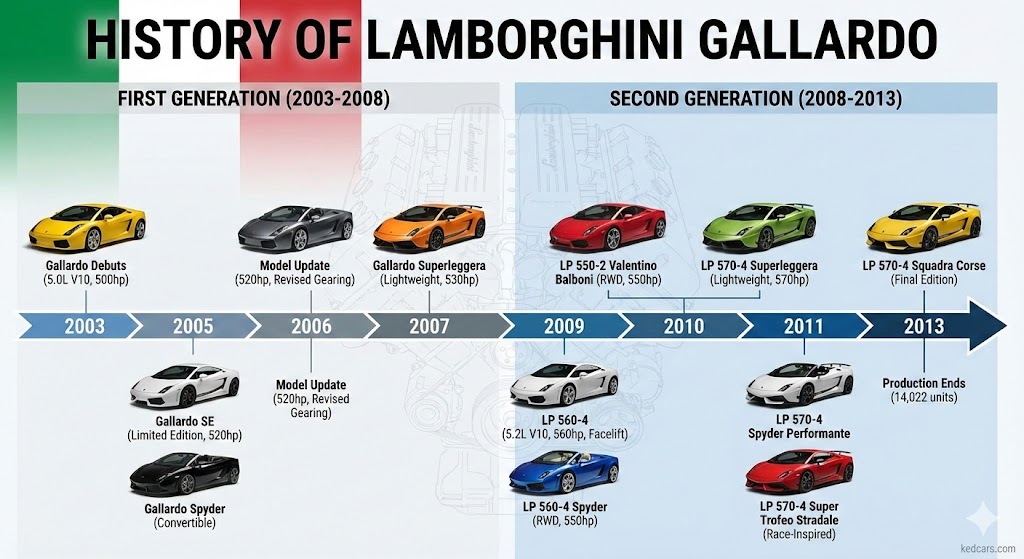
The Lamborghini Gallardo represents an automotive paradox resolved: a supercar that achieved commercial success without sacrificing the visceral character that defines the Lamborghini brand. Produced across a decade (2003-2013), 14,022 examples left the Sant’Agata Bolognese factory—establishing the Gallardo as Lamborghini’s best-selling model until surpassed by the Huracán, accounting for nearly half of all Lamborghinis constructed since the company’s 1963 founding.
More significantly, the Gallardo embodied a revolutionary philosophy: that exotic supercars need not sacrifice practicality, reliability, or accessibility to deliver authentic performance. Designed by Luc Donckerwolcke under Audi’s influence and technological support, the Gallardo pioneered the concept of the “daily-drivable supercar”—combining a naturally aspirated 5.0-liter V10 engine producing 500 horsepower, sophisticated all-wheel-drive systems, and user-friendly technology with Lamborghini’s distinctive design language and raw mechanical engagement. The Gallardo’s evolutionary development produced increasingly powerful variants: the 2008 LP560-4 (560 hp), the 2010 LP570-4 Superleggera (570 hp), and special editions including the iconic LP550-2 Valentino Balboni RWD variant. The vehicle’s enduring legacy transcends performance statistics: the Gallardo democratized supercar ownership while validating the proposition that authentic engineering excellence and commercial viability need not conflict.
Genesis: From Concept to Revolutionary Execution
The Strategic Imperative and Audi’s Influence
The Lamborghini Gallardo’s development emerged from Audi’s strategic vision following the Volkswagen Group’s 1998 acquisition of the troubled Italian manufacturer. Audi recognized that Lamborghini’s legendary unreliability and inconsistent production quality required systematic engineering discipline and manufacturing infrastructure. Rather than attempting to preserve Lamborghini’s chaotic tradition, Audi executives resolved to apply German engineering precision while respecting Italian design heritage.
The Gallardo’s genesis traces directly to Italdesign Giugiaro’s Calà concept car (1995)—a vehicle that had languished through Lamborghini’s chaotic financial history without reaching production. With Audi’s resources and discipline, the Calà concept transformed into something radical: an “entry-level” Lamborghini intended to broaden market appeal without creating an inferior product.
Luc Donckerwolcke’s Design Vision
Luc Donckerwolcke, appointed Lamborghini Centro Stile director, inherited the Calà concept and transformed it into a production masterpiece. Rather than merely executing an existing design, Donckerwolcke reimagined the vehicle’s proportions through iterative refinement: the design retained only 30-40% of original Calà styling, with Donckerwolcke’s team extensively modifying every surface to optimize aerodynamics and maintain visual cohesion with Lamborghini’s design language.
Critically, Donckerwolcke’s team achieved this refinement while seamlessly integrating carry-over components and Audi technology without creating the impression of driving a “Volkswagen product.” This sophisticated integration of German engineering with Italian design philosophy represented the fundamental achievement enabling the Gallardo’s success: the vehicle delivered Audi’s engineering excellence wrapped in unmistakably Lamborghini aesthetics.
The “Daily Supercar” Philosophy
The Gallardo embodied a conceptual revolution: acknowledging that supercar ownership needn’t demand compromises in reliability, usability, or accessibility. Previous Lamborghinis—despite their visceral appeal—had earned reputations for mechanical unreliability that transcended merely difficult ownership into genuinely dangerous operation. The Gallardo rejected this tradition through Audi’s influence: systematic quality control, proven component architecture, and engineering methodologies established standards previously unknown in Sant’Agata.
This transformation proved commercial genius: the Gallardo achieved unprecedented production volumes for a Lamborghini while attracting customers previously deterred by the brand’s unreliability reputation. The vehicle proved that exotic appeal and engineering competence could coexist harmoniously.
Engineering Excellence: The Naturally Aspirated V10 Revolution
The Colombo V10: Naturally Aspirated Perfection
The Gallardo’s heart—a naturally aspirated 5.0-liter V10 engine generating 500 horsepower in original form, escalating to 570 horsepower in ultimate variants—represented perhaps the most sophisticated achievement in the entire vehicle. Rather than adopting a proven Audi engine, Lamborghini engineers developed a purpose-designed V10 featuring a distinctive 90-degree V-angle configuration that lowered the engine’s center of gravity compared to the more theoretically “optimal” 72-degree arrangement.
The engine’s character reflected Lamborghini’s philosophy: torque emphasis over raw horsepower, with 80% of peak torque available from just 1,500 rpm. This torque availability established practical usability that traditional high-revving supercars sacrificed: the Gallardo delivered genuine tractability in urban driving environments while maintaining the ability to scream to 8,000 rpm in pursuit of maximum power. The dry-sump lubrication system—unusual for production engines—further distinguished the design, enabling lower engine mounting that contributed to improved center of gravity and handling characteristics.
Aluminum Architecture and Lightweight Discipline
The Gallardo’s chassis employed aluminum space-frame construction combined with aluminum body panels—engineering that reflected the influence of Audi’s technology without compromising mechanical integrity. This lightweight approach enabled the complete vehicle to weigh merely 1,410-1,520 kilograms (3,103-3,351 pounds) depending on specification and model year.
This weight discipline proved essential to the Gallardo’s performance character: power-to-weight ratios approached 360+ horsepower per ton (approximately 0.27 kg/hp)—metrics that delivered superb acceleration despite respectable rather than extraordinary horsepower. The architecture’s sophistication extended to specialized variants: the LP570-4 Superleggera incorporated extensive carbon-fiber components reducing weight to merely 1,340 kilograms (2,954 pounds), enabling extraordinary performance.
All-Wheel Drive Innovation
The standard Gallardo employed all-wheel-drive architecture controlled through a viscous coupling distributing torque between front and rear wheels. This system represented a deliberate choice: while traditional Lamborghinis had pursued rear-wheel-drive aesthetics, Audi’s influence established that all-wheel-drive delivered superior traction and driver confidence without sacrificing engagement.
The exception proved the rule: the LP550-2 Valentino Balboni special edition (250 units) retained rear-wheel-drive exclusively—a tribute to legendary test driver Valentino Balboni and an acknowledgment that purists valued mechanical engagement over technological sophistication. This special variant achieved 0-60 mph in approximately 3.9 seconds while delivering the characteristic tail-happy character of rear-driven supercars.
Performance Evolution: A Decade of Progressive Refinement
Complete Generation Evolution Overview
| Model Variant | Engine (Displacement) | Power Output | Top Speed | 0-60 Acceleration |
|---|---|---|---|---|
| Original 5.0 (2003-2005) | 5.0L V10 | 500 PS (493 hp) | 309 km/h (192 mph) | ~5.0 seconds |
| Updated 5.0 (2006-2008) | 5.0L V10 | 520 PS (513 hp) | 315 km/h (196 mph) | ~3.8 seconds |
| 5.0 Spyder (2006-2008) | 5.0L V10 | 520 PS (513 hp) | 315 km/h (196 mph) | ~4.1 seconds |
| LP560-4 (2008-2010) | 5.2L V10 FSI | 560 PS (552 hp) | 325 km/h (202 mph) | 3.5-3.7 seconds |
| LP550-2 Balboni (2009, RWD) | 5.2L V10 | 550 PS (542 hp) | 317 km/h (197 mph) | ~3.9 seconds |
| LP570-4 Superleggera (2010+) | 5.2L V10 | 570 PS (562 hp) | 329 km/h (204 mph) | 3.2 seconds |
All performance figures represent factory claims or verified testing documentation. Real-world performance frequently exceeded conservative estimates, particularly with professional drivers and optimal road surfaces. The progression from base 500 PS to ultimate 570 PS represents a decade of sophisticated engineering refinement.
Cultural Impact: The Daily Supercar Established
Democratizing Exotic Ownership
The Gallardo’s significance transcends numerical achievement to encompass fundamental market transformation. For the first time in Lamborghini’s history, the company offered a “complete” supercar capable of serving as primary transportation without requiring tolerance for mechanical eccentricity. Previous Lamborghinis demanded acceptance of unreliability, exotic fuel requirements, and mechanical unpredictability as necessary costs of exotic ownership.
The Gallardo eliminated this traditional trade-off: the vehicle delivered supercar performance and aesthetics combined with Audi’s engineering reliability. This convergence proved commercially revolutionary—14,022 Gallardos sold against only 4,099 Murciélagos during overlapping production, demonstrating overwhelming customer preference for accessible reliability over traditional exotic mystique.
Pop Culture Icon Status
The Gallardo achieved unprecedented cultural penetration among supercars. The vehicle appeared throughout the “Need for Speed” video game franchise, blockbuster films including “The Dark Knight,” and countless television appearances establishing visual familiarity that transcended automotive enthusiasm. This mainstream visibility elevated the Gallardo beyond specialist recognition into general popular consciousness.
The cultural saturation reflected authentic market presence: the Gallardo’s relative accessibility (compared to Ferrari or McLaren) enabled film and game creators to feature the car authentically representing contemporary exoticism. This ubiquity further validated Lamborghini’s strategic vision: by making genuine supercars accessible, the brand achieved genuine cultural prominence.
The Enthusiast Perspective
For performance enthusiasts, the Gallardo represented something previously unavailable: a naturally aspirated, high-revving V10 capable of delivering genuine sonorous character while remaining mechanically dependable. As modern supercars increasingly employ turbocharging and electronics, the Gallardo’s naturally aspirated character assumes historic significance—representing the final widespread availability of naturally aspirated exotic performance.
This characteristic proves increasingly valuable as collectors recognize that genuine mechanical engagement and acoustic character become progressively rarer as automotive technology evolves. Early Gallardos acquire collector status not through rarity (14,022 units suffice for ready availability) but through authentic performance delivery and mechanical sophistication.
The Bottom Line
The Lamborghini Gallardo’s ten-year production run establishing 14,022 units as the brand’s best-seller represented a categorical transformation of Lamborghini’s market position. By demonstrating that authentic exotic performance could coexist with engineering reliability and practical usability, the Gallardo vindicated Audi’s strategic vision and established commercial principles that enabled Lamborghini’s continued prosperity.
The vehicle’s ultimate achievement transcends performance specification or production statistics: the Gallardo proved that supercar exoticism did not require mechanical unreliability as a prerequisite, that naturally aspirated engines could deliver satisfied ownership across contemporary market demands, and that design authenticity could survive integration with proven technical components.
As the automotive industry progresses toward electrification and autonomous systems, the Gallardo assumes historical significance as the final era of traditional supercar design philosophy—a vehicle that delivered raw mechanical engagement, naturally aspirated sonority, and authentic driver involvement without requiring technological compromise. The Gallardo stands as final testimony to the principle that accessible excellence transcends exclusivity to achieve genuine cultural significance.