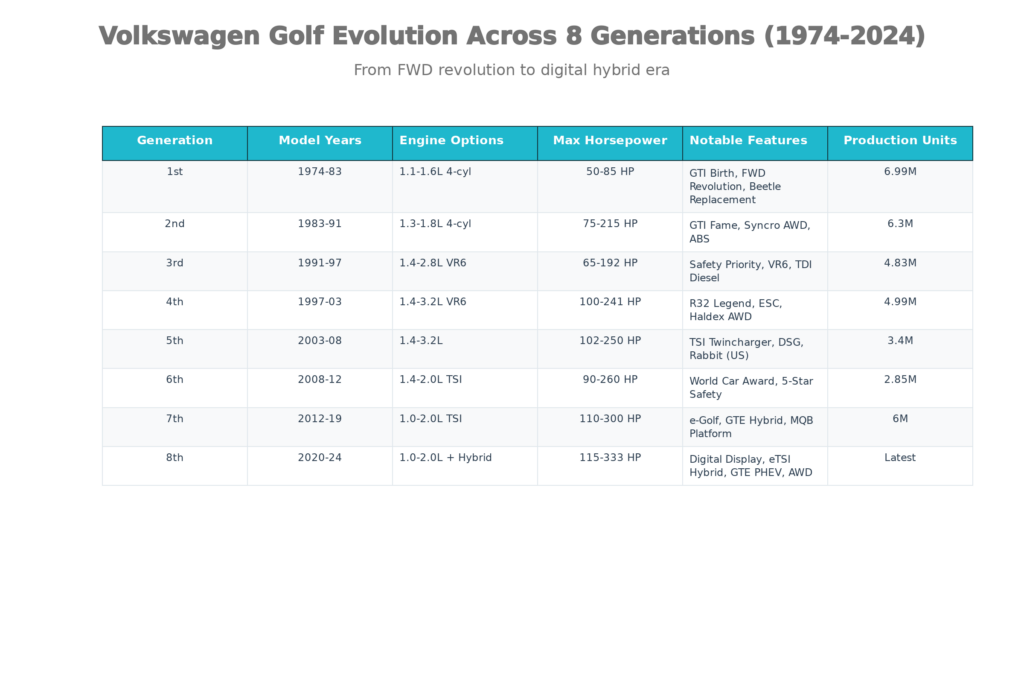
The Volkswagen Golf stands as one of automotive history’s most commercially successful and culturally significant vehicles, establishing itself as the world’s best-selling European automobile for more than five decades through eight consecutive generations spanning from 1974 to the present day. With approximately 37 million examples manufactured worldwide since its revolutionary 1974 debut, the Golf represents the culmination of designer Giorgetto Giugiaro’s visionary styling merged with Volkswagen’s engineering philosophy emphasizing practicality, reliability, and accessible performance. The Golf’s introduction fundamentally transformed automotive design language: the transition from Beetle-era rear-engine, rear-wheel-drive architecture to modern front-engine, front-wheel-drive configuration established fundamental principles that subsequent generations of hatchback and sedan manufacturers would perpetually refine. From the original 1974 Mk1 employing a simple 1.1-liter engine through contemporary Mk8 variants featuring turbocharged four-cylinders, plug-in hybrid systems, and the legendary Golf GTI performance lineage, the nameplate has continuously evolved while preserving the essential character that defines Volkswagen identity: purposeful design, engineering integrity, and the democratization of automotive performance through accessible pricing that enables customers across diverse economic segments to experience driving engagement previously reserved for expensive imports.
Origins and Revolutionary Design Philosophy
Giorgetto Giugiaro’s Masterpiece and the 1974 Wolfsburg Debut
The Volkswagen Golf emerged from a strategic imperative: Volkswagen required a replacement for the legendary Beetle—a vehicle that had dominated global automotive markets since 1938 yet was beginning to show its technological age by the early 1970s. The responsibility for this monumental redesign fell to Giorgetto Giugiaro, a legendary Italian stylist at Italdesign, who envisioned a complete architectural departure from Beetle tradition. Rather than pursuing evolutionary refinement of rear-engine, rear-wheel-drive configuration, Giugiaro proposed a revolutionary transformation: a modern front-engine, front-wheel-drive layout with a boxy, practical profile emphasizing interior space and user functionality.
The design process commenced in 1967, with development spanning several years as Volkswagen engineers collaborated with Italdesign to translate the stylistic vision into production reality. The radical departure from Beetle proportions proved controversial among Volkswagen traditionalists, yet Giugiaro’s vision ultimately prevailed. The dramatic shift from curved, organic Beetle silhouette to angular, geometric Golf proportions established design language that subsequent generations would perpetually refine rather than replace. The distinctive upright C-pillar, the prominent wheel arches, the characteristic horizontal front grille, and the practical, honest styling communicated a fundamental philosophy: the Golf prioritized user value and functional authenticity over fashionable excess.
The production Golf debuted on March 29, 1974, at the Wolfsburg factory, with official market introduction following in May 1974. The original Mk1 Golf featured a straightforward 1.1-liter naturally-aspirated four-cylinder engine producing approximately 50 horsepower, paired with either a four-speed manual or optional automatic transmission. Despite the modest power output, the Golf proved extraordinarily successful: by 1976—just two years after market introduction—Volkswagen had manufactured and sold its one-millionth Golf, demonstrating consumer enthusiasm for the practical, reliable, affordable hatchback that the nameplate represented.
The GTI Revolution and Performance Accessibility
The Golf’s potential for performance transformation became apparent almost immediately following the standard model’s introduction. In June 1976, Volkswagen launched the Golf GTI—a turbocharged, fuel-injected variant producing 110 horsepower from a 1.6-liter displacement, equipped with sports suspension, brake upgrades, and distinctive red-striped grille badging that became the GTI’s defining visual signature. The GTI established a revolutionary concept: genuine performance need not require exotic engineering or prohibitive pricing. Instead, focused engineering applied to proven mechanical architecture could deliver acceleration and handling dynamics that owners could actually afford to purchase and maintain.
The GTI’s cultural significance transcended automotive specifications—the badge became synonymous with accessible performance, youthful enthusiasm, and the democratization of driving excitement. Throughout subsequent decades, the GTI variant maintained its position as the Golf lineup’s performance flagship, with each generation receiving progressive power increases and chassis refinements while preserving the fundamental formula: modest displacement turbocharged engines delivering compelling performance at attainable pricing.
Generational Evolution Across Eight Distinct Versions
Mk1 and Mk2: Foundation and Refinement (1974-1992)
The first-generation Mk1 Golf, produced from 1974 through 1983, achieved approximately 6.6 million unit sales worldwide, establishing the nameplate’s commercial viability. The second-generation Mk2, introduced in 1983 and produced through 1992, featured a larger wheelbase, rounded bodywork, enhanced interior space, and progressive mechanical refinements that transformed the Golf into a genuinely refined daily driver rather than purely utilitarian transportation. The Mk2 generation achieved approximately 6 million unit sales, consolidating the Golf’s position as a commercially dominant nameplate.
Mk3 through Mk5: Safety and Sophistication (1991-2009)
The third-generation Mk3 Golf, introduced in August 1991 and produced through 1999, pioneered integrated front airbags and enhanced safety systems, earning recognition as European Car of the Year in 1992. The Mk3 generation represented a design watershed—establishing the clear-cut, precise proportions that would define the brand’s visual direction for decades. The fourth-generation Mk4, produced from 1997 through 2005, offered comfort and dynamic handling exceeding many upper-mid-size competitors, while the fifth-generation Mk5, introduced in 2003 and produced through 2009, achieved near-universal acclaim for its lightweight construction, nimble driving characteristics, and sophisticated engineering balance that many enthusiasts regard as the quintessential Golf expression.
Mk6 and Mk7: Modern Platform Maturity (2008-2020)
The sixth-generation Mk6 Golf, introduced in 2008 and produced through 2012, achieved 2.85 million unit sales and won the World Car of the Year award, demonstrating universal recognition of the platform’s excellence. The seventh-generation Mk7, produced from 2012 through 2020, sold approximately 6.3 million units—the highest-volume generation in Golf history—and established the benchmark for hot-hatch performance through the iconic Mk7 GTI variant that enthusiasts frequently cite as the ultimate expression of the nameplate’s character.
Mk8: Digital Transformation (2019-Present)
The eighth-generation Mk8 Golf, introduced for the 2020 model year and continuing through the present, initiated a comprehensive digital transformation reducing physical buttons in favor of touchscreen interfaces and touch-sensitive controls. The Mk8 generation introduced the plug-in hybrid variant, offering up to 38 miles of all-electric driving range alongside traditional gasoline propulsion, establishing the Golf as a platform embracing diversified electrification strategies. Contemporary Mk8 sales have already exceeded one million units, establishing the generation as commercially successful despite its abbreviated production timeline compared to the preceding Mk7’s thirteen-year span.
Engine Evolution and Powertrain Diversity
From Simple Beginnings to Turbocharged Modern Era
The original 1.1-liter naturally-aspirated engine producing 50 horsepower established mechanical simplicity as a foundational characteristic. Successive generations progressively increased displacement and sophistication: 1.3-liter, 1.5-liter, and 1.6-liter variants emerged throughout the Mk1 and Mk2 eras, with GTI variants utilizing fuel injection and modest boost pressure to deliver performance disproportionate to displacement figures.
Contemporary Golf variants emphasize turbocharged architecture and efficiency. The standard 1.5-liter turbocharged TSI four-cylinder produces approximately 130 horsepower in base configurations, while the GTI’s 2.0-liter turbocharged EA888 variant delivers 241 horsepower and 273 pound-feet of torque—performance rivaling naturally-aspirated six-cylinder engines. The Golf R, equipped with the same 2.0-liter turbocharged engine in higher-output configuration, produces 328 horsepower and 310 pound-feet of torque through an all-wheel-drive system enabling four-second 0-60 mph acceleration.
Plug-in Hybrid Innovation and Electrification Commitment
The Mk8 Golf GTE plug-in hybrid variant combines a 1.4-liter turbocharged four-cylinder engine with electric motor assistance and a rechargeable battery pack, delivering combined output of 243 horsepower alongside up to 38 miles of all-electric range. The strategic hybrid implementation preserves the Golf’s practical character—rear-seat passengers enjoy uncompromised space thanks to battery positioning beneath the rear seat, while cargo area capacity remains virtually identical to pure gasoline variants.
Design Language and Visual Continuity
The Golf’s design evolution reflects careful balance between preserving iconic visual characteristics established across five decades while embracing contemporary styling sensibilities. The distinctive upright C-pillar, the characteristic prominent wheel arches, the horizontal front grille proportions, and the practical, honest aesthetic established by Giugiaro remain instantly recognizable across all eight generations. Contemporary Mk8 variants feature LED lighting technology, updated bodywork proportions, and modern material treatments, yet the fundamental silhouette remains unmistakably Golf.
This design continuity—demonstrating the possibility of meaningful evolution without discarding foundational design principles—distinguishes the Golf among competitors who frequently pursue wholesale aesthetic transformations with each generational change. The Golf’s approach of iterative refinement establishes visual heritage that customers immediately recognize and emotionally connect with, reinforcing brand loyalty across decades.
Production Scale and Manufacturing Excellence
37 Million Vehicles: Historic Achievement
The cumulative production of approximately 37 million Golf examples across eight generations and 50 years establishes the nameplate as the world’s best-selling European automobile. The Wolfsburg factory in Germany alone has manufactured approximately 20 million Golf variants, with additional production facilities established across multiple continents including Mexico, Germany, Belgium, Portugal, China, India, and numerous other locations. This global manufacturing network has enabled Volkswagen to serve regional markets efficiently while maintaining consistent quality standards.
Contemporary production volumes remain substantial: in 2024, Volkswagen manufactured approximately 309,000 Golf variants worldwide, demonstrating sustained market demand despite fierce competition from alternative vehicle categories including SUVs and crossovers. The consistency of Golf sales across diverse geographic markets and economic conditions reflects the platform’s universal appeal transcending cultural boundaries and lifestyle preferences.
Contemporary Models and Variant Range
The GTI Clubsport: Performance Pinnacle
The 2024 Golf GTI Clubsport, the most comprehensive GTI evolution yet offered, features the 2.0-liter turbocharged EA888 engine producing 296 horsepower and 295 pound-feet of torque, delivering 0-62 mph acceleration in 5.6 seconds. The Clubsport variant incorporates sport suspension, performance braking systems with ventilated discs, and sophisticated electronic differential controls enabling responsive, engaging handling across diverse driving conditions. The standard seven-speed DSG dual-clutch automatic transmission provides rapid ratio changes absent in pure manual configurations, balancing mechanical engagement with contemporary convenience expectations.
The Golf R: All-Wheel-Drive Performance
The contemporary Golf R delivers 328 horsepower from the turbocharged 2.0-liter engine paired with Volkswagen’s 4Motion all-wheel-drive system featuring an electronically controlled rear differential enabling dynamic torque distribution. The Golf R achieves 0-60 mph acceleration in approximately 4.1-4.4 seconds depending on driving conditions, establishing genuine supercar-competitive performance in a practical five-door hatchback format. The available Race package unlocks top speeds approaching 170 miles per hour, providing genuine track-day capability within a daily-driver platform.
The GTE Plug-in Hybrid: Electrified Practicality
The Golf GTE plug-in hybrid variant combines the 1.4-liter turbocharged engine with electric motor assistance and a rechargeable 13-kilowatt-hour battery pack, delivering 243 combined horsepower and 51 miles-per-gallon equivalent efficiency. The 38-mile all-electric range accommodates most daily commutes without engine operation, while the petrol engine ensures extended journey capability. The GTE achieves competitive acceleration despite the hybrid system’s weight penalty, delivering genuine practical utility alongside environmental responsibility.
Future Direction and Electric Evolution
Volkswagen’s Commitment to Gasoline and Electric Options
Volkswagen leadership confirmed that combustion-powered Golf variants will continue through the end of the current decade, establishing a deliberate multi-powertrain strategy rather than wholesale electrification. The next-generation Golf will receive both electric and gasoline variants, each employing exclusively developed architectures while sharing familiar design language preserving the iconic Golf character.
The all-electric e-Golf, expected to launch by 2028-2029 based on Volkswagen’s revised timeline, will employ the Scalable Systems Platform architecture expected to deliver superior efficiency and advanced digital capabilities compared to contemporary electric platforms. The electric Golf will incorporate distinctive design elements including a flatter roofline than the smaller ID.3, refined proportions emphasizing contemporary digital aesthetics, and integrated design language establishing visual continuity with gasoline-powered siblings.
The Electric Golf GTI and R Future
Volkswagen CEO Thomas Schäfer confirmed that the next-generation electric Golf will receive both GTI and R variants, with the electric GTI representing a front-wheel-drive performance platform and the electric R providing all-wheel-drive performance capability. The electric GTI, expected to follow the ID.2 GTI introduction in 2026, will emphasize responsive performance delivery through instantaneous electric torque characteristics while maintaining the GTI heritage of accessible, engaging performance. The electric R variant, requiring the greater power and torque capacity enabled by Volkswagen’s Scalable Systems Platform, will deliver approximately 450 horsepower enabling 3.5-second 0-60 mph acceleration—genuine hyperhatch performance surpassing contemporary petrol variants through electric propulsion advantages.
Cultural Impact and Generational Significance
The Golf transcends automotive specifications to become a cultural icon representing generational identity and aspirational achievement. The phrase “Golf generation”—coined by German author Florian Illies—encompasses contemporaries who learned to drive in the Mk2 Golf during the 1980s and 1990s, establishing the vehicle’s profound connection to life experience and personal memory. The GTI variant achieved particular cultural prominence as the accessible performance car enabling young drivers to experience legitimate driving engagement without requiring wealth to purchase exotic alternatives.
The Golf’s ubiquity across global markets established it as a universal symbol of practical German engineering excellence and reliable transportation. Families across Europe, Asia, and North America grew up in Golfs, establishing profound emotional connections that persist across decades and generations. This cultural resonance—transcending mere transportation to become embedded within personal identity and memory—distinguishes the Golf among competitors lacking comparable emotional significance.
The Bottom Line
The Volkswagen Golf’s extraordinary fifty-year saga—from Giorgetto Giugiaro’s visionary 1974 design through eight evolutionary generations culminating in contemporary electrified variants—represents one of automotive history’s most impressive achievements in continuous product excellence. Approximately 37 million Golf examples manufactured worldwide, combined with the nameplate’s consistent position as the world’s best-selling European automobile, establish the Golf as fundamentally significant to automotive culture and global transportation development.
The Golf succeeded through the convergence of multiple factors: Giugiaro’s revolutionary design language that established hatchback proportions and proportions replicated by competitors worldwide; Volkswagen’s engineering discipline emphasizing practicality and reliability over fashionable excess; the accessibility of GTI performance enabling customers of modest means to experience driving engagement previously reserved for exclusive imports; and the nameplate’s genuine cultural integration into automotive consciousness across diverse geographic and demographic segments.
Contemporary Golf variants—encompassing turbocharged gasoline engines, plug-in hybrid systems, and performance-oriented GTI and R variants—provide unprecedented customer choice regarding powertrain philosophy and performance ambitions. Volkswagen’s commitment to maintaining gasoline, hybrid, and ultimately electric options simultaneously reflects recognition that diverse customer preferences require equally diverse offerings rather than wholesale transitions toward singular propulsion technologies.
As automotive markets transition toward comprehensive electrification, the Golf’s enduring commercial success—with 309,000 annual deliveries and sustained customer enthusiasm—demonstrates that vehicles delivering genuine practical value, engaging driving dynamics, and emotional connection retain eternal appeal transcending technological fashions. The Golf stands as proof that exceptional design executed through engineering discipline and manufacturing excellence establishes foundation for unprecedented commercial longevity. The vehicle that emerged from 1974 as a revolutionary replacement for an aging icon has itself become the icon that defines automotive excellence across half a century and counting.